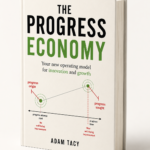
The book (not yet available) is divided into 3 parts:
» The logic that broke growth
» Progress – the new unit of strategy
» Putting the progress economy to work
The logic that broke growth.
Innovation has long been seen as the engine of growth.
Yet despite unprecedented investment in innovation, growth is slowing, expectations are rising, and most organisations struggle to convert innovation activity into meaningful results.
Why?
This part of the book exposes a hidden assumption at the heart of modern management: that organisations create value, embed it in products and services, and exchange that value with customers.
That logic helped build the modern economy. It is now constraining your ability to grow.
Drawing on contemporary and the latest research with practical examples, we uncover the Value Exchange Trap – an increasingly outdated value model for our modern world that drives organisations to optimise transactions while overlooking how customers actually achieve outcomes.
Chapters include:
» Innovation is failing, growth is stalling
» The value exchange trap
» Customers don’t buy value, they buy…
Progress – the new unit of strategy
We escape the value trap by seeing that value is created in use rather than in exchange. This takes us into the world of service-dominant logic, which infors us that people seek to improve their well-being and do so by using service (and goods distribute service). But well-being is difficult to operationalise, measure, and innovate around.
The missing link is progress.
Progress gives organisations a practical way to understand how people move from their current state to a more desired one, how capabilities help them get there, what resources carry those capabilities, and that lacking capabilities is a hurdle to progress…giving rise to actors that offer help to make progress.
From this simple insight emerges an entirely new way of understanding innovation, growth, and competition (and reveals the various forms of value are actually comparisons of progress states).
Chapters include:
» Discovering progress
» Making progress
» Judging progress
» Helping progress
» Designing for progress
» Competing on progress
» Uncovering the progress economy
Key extracts can be found in “the concepts” section of this site.
Putting the progress economy to work
Any useful new approach (theory/framework/lens) should do more than describe the world. It should explain important business problems more clearly than existing approaches and provide practical guidance for action.
This part of the book puts The Progress Economy to that test.
Starting with a simple but powerful insight – innovation is the act of enabling better progress – we derive a 4-point practical definition of innovation and identify 24 innovation levers that help organisations innovate more systematically, focus investment more effectively, and improve the likelihood of growth (the “innovation actions” section of this site).
Chapters include:
» Enabling better progress (innovation)
» Exploring the 24 levers for innovation
The Progress Economy is then applied to a range of contemporary business challenges and established management theories. In doing so, it reveals new insights and a common underlying logic that often remains hidden in traditional approaches.
» Applying The Progress Economy
» The progress logic behind key business theories
Explore highlights of these in “the examples” section.