well-being-through-progress

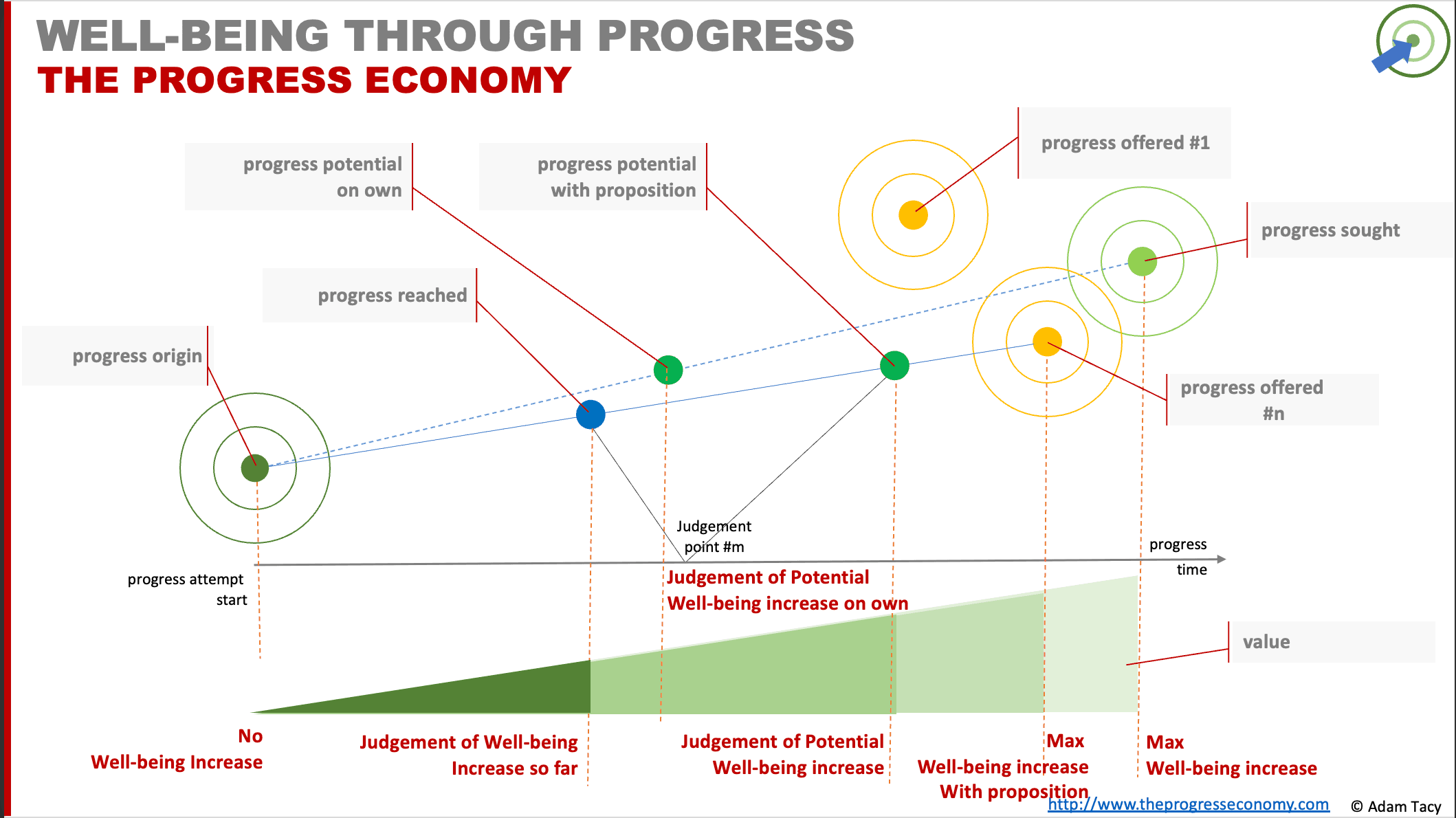
Forget value. It is your well-being you increasingly improve as you seek to make progress towards your progress sought. Discover the actionable model that will accelerate your sales, innovation and growth.
Well-being recognition

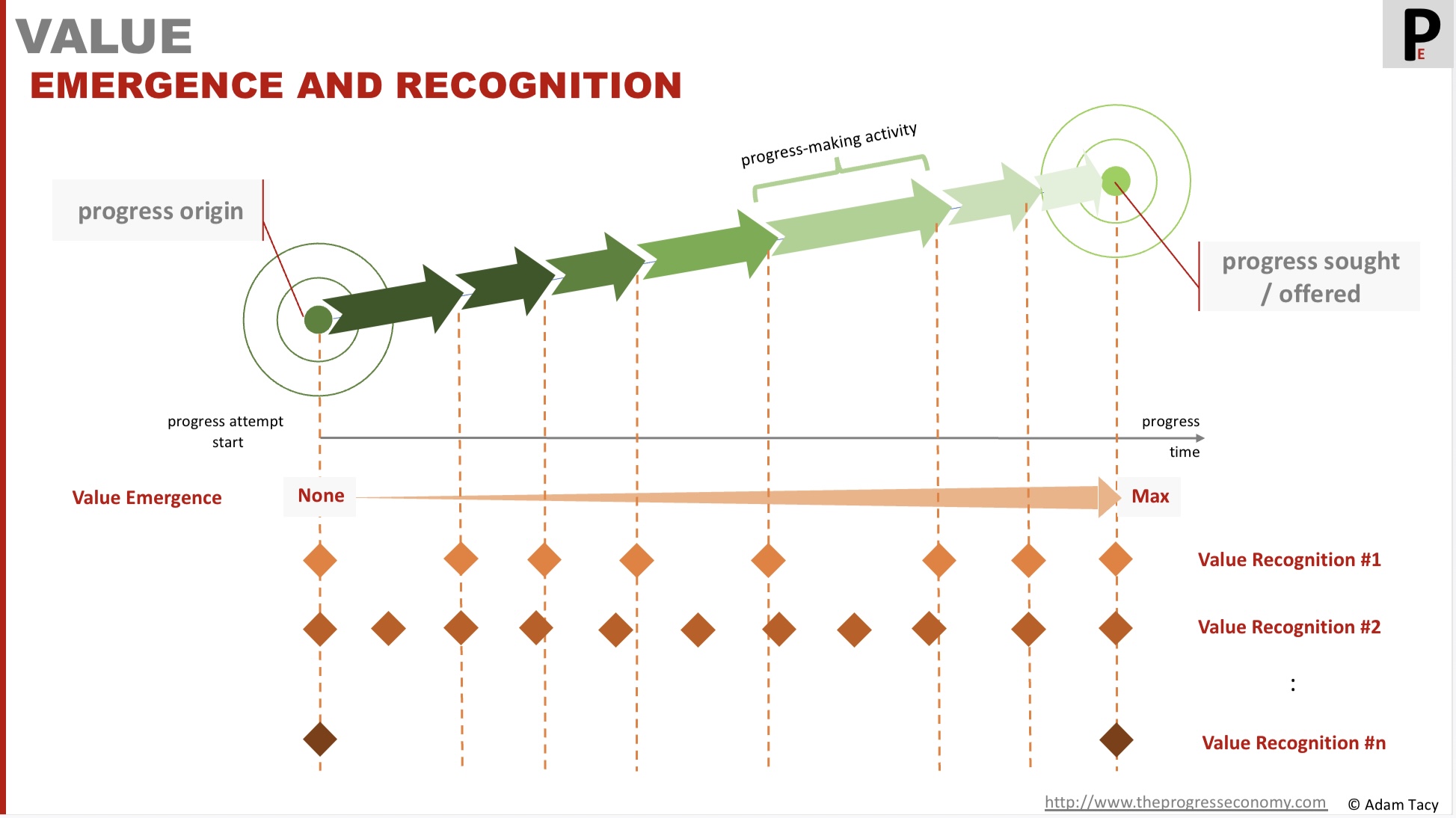
Emerged value (through progress) needs to be recognised by a Seeker – in a process akin to revenue recognition – for it to be meaningful to them.
Well-being destruction

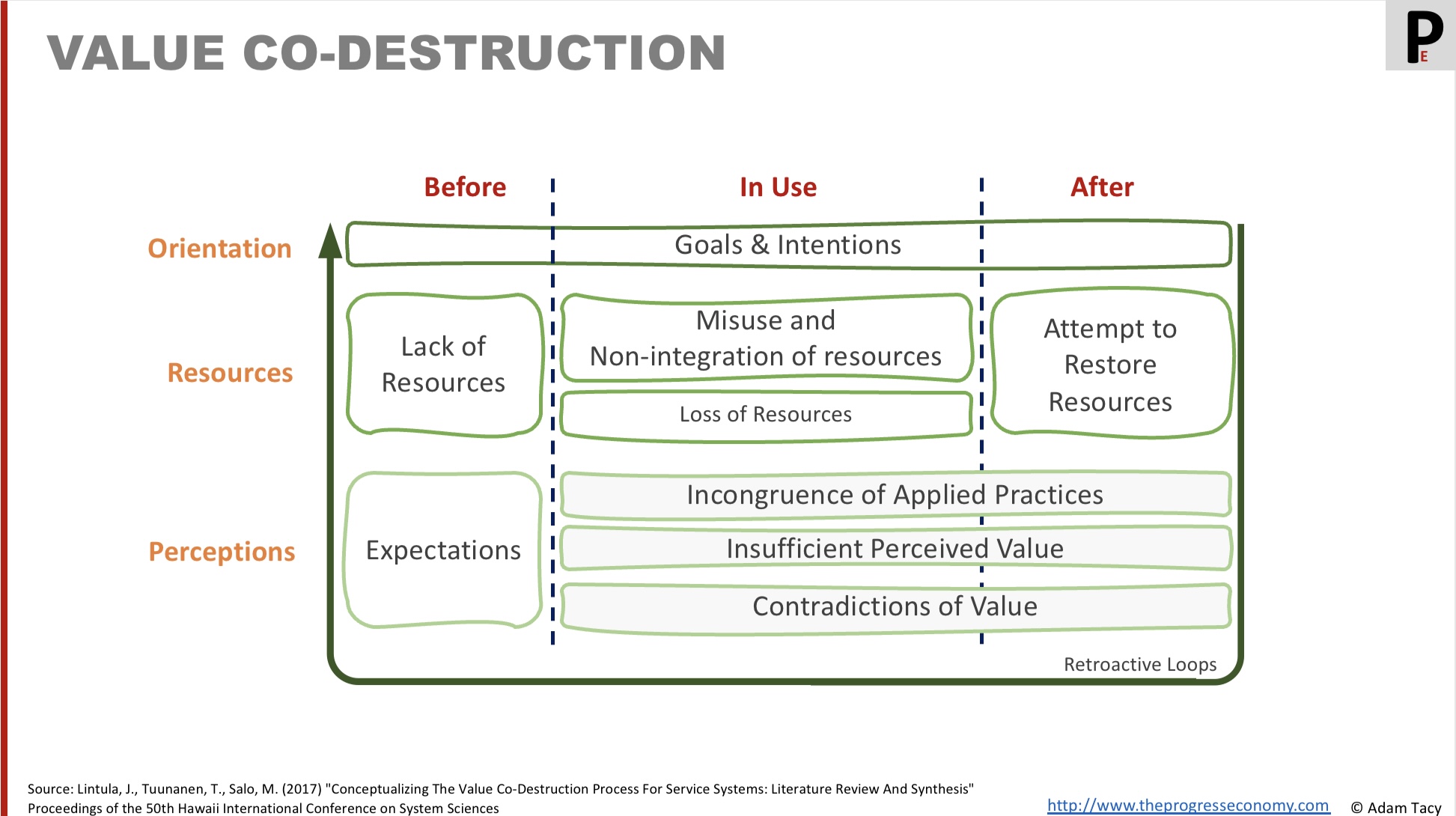
Value (improvements in well-being) can be destroyed y one or more actor in the progress attempt hinders progress.
The Progress Economy
your new operational model for innovation and growth
Tag: well-being
If value is no longer a sufficient unit of strategy for our modern world, what should replace it?
The answer proposed by the Progress Economy is progress. Before we can establish why, we need to understand what the concept of value has been pointing towards all along.
Our first clue comes from Christian Grönroos’ work on service logic. Grönroos observed that customers do not seek products, services, or even experiences for their own sake. Rather, they seek to become better off.
Value for customers means that after they have been assisted by a self-service process (cooking a meal or withdrawing cash from an ATM) or a full-service process (eating out at a restaurant or withdrawing cash over the counter in a bank) they are or feel better off than before.
Grönroos, C. (2008). Service logic revisited: who creates value? And who co-creates?”. European Business Review 20(4) pp 298-314
This observation shifts attention away from the things being exchanged and towards the change that occurs in the customer’s circumstances. Whether the customer performs the change themselves or is assisted by others is secondary.
Service-dominant logic follows a similar line of reasoning. Vargo and Lusch argue that value creation is ultimately concerned with improving the well-being of actors.
Value creation is ultimately about improving the well-being of actors.
Vargo, S. & Lusch, R. (2016). Institutions and Axioms: An Extension and Update of Service-Dominant Logic.
Here again, the focus is not on products, services, or transactions. It is on the change in circumstance.
Later, Vargo, Peters, Kjellberg, and Koskela-Huotari re-emphasise value not as something produced or exchanged, but as an emergent change in an actor’s well-being — one that may be positive or negative.
value – an emergent change in the well-being or viability of a particular system/ actor, which can be positively or negatively valanced.
Vargo, Peters, Kjellberg, Koskela-Huotari (2022). Emergence in marketing: an institutional and ecosystem framework; Journal of the Academy of Marketing Science 51(4)
An actor’s well-being can be improved, or impacted/reduced (what we might have called value destruction)
These lines of thought allow us to say that value is no longer the objective itself. Instead, it becomes a phenomenological assessment of a change that has occurred.
And, if value is fundamentally a judgement about change, then the phenomenon that strategy, innovation, marketing, and sales should seek to understand is not value itself, but that change and how it is actioned, judged, measured, and felt by the actor(s) affected by the change.
That is what The Progress Economy operationalises as progress: a move over time to a more desired state.
Seen in this way, progress sits one level of analysis deeper than value. Progress is the change; value the phenomenological assessment. As such, progress should be the preferred unit of strategy.
The Progress Economy sees improvements in well-being emerge as progress is made. However, those improvements need to be recognised by the Seeker for them to be meaningful to them – a process akin to revenue recognition in finance.