Value-in-Exchange

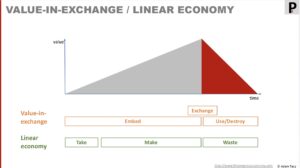
The value model that built industries and economies – embed, exchange, use-up. But is increasingly holding us back with its blind spots increasingly stalling your innovation and limiting your growth.
Value-in-use

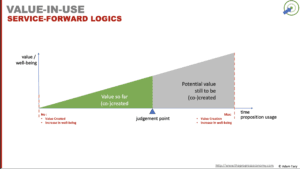
The value model underlying service-dominant logic, which sees value created as products are used and having only potential when not used. We see usage as improving well-being.
Comparing Models
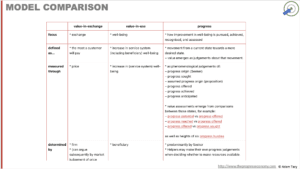
[DRAFT] Attributes comparison of value-in-exchange, -in-use, and improving well-being through progress.
Value-in-exchange: Powering Growth for Centuries

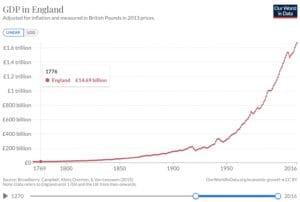
The recent centuries explosive growth comes from following the value-in-exchange model.
Value-in-exchange: stalling growth
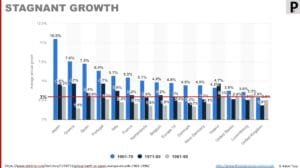
Over recent decades, growth has been stalling; a worrying sign!
Value-in-exchange: Crack #1
Value is difficult to define, meaning many things to many people
Value-in-exchange: Crack #2
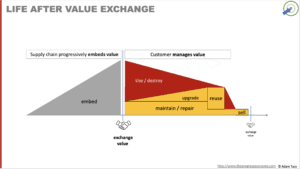
Value-in-exchange is an incomplete view of a customer/consumer’s value lifecycle
Value-in-exchange: Crack #3

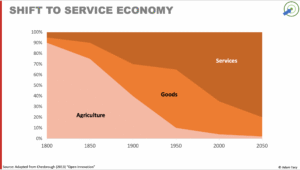
We’re no longer in the industrial-era; is value-in-exchange the optimum model for growth?
Value-in-use: Limitations
Whilst value-in-use addresses the cracks in value-in-exchange, it has its own limitations.
Innovation: through value-in-exchange lens
Innovation though the value-in-exchange lens may “limit” us to incremental innovation to minimise disrupting flow of exchanges
Innovation: through value-in-use lens
Innovation though the value-in-use lens encourages us to focus on trying to to further improve actor’s wellbeing
The Progress Economy
your new operational model for innovation and growth
»
Value
Value as a unit of strategy helped create extraordinary growth during the past few centuries. But growth has slowed and economies have become increasingly service-based, digital, and interconnected, it is worth asking whether value remains the most useful unit for understanding innovation and creating growth
What is Value
Boardrooms, financial institutions, and business schools are filled with discussions about creating and co-creatiing, value, adding value, and exchanging value. Few concepts have become more central to management thinking.
By almost any measure, value has become our predominant unit of strategy.
Yet despite its ubiquity, value remains surprisingly difficult to define, measure, and operationalise.
At first glance, defining value appears straightforward. It is the most a customer will pay. A view that has driven substantial growth over the centuries.
Dig deeper though, and that definition becomes shallow. Researchers tell us value is elusive, difficult to define, and even “value creation probably is among the most ill-defined and elusively used concepts in service marketing, and in management in general”
This creates a practical problem. When managers say they are creating value, are they discussing financial outcomes, emotional outcomes, social outcomes, functional outcomes, or some combination of them all? The answer is often unclear.
How do we model value?
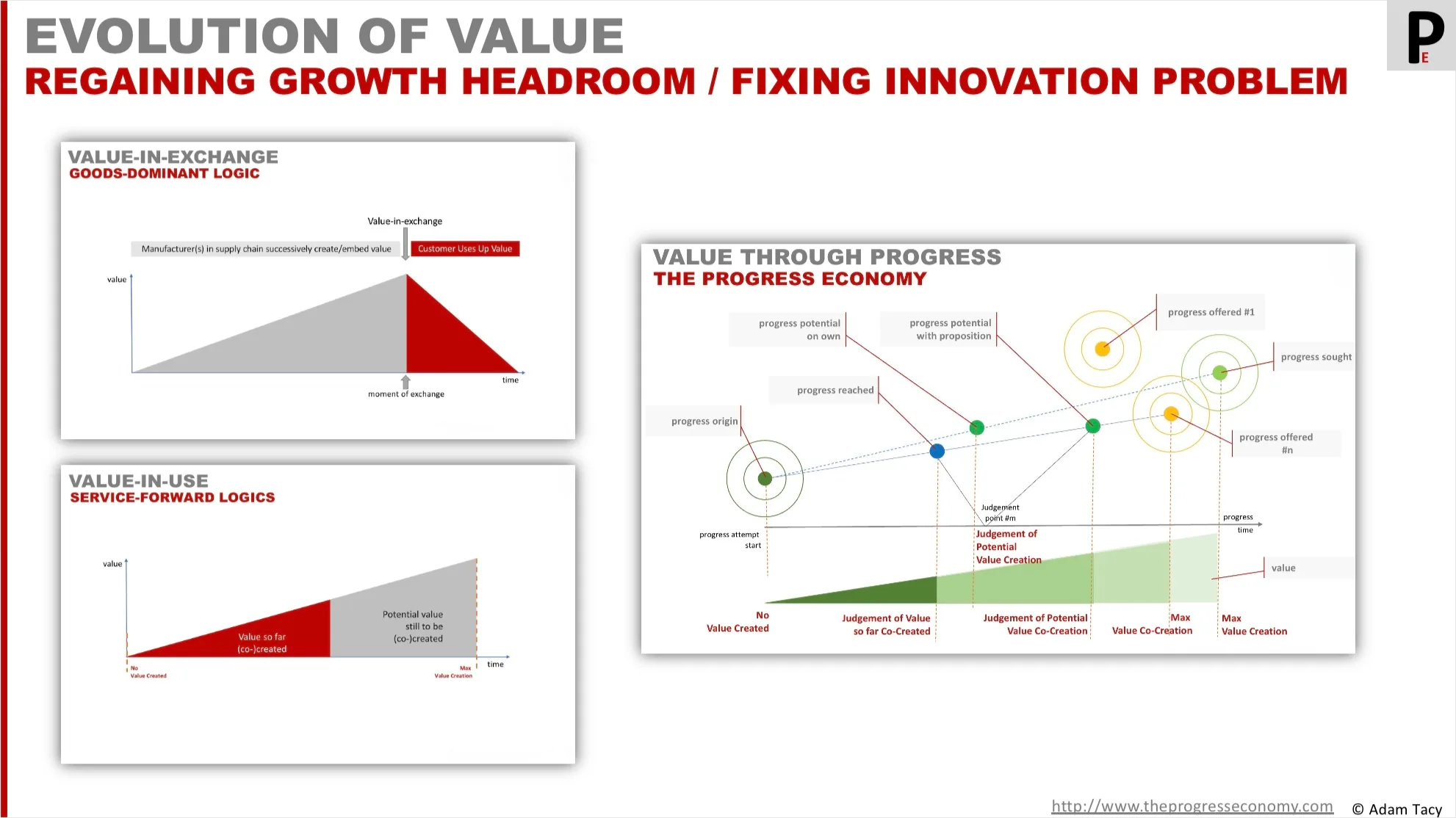
Our prevailing mental model of value remains value-in-exchange. Heavily influenced by observing manufacturing industries, we see value as something embedded by manufacturers in products, exchanged for other items of value (typically money) and then destroyed or used up by end customers
Much of the growth over the last few centuries can be understood by how we have optimised this model.
It is a perspective that remains deeply embedded in contemporary strategy, pricing, innovation (add more value), finance, and economics.
Yet even Adam Smith recognised another possibility: value-in-use.
Under this model, value is not embedded and exchanged, rather it emerges during use. It is created, often co-created, through the performance of activities and services.
This perspective shifts attention from products to outcomes. A drill has little value because of the metal and plastic from which it is made. Its value emerges when it enables a hole to be created. A restaurant meal creates value not when it is prepared, but when it satisfies hunger, creates enjoyment, or supports social connection.
During Adam Smith’s time, global trade of products was the obvious driver of growth. Maids, servants and shopkeepers were not.
Recent economic thinkers have revisited this, not least because services now deliver a high proportion of economic activity. It is the basis of both Grönroos’ Service Logic as well as Vargo & Lusch’s Service-dominant Logic.
The challenges with Value
Worryingly, growth has stalled in recent decades – the IMF is warning of the “tepid 20s”.
Value in exchange model has three cracks, that are increasingly impactful in our modern world
- Value is difficult to define
- The world has changed since value-in-exchange was king
- value-in-exchange is an incomplete model
Whilst value-in-use addresses the above cracks, it is hard to operationalise.
The Progress Economy’s view
The Progress Economy builds on Service-Dominant Logic’s observation that actors seek to improve their well-being.
Rather than operationalising this improvement through the ambiguous concept of value, we operationalise it through progress.
Progress is the movement to a more desirable state (which represents an improvement in well-being). Value is the judgement of that movement, before, during, and after.