Service Exchange – the true basis of economic activity

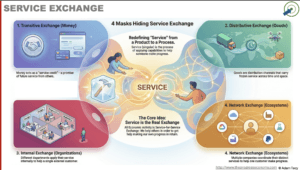
We don’t exchange value, we exchange service – but this is often indirectly via service credits (of which cash is a successful implementation)
Service vs Services: Why the difference matters
We make a distinction between service (singular) and service (plural). Here’s why, and why it matters
The Innovation Problem

You’re not alone in thinking innovation investments are not moving the needle much. We have an innovation problem that’s impacting your organisation’s, and macroeconomic, growth…and it’s because we chase value. Beyond Value Podcast Episode: What we’re thinking McKinsey tell us only 6% of executives are happy with their innovation initiatives – think about that for a moment, 94% of executives are not happy! Yet 84%, according to the same research, see innovation as important to growth. More recent research tells the same story. And worryingly, the IMF cautions us that we are heading into the “tepid 20s” in terms of…
Judgements are Phenomenological
Judgements are messy – based on previous lived experiences and current living experience. It’s why two Seekers see progress differently; and why the same Seeker may see progress differently on different attempts.
Progress as a verb and a state transition
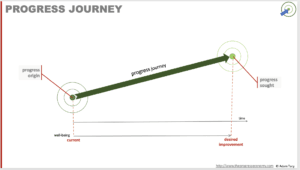
Progress is a verb, a continuous journey between two progress states. It can equally be seen as a discrete series of state transitions.
Progress as a State
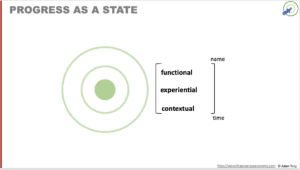
Progress is a state, comprising three equally important dimensions: functional, experiential, and contextual.
Progress as a noun

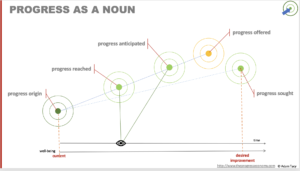
It is useful to name several specific states. Several act as waypoints – progress origin, sought and offered – whereas there indicate judgements – progress reached and progress potential.
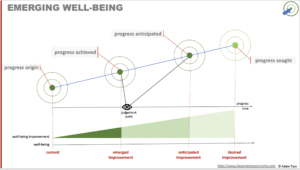
Well-being emerges through progress
Forget value. It is your well-being you increasingly improve as you seek to make progress towards your progress sought. Discover the actionable model that will accelerate your sales, innovation and growth.
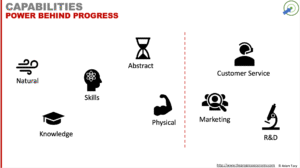
Capabilities – the power behind progress
Capabilities – like skills, knowledge, availability, strength – are the power behind progress: better capabilities, better progress; lacking capabilities is the foundational progress hurdle.
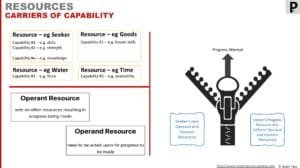
Resources – carriers of capabilities
Resoures carry capabilities; and one resource may be swapped for another if it carries the same capability (for example, an AI system for a compliance tam).
Operant Resources
Operant resource – such as people – act upon other resources in order make progress. In many cases they are the source of competitive advantage.
Operand Resources
Operand resources need to be acted upon in order for progress to be made.