
What we’re thinking
The stage on which our actors perform is life itself. Every actor is a Seeker looking to progress with every aspect of their life
Why this matters
It is the fact that every actor is a seeker coupled with the uneven distribution of capabilities across all actors that creates The Progress Economy.
How do all our actors interact? It’s on the stage of the progress economy. And we can see how through the simplified view of the progress economy’s 4-layer model in this diagram.
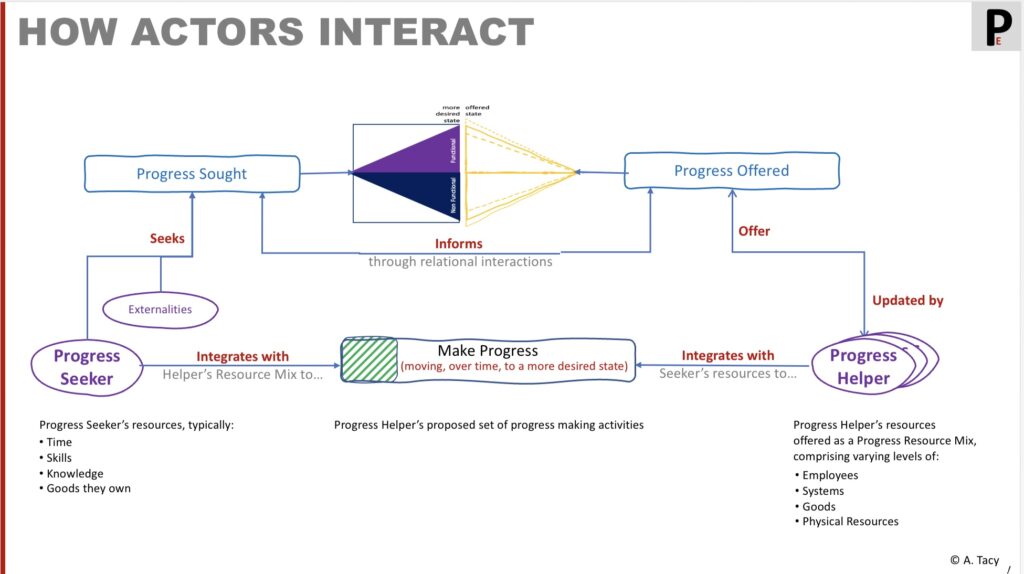
A Progress seeker – on the left – determines specific progress they are seeking. That progress sought is shaped by institutions. If the Seeker has the necessary capabilities – including skills, knowledge, availability, strength, etc – they may decide to make a progress attempt on their own.
Where a Seeker lacks capability, they may attempt anyway, but the likelihood of success is lowered the higher the lack of capability. This is the lack of capability progress hurdle.
On the right of the stage are various progress helpers, offering to help make progress. They propose progress to a state of progress offered, from an assumed progress origin. The closer those two states are to the Seeker’s current progress origin and progress sought, the more attractive the proposition is likely to be (the Seeker also needs to judge that 6 progress hurdles are sufficiently low enough).
Making progress with a proposition becomes a joint endeavour. Some combination of seeker and helper perform the progress-making activities through integrating some combination of seeker and helper capabilities carried by various resources.
Let’s progress together through discussion…