
DRAFT
It is common that both the beneficiary and service provider are involved in the series of activities. In such case, value is the sum of well-being improvements of the beneficiary and provider activities on the initial wellbeing:
We often refer to the case where the beneficiary and provider act together to improve wellbeing as co-creation of value. Vargo & Lusch see value as always being co-created by multiple actors (always including the beneficiary). Grönroos has a tighter definition, arguing co-creation only occurs when firms offer resources capable of dialogue. (Grönroos (2008) “Service Logic Revisited: Who Creates Value? And Who Co-creates?”). That is co-creation comes from interactive activities rather than all activities. (note: the sequencing of activities is also important; but not visible in our simplified notation above).
There are also cases where multiple providers are required to improve wellbeing. In which case value equals the sum of all providers activities on the initial wellbeing.
Consider online shopping: website hosting, warehousing, product fulfillment, delivery, customer service, and payment processing must all work together with the beneficiary. We can see this as a service system.
service system, a configuration of people, technologies, and other resources that interact with other service systems to create mutual value.
Maglio, Vargo, Caswell, Spohrer (2009) ”The Service System Is the Basic Abstraction of Service Science”; Inf Syst E-Bus Managent 7:395–406
Coordination of the system can be the beneficiary or, more often, by one of the providers. Bundling, unbundling, offering choices – such as payment or delivery me
The relational and open-ended time logic of value-in-use profoundly impacts innovation. It transforms innovation from a special event into a constant, every day, activity within the firm, with strong input from the beneficiary. Lusch and Nambisan identify the beneficiary as:
…having three broad roles:
Lusch and Nambisan (2015) ”Service Innovation: A Service-Dominant Logic Perspective”; MIS Quarterly 39(1): pp155-175
- ideator
- designer
- intermediary
Beneficiaries can articulate the increase in well-being they seek, their context, and how they use existing offerings to imagine new ones (ideator). As designers, they can help shape the development of offerings. Importantly, as intermediaries, they “carry” innovations from other markets and industries. Beneficiaries are exposed to service in multiple industries and markets. What they learn and expect in one area, they soon expect from you as well.
In fact, it is beneficiaries’ continuous efforts to enhance their well-being and exposure to offerings that drives their expectations for your offerings. Consequently, you must innovate to meet these evolving expectations or risk being left behind. This is the essence of Drucker’s “innovate or die”.
defining innovation
There are a couple of ways of interpreting the result of innovation in a value-in-use model. First we can take a service systems view, which tells that an innovation enhances the well-being, adaptability, and survivability of the service system compared to any existing offering. That is to say, for the service system:

This captures innovation improving the service system compared to an existing approach. The innovation may directly impact beneficiaries and/or value proposers (which in turn may indirectly benefit the beneficiary).
Alternatively we can take a more beneficiary perspective and simplify the above to the following:

where additionally the impact of innovation on the system’s well-being, adaptability and survivability is the same or enhanced compared to the existing offering.

The actual act of innovation is seen as creating new resource(s) from existing resources, ie:
rebundling of diverse resources that create novel resource that are beneficial (ie value experiencing) to some actor in a given context
Lusch and Nambisan (2015) ”Service Innovation: A Service-Dominant Logic Perspective”; MIS Quarterly 39(1): pp155-175
Beneficiaries can directly benefit from these new resources if offered as part of a new value proposition, such as new employee skills, goods, AI co-pilots, improved IT system interfaces etc. Or they may be resources internal to a value proposer – such as new processes, tooling, improved internal capabilities. Those internal improvements may indirectly benefit beneficiaries.
They could also involve new configurations of the service system, such as extending the service scope, swapping sub-service providers, or enabling real-time configuration by beneficiaries.
When we discuss innovation in detail we’ll leverage some updates to den Hertog’s model as a way of systematically hunting/explaining innovations in service provision.
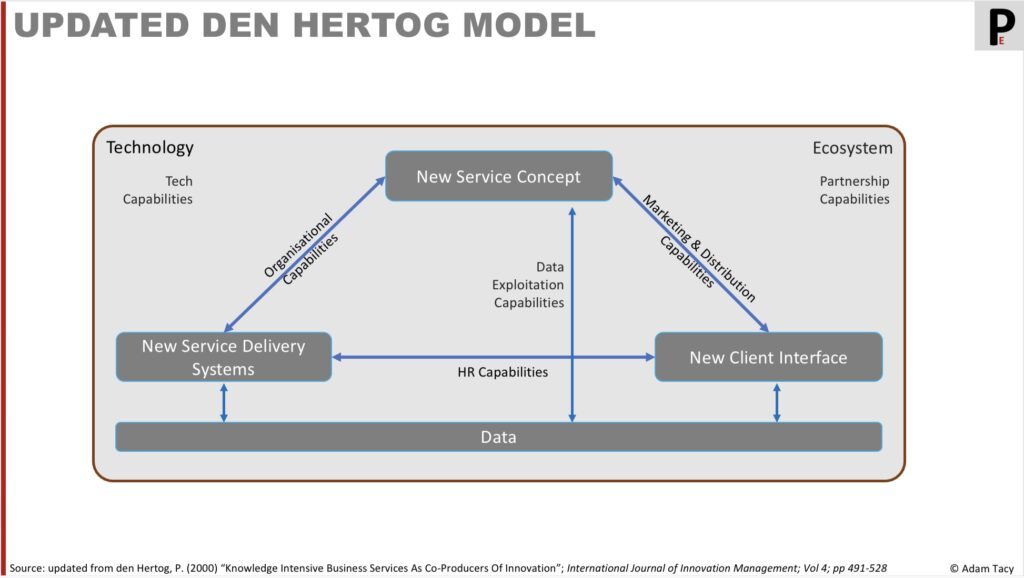
However, this definition of innovation carries the challenge we lifted earlier with the definition of well-being (and adaptability and survivability) in that it does not include the necessary levers to make it more systematic. This in part is to do with the other constraint we raised about the mechanism of improving well-being is not sufficiently detailed.
Yet, our definition of innovation faces challenges, linked to two points we’ve already discussed:
- hard to define well-being (and adaptability and survivability)
- low details on the mechanisms relating to value co-creation
business model innovation
Separating value from price can obscure opportunities for business model innovation related to pricing.
For instance, the transition from a one-time payment to a subscription model isn’t immediately evident within the value-in-use framework. Of course we can torture the model to make it fit. One might argue that this shift enhances the system’s survivability by allowing beneficiaries to make smaller, recurring payments instead of a single large one. However, we must also consider its impact on other service system members, such as changes in cash flow.
We need a value model that uncovers new business models rather than struggle forcing existing ones to fit.
Value-in-use does open our eyes to opportunities like platform-as-a-service (PaaS) by addressing the desire to minimise inefficient resource usage. Eliminating the goods versus service debate also clarifies the concept of “servitization”.
To fully grasp alternative business models, such as subscriptions or advertising-supported frameworks, we must reintegrate price. We can achieve this by recognising value-in-exchange at a higher level, as suggested by Vargo, Maglio, and Akaka. Alternatively, as we will do in the progress economy, we can relate price to effort in service exchange (where business model innovation looks at how to minimise headline effort exchange).
Let’s progress together through discussion…