
What we’re thinking
The growth achieved over the last few centuries has been extraordinary. Yet a closer look at recent decades tells a more troubling story.
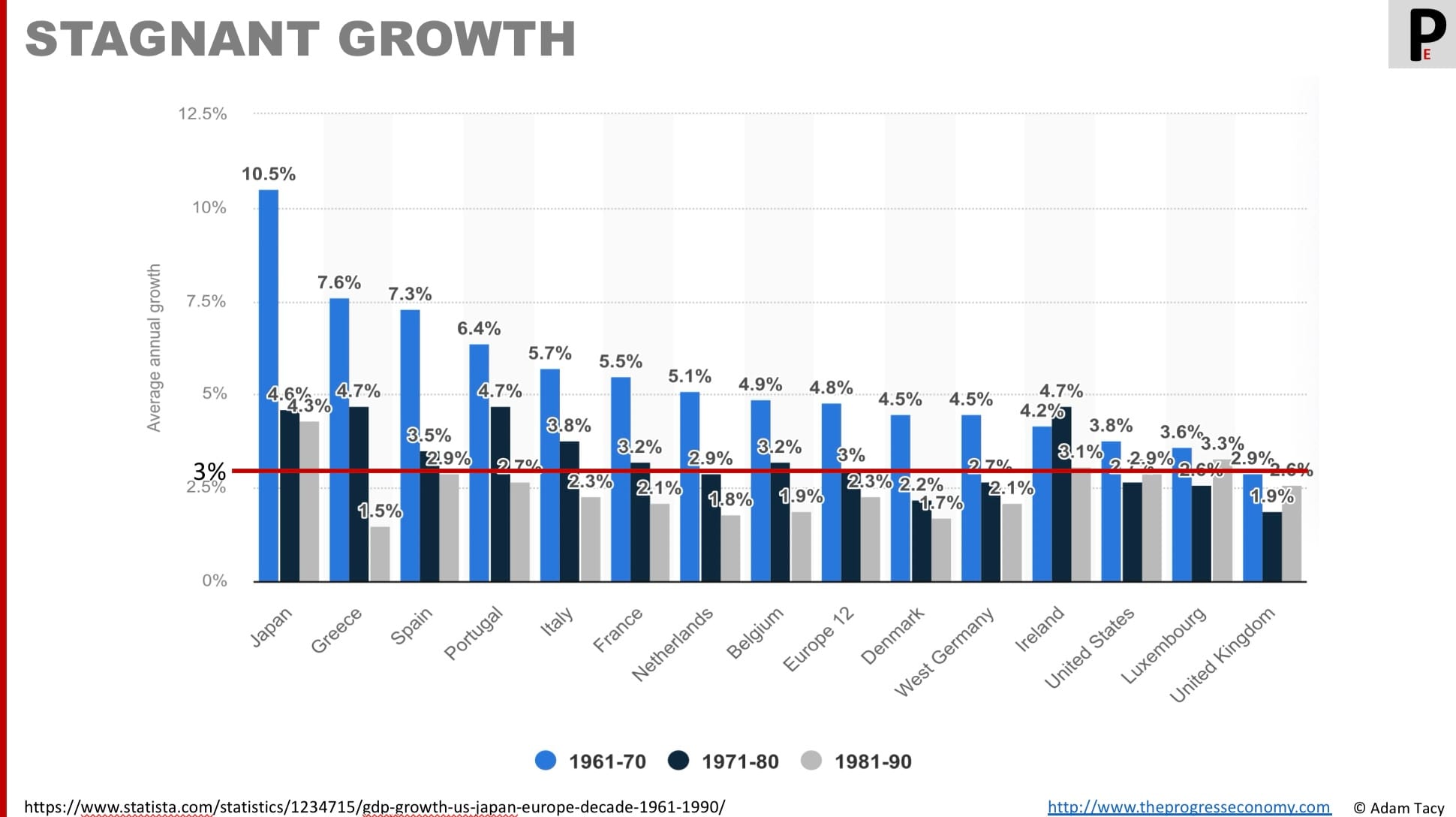
Across much of the developed world, productivity growth has slowed, innovation outcomes have become harder to sustain, and economic expansion has become increasingly difficult to achieve. The optimism that characterised much of the twentieth century has given way to concerns about stagnation.
These concerns are now being voiced at the highest levels. In 2024, IMF Managing Director Kristalina Georgieva warned that, without significant change:
Without a course correction, we are indeed heading for ‘the Tepid Twenties’ — a sluggish and disappointing decade.
International Monetary Fund Managing Director, Kristalina Georgieva (2024)
The question is not whether growth has slowed. The question is why.
Why this matters
Most responses focus on symptoms: productivity, investment, regulation, demographics, technology adoption, or geopolitics. Each undoubtedly matters.
The Progress Economy asks a more fundamental question: what if part of the challenge lies in the lens through which we understand growth itself?
For more than two centuries, value has been our primary unit of strategy. It has shaped how organisations think about customers, innovation, competition, and economic exchange. It helped explain and drive extraordinary growth during the industrial era.
But if the world has changed, perhaps our foundational assumptions should be revisited as well.
The Progress Economy proposes that managers shift their focus from value to progress. Not because value has become irrelevant, but because value is an assessment of change, while progress is the change itself.
Understanding that distinction opens up new ways of thinking about innovation, sales, growth, and customer improvement. The purpose of this site is to explain why that shift matters and how organisations can apply it in practice.
Let’s progress together through discussion…