Why we innovate

We innovate in order to make better progress; either for ourselves or to get help making progress we seek through service exchange Editing below here What we’re thinking There are many commonly cited reasons for why we innovate. Most revolve around creating value or generating cash. The progress economy reframes that question. We innovate to make better progress – from a progress origin to a progress sought – and, in doing so, improve well-being. We also make a simple observation: the capabilities required to make progress are unevenly distributed across economic actors. Why this matters That imbalance creates the conditions…
The real goal of innovation – improving well-being
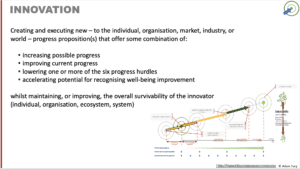
To minimise the limitations chasing value brings we need to offer to improve well-being, that is to say “how do we enable better progress?” Editing below here What we’re thinking We’ve identified solving our innovation problem requires a mind shift from chasing added value to improving well-being by enabling better progress. But what does that mean? Why this matters Our progress-first definition of innovation: Now we can design for improved progress rather than depend on chance. Turning Christensen’s call to “compete against luck” into a practical reality. The real question for innovators is “how do we help Seeker(s) make better progress?”…
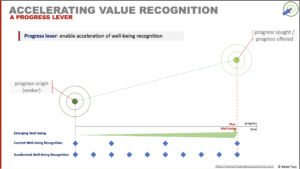
Accelerating well-being recognition
The quicker a Seeker recognises well-being recognition the more tangible progress feels – think Agile, or improving the measurement scale
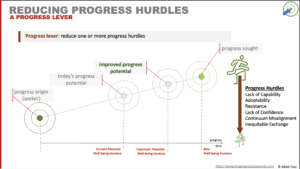
Lowering progress hurdles
Lowering one or more of the 6 identified progress hurdles increases a Seeker’s progress potential
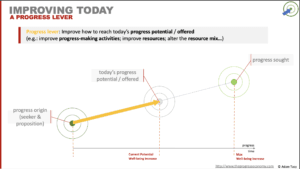
Improving today’s progress
Improving how to make the same progress possible today – better resource mix, better progress-making activities…
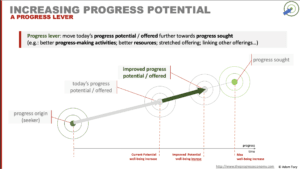
Increasing progress potential
Can you innovate to enable Seekers get closer to their progress sought than they can today? What we’re thinking One of the four innovation outcomes is a proposition that offers increased progress potential. That is to say, a proposition that enables a Seeker to get closer to their progress sought. And that might mean starting closer to their current progress origin. Increasing progress potential An outcome of innovation is a progress proposition that enables a Seeker to get closer to their progress sought than is currently possible Our first innovation outcome is the one that most likely springs to mind…
Innovation and sales: two sides of the same coin
Sales and innovation both aim to enable the making of better progress. Innovation is often off-line, sales more in-line. The former helps sales, and the later may result in local innovation. Both leverage the same progress levers.
Transforming innovation: the operational definition
The real question for innovators is not “how do we add value?” but “how do we enable better progress?”. Seekers want improved well-being, which is operationalised through progress – enable better progress (functional, non-functional, contextual) with lower progress hurdles and quicker well-being recognition. What we’re thinking We’ve uncovered that chasing value is the root of our innovation problem – despite increasing investment, innovation outputs are disappointing and growth is stagnating. I’ve also proposed that the solution comes from a mind shift away from chasing value towards increasing well-being; which is operationalised through enabling better progress. Taking a progress-forward view reveals four clear, actionable,…
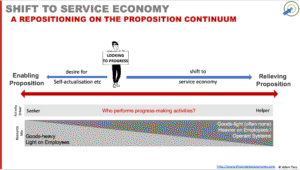
Sliding along the progress continuum

Close the gap between proposition and Seekers, or explore implications of new positions, on the enabling-relieving progress continuum
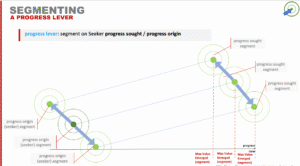
Segmenting

Segment on progress sought, and progress origin, to unlock innovation and sales
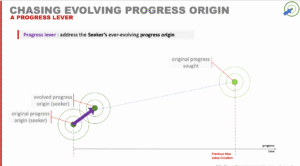
Chasing Evolving Progress Origin
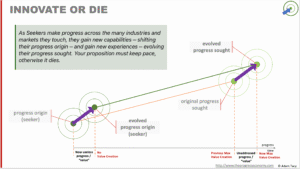
Seeker’s constantly gain capabilties, through other progress attempts, meaning their origin evolves – miss that, and your proposition becomes stale.
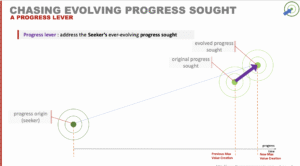
Chasing Progress Sought