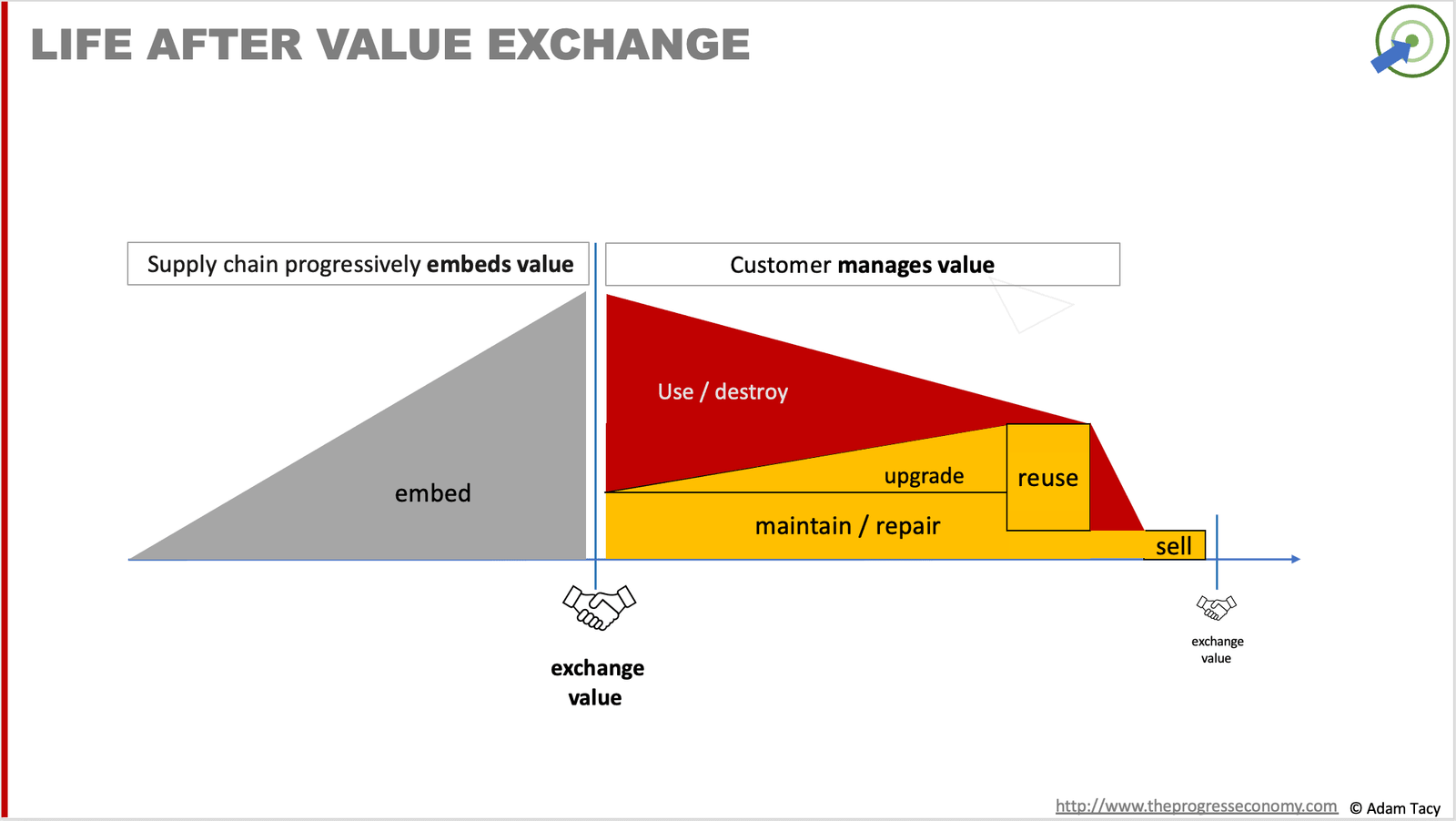

The problem is not that the value-in-exchange story is wrong; it just stops too early.
What we’re thinking
Value-in-exchange is fundamentally manufacturer-centric.
It describes the lifecycle of value from the perspective of the producer. Manufacturers create value by embedding it in products, exchanging that value with customers for items of value (usually money), and the largely view the customer as consuming, using up, or destroying that embedded value.
The customer experiences the lifecycle very differently.
Why this matters
If we only focus on value creation up to the point of exchange, we risk overlooking substantial innovation and growth opportunities that exist before, during, and long after the exchange takes place.
The story stops too early
Value-in-exchange tells a remarkably successful story.
Raw materials are transformed into components. Components become products. As products move through the supply chain, value is progressively embedded within them. Eventually, value is exchanged with a customer in return for money.
From the manufacturer’s perspective, the story largely ends there.
The customer purchases the product, uses it, and gradually consumes or destroys the value embedded within it. When sufficient value has been used up, the customer returns to the market and another exchange occurs.
However, there is a problem: the story stops too early.
The customer’s perspective
Customers do not spend their time trying to destroy value. They spend much of their time attempting to preserve, restore, recover, extend, and sometimes increase it.
The real lifecycle of value looks more like the diagram below.
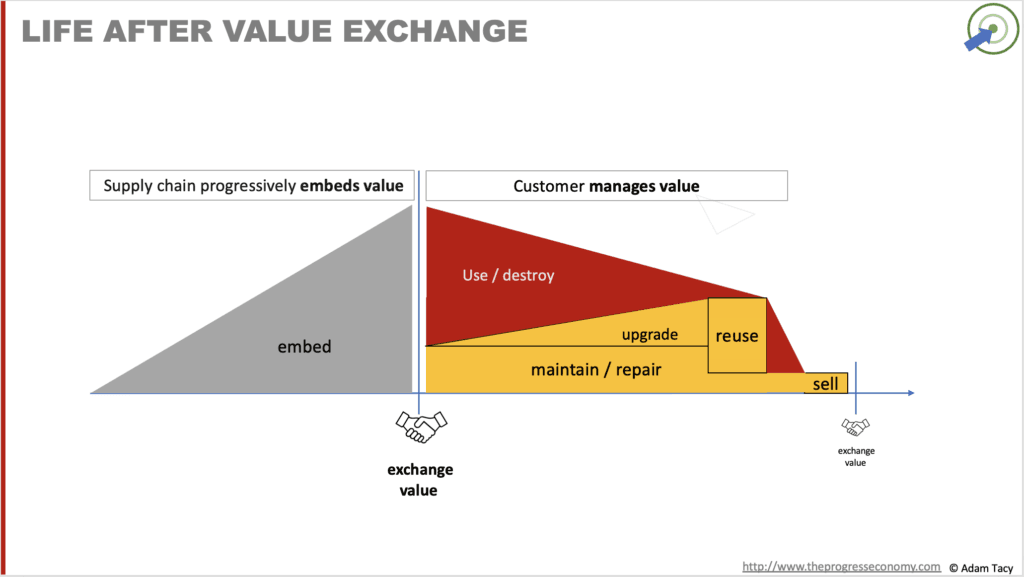
After an exchange takes place, customers try to actively manage the value they possess. They:
- maintain products to preserve value
- repair them to restore value
- upgrade them to increase value
- reuse them in new contexts to extend value, and eventually
- may sell them in an attempt to recover value in another form, such as cash or credit towards a replacement purchase.
Let’s take our familiar example: the car.
The traditional value-in-exchange story focuses on extracting raw materials, manufacturing components, assembling the vehicle, and ultimately selling it to a customer. Once purchased, some value is immediately lost as the car leaves the dealership, and the remaining value is gradually consumed through wear and tear.
Yet this is not how the owner experiences the vehicle. The owner:
- services the car to preserve value
- repairs it to restore value
- may install an external exhaust system to increase value
- sell or trade in the vehicle to recover part of the remaining value and apply it elsewhere.
The customer’s relationship with value continues long after the initial exchange.
WHO HELPS THE CUSTOMER MANAGE VALUE?
Once we recognise that customers actively manage value after exchange, an immediate question emerges: who helps them do it?
The answer is increasingly not the original manufacturer alone.
Instead, entire industries emerge around helping customers preserve, restore, recover, and extend value. Repair services, maintenance providers, aftermarket suppliers, training organisations, consultants, refurbishment specialists, marketplaces, insurers, finance providers, and recycling businesses all exist because customers continue pursuing better outcomes after the original transaction.
From a growth perspective, these activities are not peripheral. They represent substantial opportunities that sit outside the traditional value-in-exchange model.
THREE MISSED OPPORTUNITIES
Once value is defined primarily through exchange, managerial attention naturally concentrates on creating the next exchange. Activities occurring before, after, or across exchanges become secondary concerns. Yet many of the most significant growth opportunities exist precisely in these neglected spaces.
value-management activities are routinely overlooked
Osterwalder, A., Pigneur, Y. (2003). Modeling Value Propositions in e-Business. In Proceedings of the 5th International Conference on Electronic Commerce, ICEC 2003, Pittsburgh, Pennsylvania, USA, September 30 – October 03, 2003
Post-exchange opportunities
The most obvious opportunities exist after exchange.
Customers continue seeking help long after they have purchased a product. Maintenance, servicing, repair, upgrades, support, education, optimisation, refurbishment, resale, and recovery services all help customers achieve better outcomes over time.
Many of today’s fastest-growing service businesses operate in precisely these spaces. But if you maintain a value-in-exchange perspective, these growth opportunities are not of interest to you.
Pre-exchange opportunities
A second category exists before exchange.
A value-in-exchange perspective naturally encourages standardisation. Products are designed to maximise manufacturing efficiency and inventory management rather than alignment with the circumstances of individual customers. Customisation therefore appears costly and undesirable because it disrupts efficient production and requires greater customer involvement.
Where customisation does appear, it is frequently constrained to predefined option packages. Automotive performance, safety, and comfort packs illustrate the point. They create the appearance of tailoring while preserving the manufacturer’s operational efficiency. Customers receive a solution that is close enough rather than precisely aligned with their circumstances.
Vargo & Lusch encouraged us to make customisation the default mode of marketing when they were dispelling the 4 service marketing myths.
Vargo, S. & Lusch, R. (2004). The Four Service Marketing Myths. Journal of Service Research, 6(4), pp324-335,
- The normative marketing goal should be customization, rather than standardization.
- Unless tangibility has a marketing advantage, it should be reduced or eliminated if possible
- The normative marketing goal should be to maximize consumer involvement in value creation;
- The normative goal of the enterprise should be to reduce inventory and maximize service flows
Across-exchange opportunities
A third category spans exchanges.
Products increasingly move through multiple owners, multiple uses, and multiple lifecycles. Refurbishment, remanufacturing, leasing, subscription models, marketplaces, recycling, and circular economy initiatives all recognise that value does not simply disappear after a single exchange.
Instead, value can be recovered, renewed, and redirected. But to recover that value after exchange often requires decisions before exchange – what materials to use, how to put the product together etc.
As the Ellen McArthur Institute say:
One of the biggest challenges… to transition from linear to circular is that it requires… revisiting the very notion of value creation
Ellen MacArthur Foundation. (2013). Towards the Circular Economy: Economic and Business Rationale for an Accelerated Transition. Cowes: Ellen MacArthur Foundation
THE DEEPER IMPLICATION
It is not just that value-in-exchange overlooks parts of the value lifecycle. It overlooks what customers are actually trying to achieve throughout that lifecycle.
Maintenance, repair, upgrading, reuse, resale, customisation, refurbishment, and circular recovery are not activities undertaken to manage value for its own sake. They are attempts to improve outcomes. They are attempts to continue moving towards more desirable states despite changing circumstances.
Once viewed through that lens, the limitations of value-in-exchange become clearer. The model captures an important moment – the exchange – but provides only a partial view of the customer’s broader journey.
To understand that journey fully, we need a unit of analysis that extends beyond exchange itself. That unit is progress.
Let’s progress together through discussion…