
We’re no longer in the industrial-era; is value-in-exchange the optimum model for growth?
What we’re thinking
Value-in-exchange emerged from observations of an industrial world in which products dominated economic activity and growth came largely from producing, distributing, and exchanging goods.
That world still exists, but it is no longer the world most organisations operate within.
Today, services generate the majority of economic output, employment, and growth. If our economy has fundamentally changed, it is reasonable to ask whether the industrial-era logic of value-in-exchange remains the most useful model for understanding innovation and growth.
Why this matters
The models we use determine what we notice, what we measure, and ultimately what opportunities we pursue.
If value-in-exchange was developed to explain how growth occurs in a product-dominated economy, relying on it exclusively may leave us poorly equipped to understand growth in a service-dominated one.
The economy has changed
For much of human history, economic activity centred on agriculture. During the Industrial Revolution, manufacturing became the dominant engine of growth. It was during this period that economists such as Adam Smith developed theories that explained how value was created through production and realised through exchange.
Those theories proved enormously successful.
Yet over the past century the structure of economies has changed dramatically.
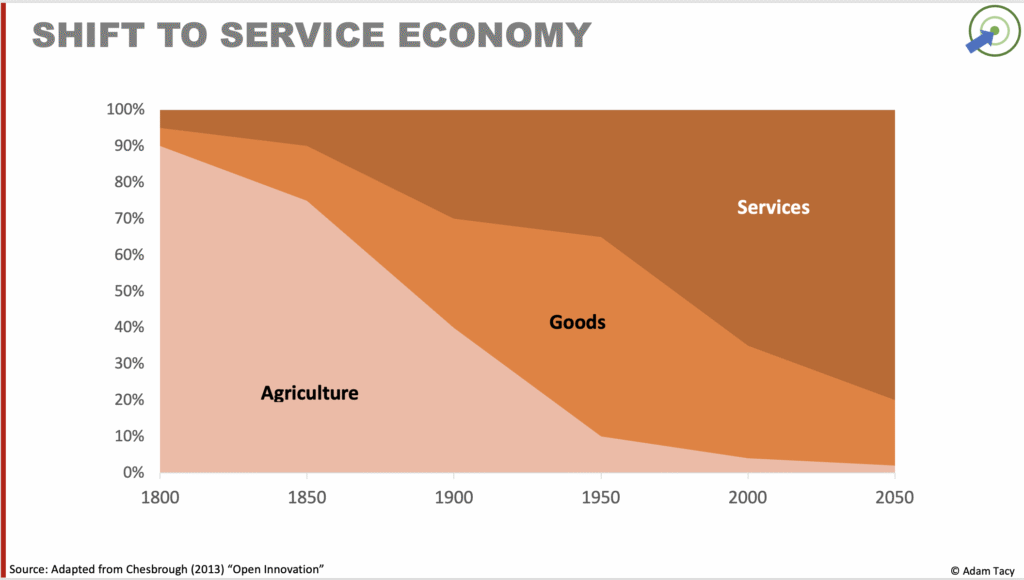
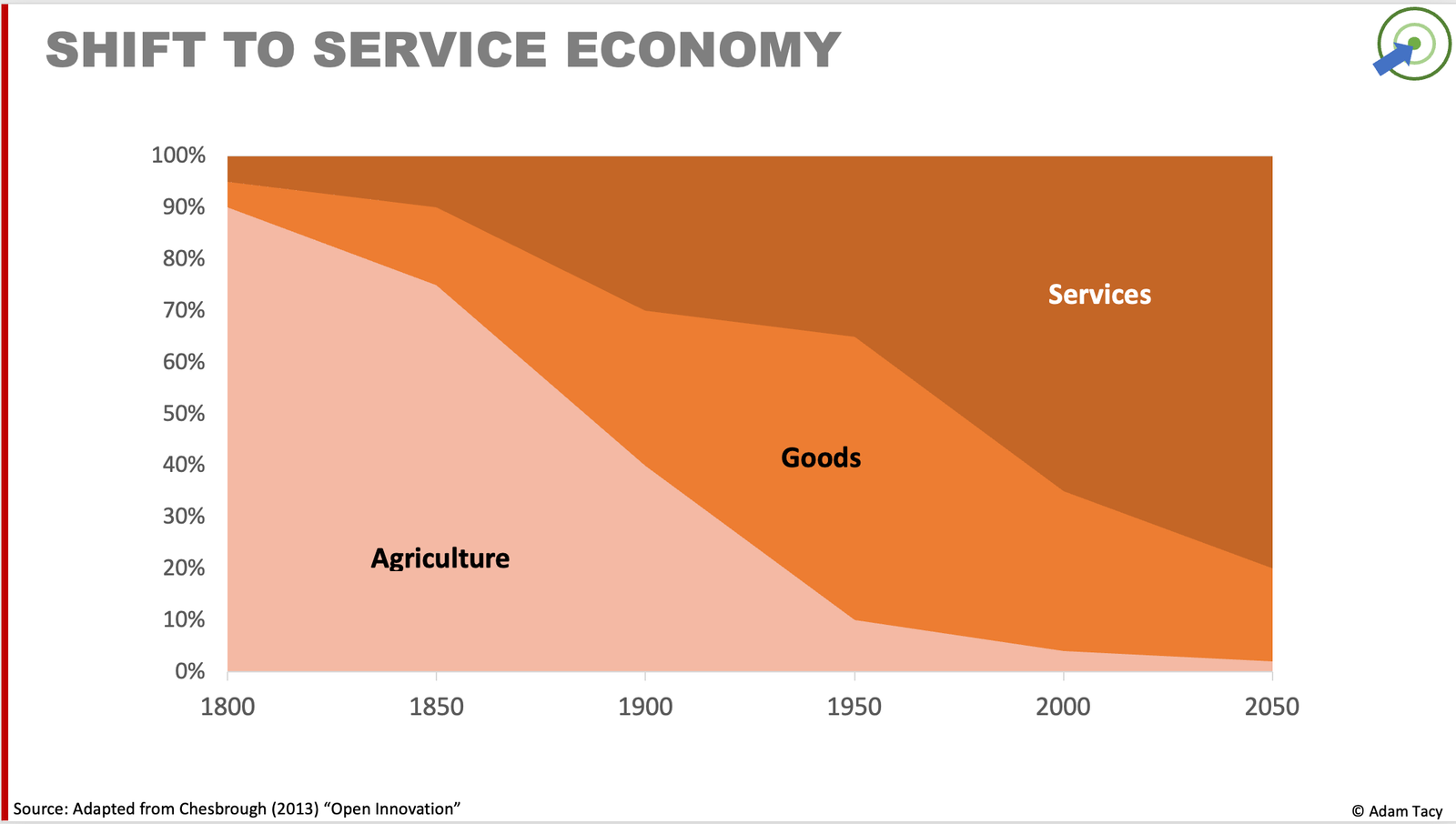
Economic activity has progressively shifted from agriculture, to manufacturing, and then towards services. By around 1970, services accounted for more than half of economic output in many advanced economies. Today they dominate. (see above from Chesbrough (2013), Open Innovation).
By around 1970, services accounted for more than half of economic activity. By 2019, according to the World Trade Organisation, services contributed around two-thirds of global GDP.
The services sector today generates more jobs (50 per cent share of employment worldwide) and output (67 per cent share of global GDP) than agriculture and industry combined – and is increasingly doing so in economies at earlier stages of development
World Trade Organization. (2019). World Trade Report 2019: The Future of Services Trade. Geneva: WTO
The OECD was already noting back in 2000:
The service sector accounts for about 70% of aggregate production and employment in OECD economies and continues to grow.
Anita Wölfl. (2005).The service economy in OECD countries, STI working paper 2005/3, Statistical Analysis of Science, Technology and Industry, OECD.
And this isn’t limited to the “developed” world. In Nigeria, services made up 50% of the economy in 2010. By 2017, that figure had climbed to 55.8%.
At the same time, an increasing proportion of economic value resides in intangibles rather than physical assets. Haskell and Westlake argue in heir 2018 2018 “Capitalism without Capital” that investments in software, design, brands, organisational capability, research, data, and other intangible assets now represent a major component of modern economic activity.
By almost any measure, we have entered a service economy.
The question therefore becomes: should we continue using a model of value developed primarily to explain an industrial one?
Service reveals a different logic
The distinction between goods and services is often presented in terms of tangibility. Products are tangible; services are not. Products can be inventoried; services generally cannot. While these differences are real, they are not the most important distinction. The more consequential difference concerns how outcomes emerge.
A manufacturer can build a car months before a customer arrives. Most of the economic activity occurs before the exchange takes place. The customer selects the vehicle, pays for it, and drives away. From the perspective of value-in-exchange, value has already been embedded within the product.
Services operate differently. Consider something as simple as a haircut. The customer participates throughout the process. Requirements are discussed. Alternatives are proposed. Adjustments are made. Feedback is sought. The outcome emerges through interaction between provider and customer rather than through the transfer of a completed object. The customer is not merely receiving value. They are actively involved in creating the outcome.
This observation creates a challenge for value-in-exchange thinking. If outcomes emerge through use, participation, and interaction, then it becomes increasingly difficult to argue that value exists solely before exchange.
Christian Grönroos captures this tension clearly:
It is of course only logical to assume that the value really emerges for customers when goods and services do something for them. Before this happens, only potential value exists.
Grönroos (2004) Adopting a service logic for marketing
This ushers in a new logic of thinking: value-in-use. And that is equally applicable to goods and services. In fact, under such a model, we find goods are distribution mechanisms for service. They freeze service provision – application of competences for the benefit if another – allowing it to be transported and unfrozen when and where needed.
Is innovation the same in services as in goods?
As increasing value is often seen as a way of defining innovation, let’s see if innovation in services is similar to innovation in goods.
Innovation scholars had wrestled with precisely this question. Broadly speaking the literature has converged around three competing perspectives: assimilation, demarcation, and synthesis
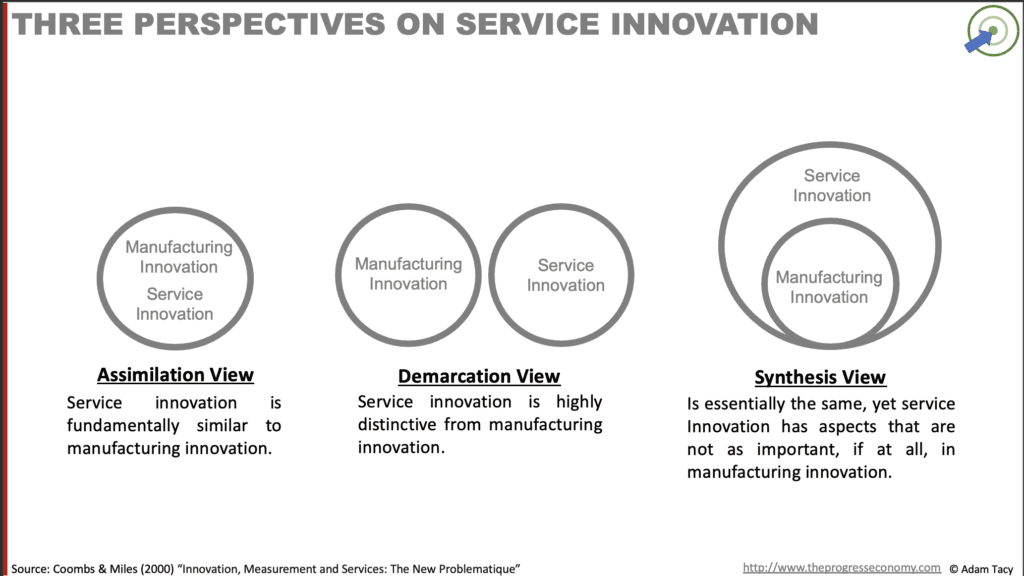
The 5Is of services – differences to goods – suggest that the assimilation view is not the right one.
It is the synthesis view that proposes innovation in goods and services shares many common mechanisms, but service innovation places greater emphasis on dimensions that manufacturing innovation has traditionally underplayed. These dimensions include interaction, context, participation, relationships, and co-creation.
Implications
None of this makes value-in-exchange obsolete. Products remain important. Manufacturing remains important. Exchange remains important.
The challenge is that value-in-exchange increasingly appears to explain only part of what is happening.
It explains how:
- firms generate revenue.
- products are traded
- the mechanism that drove industrial-era growth.
Yet it struggles to explain why customers engage with products and services in the first place, how outcomes emerge through use, and why interaction, participation, and collaboration have become such important features of modern economies.
As researchers increasingly shifted their attention towards service, they found themselves asking a different question. Rather than focusing on what was exchanged, they began focusing on what happened to customers as they used products.
The answer was becoming improving their well-being by becoming better off. And once becoming better off becomes the focus, attention naturally shifts away from value itself and towards the movement that produces that improvement.
In other words, towards progress.
Let’s progress together through discussion…