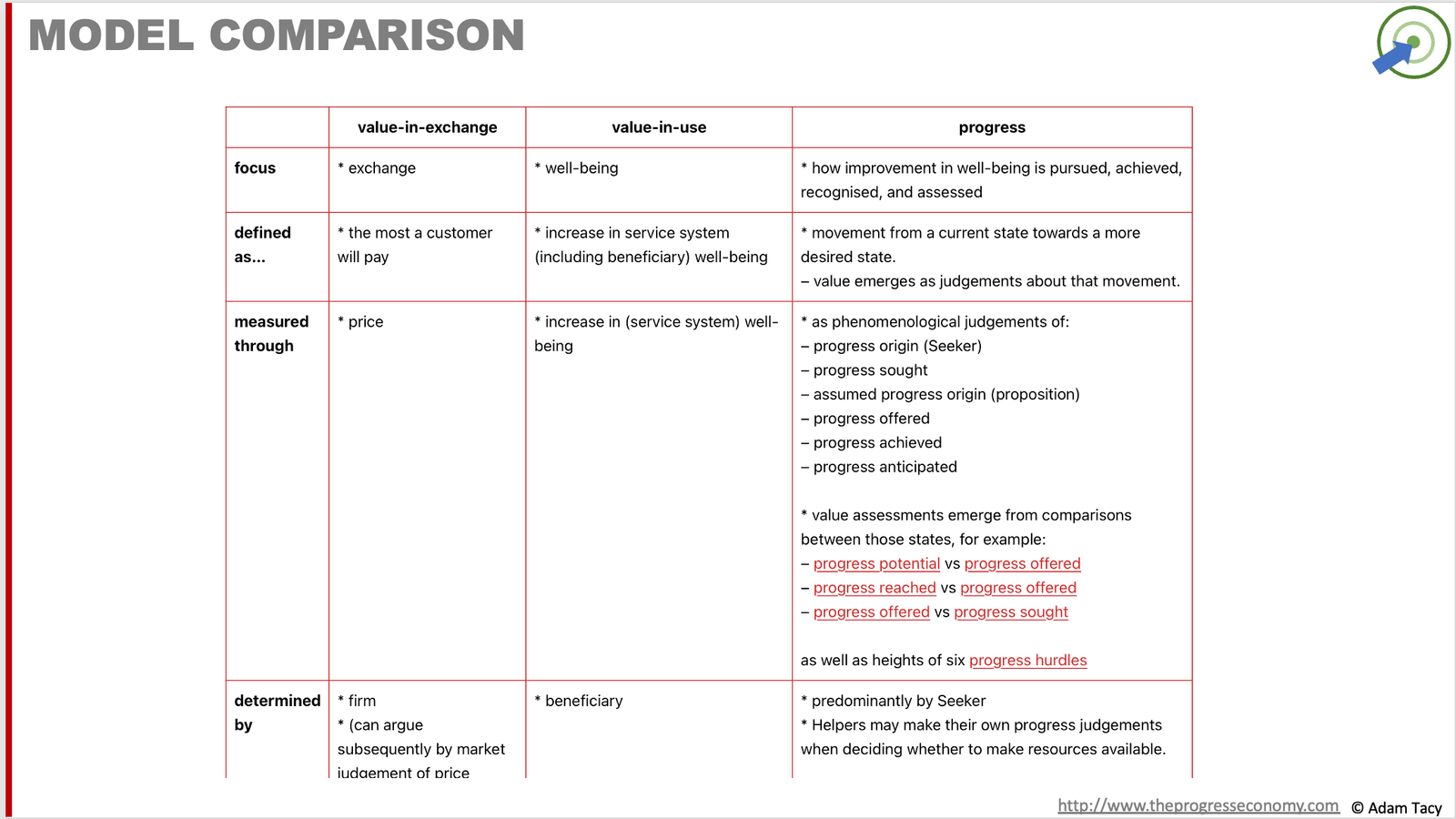

How do our three perspectives on value compare? One way is to examine them across a common set of dimensions: how value is defined, measured, created, and destroyed; which actors and resources are emphasised; and how each perspective shapes innovation. The comparison below draws inspiration from Vargo, Maglio and Akaka’s analysis of value and value co-creation, extending it to include more attributes as well as the Progress Economy perspective. (Vargo, Maglio & Akaka. (2008). “On value and value co-creation: A service systems and service logic perspective”, European Management Journal vol 26, pp145–152),)
What emerges is not simply three competing definitions of value, but an evolution in where analysis is focused. Value-in-exchange concentrates on transactions. Value is assumed to be embedded in offerings, measured through price, and realised through exchange. Value-in-use moves the locus of analysis beyond the transaction and into the customer’s world. Value is no longer something exchanged but something that emerges through use as actors attempt to become better off.
The Progress Economy focus on progress takes the next step. Rather than treating improvements in well-being as the final explanatory construct, it asks how those improvements come about in the first place. It shifts attention towards the movement from a current state to a more desired state, and the activities, resources, capabilities, and judgements involved in making that movement possible. In this view, value is not abandoned. Rather, value becomes the set of assessments actors make about progress that has been offered, achieved, anticipated, or recognised.
Seen this way, the three perspectives are not necessarily contradictory. Each moves the unit of analysis one level deeper. Value-in-exchange explains transactions. Value-in-use explains improvements in well-being. The Progress Economy seeks to explain the underlying phenomenon that gives rise to those improvements: progress itself.
| value-in-exchange | value-in-use | progress | |
|---|---|---|---|
| focus | * exchange | * well-being | * how improvement in well-being is pursued, achieved, recognised, and assessed |
| defined as… | * the most a customer will pay | * increase in service system (including beneficiary) well-being | * movement from a current state towards a more desired state. – value emerges as judgements about that movement. |
| measured through | * price | * increase in (service system) well-being | * as phenomenological judgements of: – progress origin (Seeker) – progress sought – assumed progress origin (proposition) – progress offered – progress achieved – progress anticipated * value assessments emerge from comparisons between those states, for example: – progress potential vs progress offered – progress reached vs progress offered – progress offered vs progress sought as well as heights of six progress hurdles |
| determined by | * firm * (can argue subsequently by market judgement of price asked) | * beneficiary | * predominantly by Seeker * Helpers may make their own progress judgements when deciding whether to make resources available. |
| created by | * firm through embedding it in products | * co-created by all actors including the beneficiary during the use of value proposition | * improvements in well-being emerge as a Seeker makes progress. – progress is made through progress-making activities – progress-making activities may be driven by Seeker, Helper, or a combination * emerged improvements in well-being need to be recognised by the Seeker – a process akin to revenue recognition – in order to be meaningful to them |
| destroyed by | * end customer after exchange made | * Potentially by actors in-use * often represented as co-destruction to align with co-creation position (although this is a misrepresentation) | * one or more involved actor hindering progress being made |
| resource focus | * operand – those that need acting upon for value to be created, typically goods | * operant – those that act upon other resources resulting in value creation * goods are seen as mechanisms that freeze service for temporal/location distribution | * capabilities are primary; they are carried by resources. * operant – driving progress * goods distribute service and are one potential component in the resource mix offered to a Seeker |
| actor focus | * firm | * beneficiary * a proposition sits on a continuum between enabling/relieving propositions | * progress seeker drives seeking progress * seeker drives progress attempt through progress-making activities unless they lack resource * helper provides supplementary resources including proposed progress-making activities * a proposition sits on a continuum between enabling/relieving propositions, located based on who (seeker or helper) performs majority of progress-making activities |
| innovation aims to… | * get higher price in exchange by embedding more value * or get more exchanges through lowering price * or both | * improve well-being of beneficiary and/or service system | * improve progress through some combination of: – improving how to make today’s progress – increasing progress offered towards individual seeker’s progress sought – reducing one or more of 6 progress hurdles – increasing recognition of well-being without impacting survivability of progress helper(s) |
| challenges | * is incomplete (misses value recovery) * has a number of blindspots * does not model todays service based economy | * provides no obvious operationalisation * price is undefined | * requires observing and modelling multiple progress states rather than a single measure * can appear more complex than value-based approaches |
| benefits | * explains industrial era growth | * better aligns with service-based economies * offers to address the blindspots of value-in-exchange model | * inherits value-in-use benefits * operationalises improvement in well-being * provides an explanation of price independent of value |
Let’s progress together through discussion…