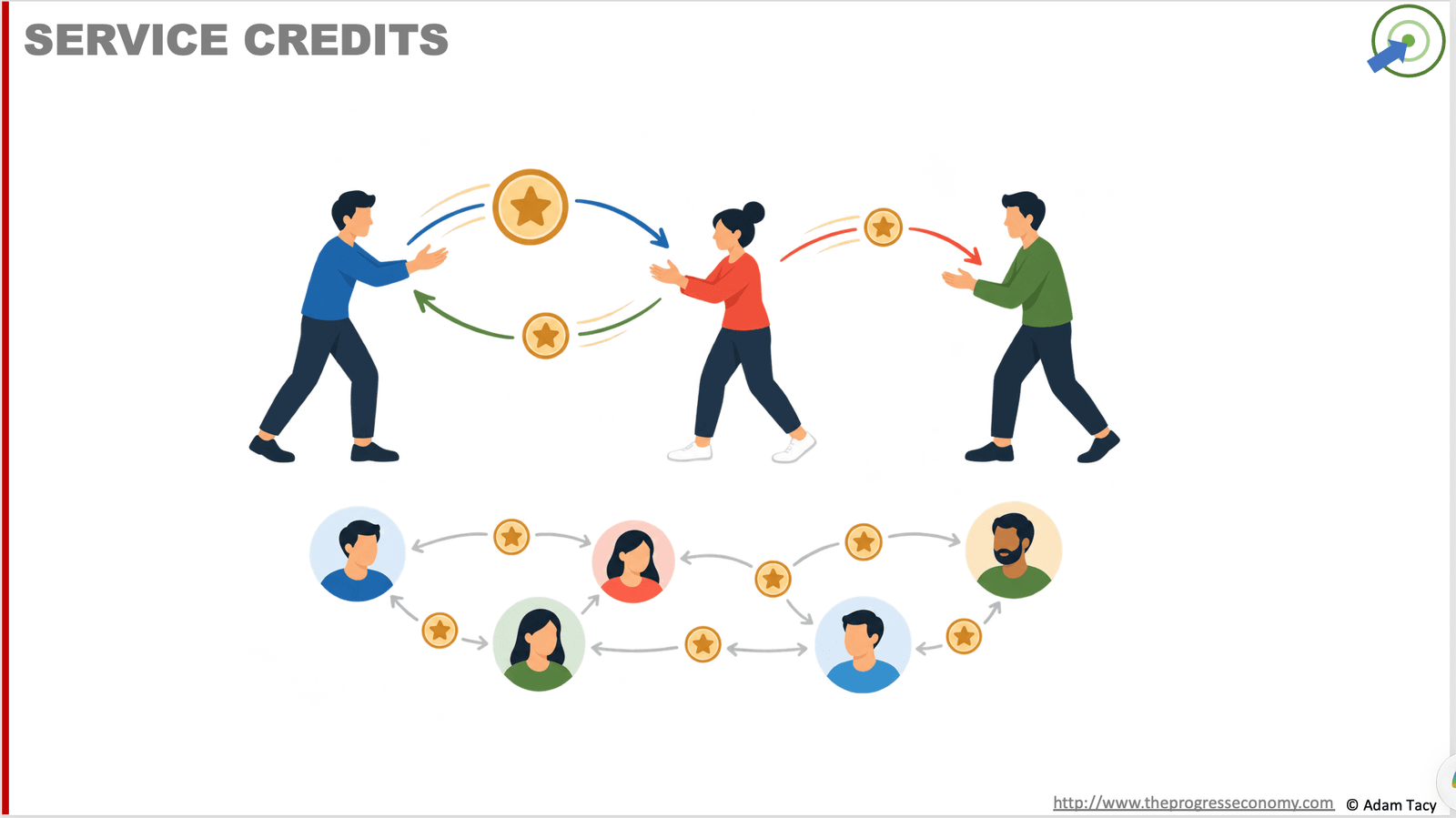

Service credits i) mediate temporal and magnitude of effort differences in service exchange, and ii) lubricate indirect exchange.
What we’re thinking
Service credits are value-less promises of future service representing an economy’s agreed measure of service effort.
They can be registered mentally, centrally, or distributed amongst actors.
To be successful, an implementation of service credits must have several characteristics: [acceptability, scarcity, fungible,…]
Why this matters
They arise from a need to mediate temporal and magnitude differences in direct service exchange and expand in role to lubricate the more commonly observed indirect exchange.
The formality of service credit implementation increases with the level of unfamiliarity or trust required between the parties involved. Friends may mentally tally favours owed; wider society may use tokens, central or distributed ledgers, contracts etc. Money is a successful implementation of service credits; bitcoin, shells, rocks have been alternatives.
…editing below this point
The need for service credits
Simplistically, as we exchange service for service, it could be thought that each exchange happens directly between two parties at a point in time. However we observe that is rarely the case.
Let’s start with a simple two-party exchange. I agree to help you move house over a nice summer weekend in July. It is rare that in return I need you to help me move on exactly the same weekend. Instead, we probably agree that you’ll help me move at some, probably as yet not determined, point in time.
Or you offer me a meal or something, or maybe I seek nothing in return. But now we’re straying into a discussion on equitable service exchange. We’ll keep to exchanging help with house moves.
Once I’ve helped you move, you owe me help with a house move in the future. Now, between friends we probably keep that in our heads. But you could give me a note (physical or digital) saying you owe me one house move.
Implication: price
do service credits relate to price
What about supply & demand? It still works. Think of it this way: you want a service, so you’ll exchange service (direct or indirect). If the service you want is in short supply, you might be tempted to offer more, greater, better service than others. That is to say you are willing to put in more effort to get the exchange quicker/earlier than others. In an indirect exchange that means offering more service credits…
Let’s progress together through discussion…