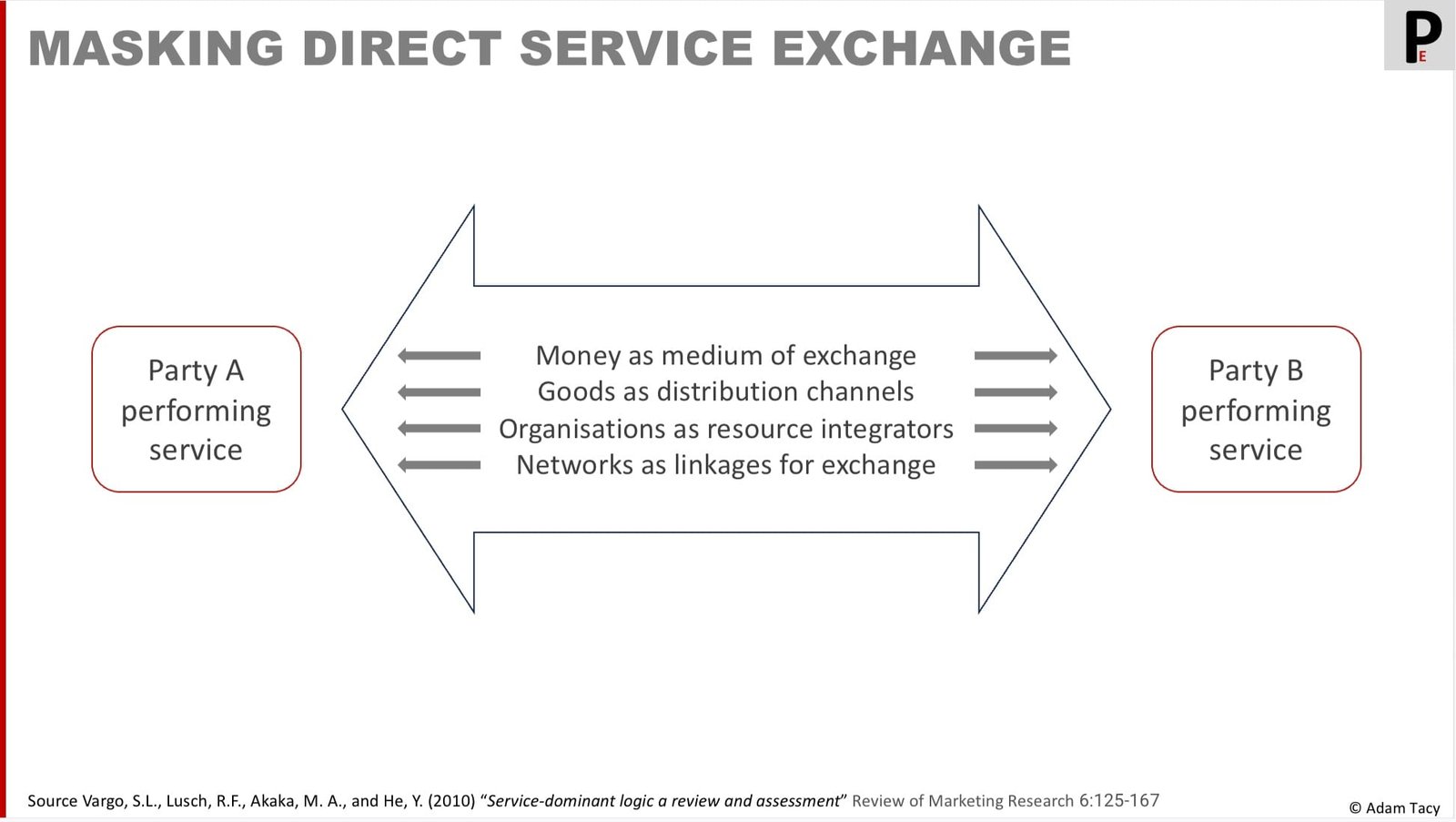

Indirect exchange masks exchanging service as the driver of economic activity.
What we’re thinking
Whilst service exchange is the driver of economic activity, its visibility is often masked by indirect exchange, of which there are five identified types:
- transitive indirect exchange – exchanges can be separated into a chain of exchanges that not all parties need to be aware of
- distributable indirect exchange – where service is frozen into goods that act as a distribution mechanisms
- pooled indirect exchange – many actors exchange one way, one actor exchanges back (sometimes only potentially)
- internal indirect exchange – organisations as resource integrators
- network indirect exchange – ecosystems/service systems as resource integrators
Why this matters
Indirect exchange can lead us to believe that service exchange is not the driver of economic activity.
Specifically, a combination of distributable and transitive exchanges forms the basis of the value-in-exchange/goods-dominant perspective that lie behind traditional management theories.
Additionally, goods (as distributable indirect exchange) can no longer be seen as fundamentally different to service provision; hence we have no goods vs services schism in The Progress economy…just two different ways service can be provided.
You may be reading this body of work with some disbelief that service exchange is the fundamental basis of economic activity. Our everyday experience seems to tell us otherwise. The idea that economic activity rests on an essentially bilateral arrangement – “I help you and you help me” – feels at odds with those experiences. In a goods-dominant economy, we appear to exchange value (money for products9. Neither money nor products, at first glance, seems to fit The Progress Economy’s understanding of service (singular).
The explanation is that we are more likely to observe indirect forms of exchange than the direct service exchange that underpins them. Over time, these indirect forms mask the service basis of economic activity.
What is indirect exchange?
Indirect exchange occurs when the underlying exchange of service for service is masked by other mechanisms.
Vargo and colleagues identify four ways in which indirect exchange masks the fundamental basis of exchange in their paper Service-Dominant Logic: A Review and Assessment.

Building on their work, we identify five forms. We will name them as follows:
| indirect exchange form | description |
|---|---|
| transitive | service credits act as a medium of exchange relieving the bilateral nature of direct service exchange and challenges of actors finding each other |
| internal | service credits enable specialisations within an actor to help the actor execute propositions |
| network | service credits enable one actor to co-ordinate additional more specific actors in offering a more generic/coordinated/attractive proposition |
| distributable | service performance is frozen into a goods allowing it to be distributed to whenever and wherever needed, where it is unfrozen in an act of resource integration whilst attempting to make progress |
| pooled | an actor receives service credits from multiple actors and subsequently allocates them to benefit one or more of the contributors as needed and perhaps some of them never benefit directly (is this true, peace of mind is a benefit…) |
These forms are not necessarily mutually exclusive. A single economic arrangement may combine several of them, as we will see when re-looking later at what value-in-exchange means. But to enable most of these indirect exchanges, we need to expand the role of service credits.
Expanding the role of service credits
We introduced service credits as a way of mediating temporal and magnitude differences in reciprocal direct service exchange. They record an agreement between two actors: one provides a service, while the other undertakes to provide reciprocal service at a later time.
This constrains reciprocal arrangements to be bilateral. If, instead, all actors in an economy agree to certain characteristics about service credits, then they become transferable. Once transferable, the bilateral constraint on reciprocal service is relieved, and transitive indirect exchange across multiple actors becomes possible.
Transferability changes the characteristics required of service credits and the conditions under which they can be issued and accepted. They must be recognised by actors beyond the original exchange, and those actors must be willing to accept them in return for their own services. At this point, service credits begin to share important characteristics with money. This is why, in The Progress Economy, money can be understood as a successful implementation of the more abstract concept of service credits.
Understanding Value-in-Exchange
Going back to our starting point: today’s value-in-exchange model – that has been so successful, though is hitting its limitations – derives from two forms of indirect service exchange operating together.
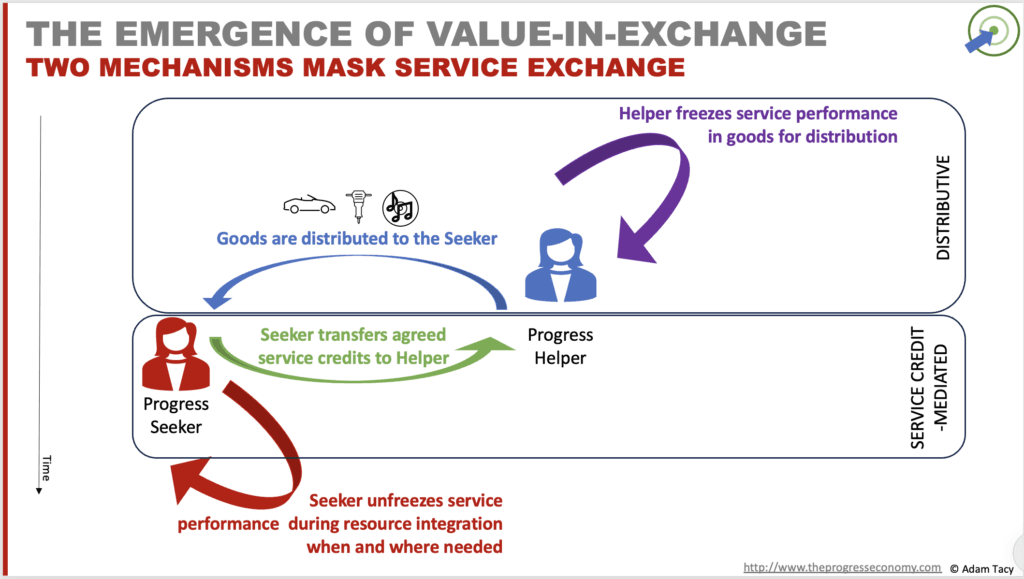
Firstly, distributable indirect exchange masks the service nature of a Helper’s proposition. Their service provision is frozen in a goods that can be distributed. Secondly, transitive exchange masks the service nature of the “transaction” between Helper and Seeker.
A Seeker gives the Helper service credits, but with no intention of providing service themselves. The Helper provides a service frozen in a goods
Goods vs Services
Where the Helper is providing a service rather than a goods, there is no need for the distributable masking in that leg of the exchange.
This is why we see no goods vs services schism in The Progress Economy.
Goods are simply an alternative way of providing service. Sometimes there is a one-one mapping between a service and a service frozen in goods, sometimes it is a one-many. That is many goods are needed, each one freezing a particular component of the end service (covering the Seeker’s progress journey). A handyman hanging a picture frame can be seen as a service; doing it your self requires several tools (distributable service) along with application of your own capabilities (self service).
Wrapping up
As Vargo & Lusch’s service-dominant logic tells us, the service basis of exchange is often masked by indirect exchange.
Indirect exchange masks the fundamental basis of exchange
#2
Transitive indirect exchange – lubricated by service credits
Let’s say I help you progress and in return you give me a service credit. The original intent of that, in direct exchange, is that I will use that credit at a later date to call on your help.
Now, maybe there’s another progress helper that is willing to accept that service credit as a call on their help instead of me helping them progress. So I can get help from them by using the credit I received from helping you.
This is a transitive indirect service exchange; lubricated by service tokens.
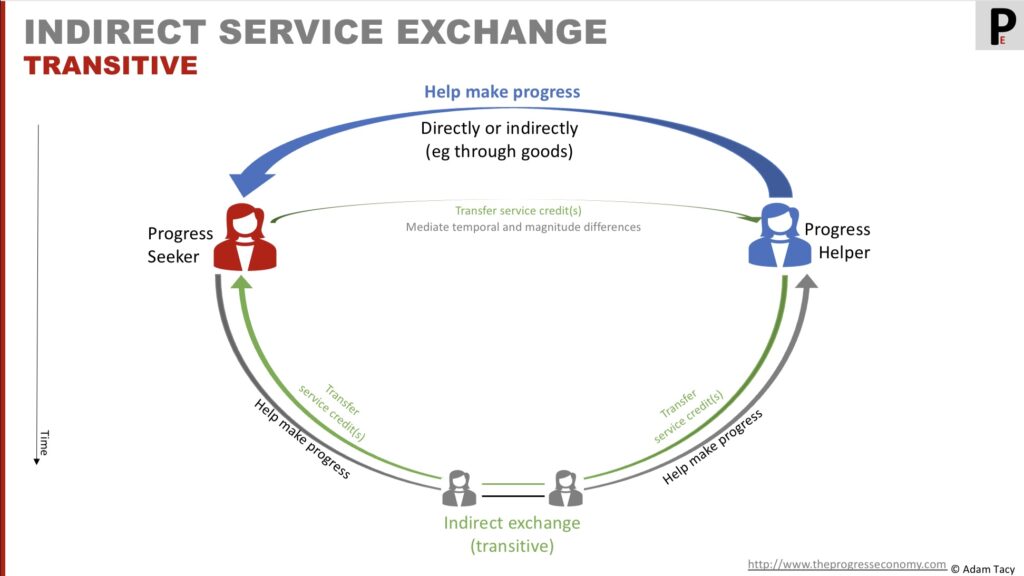
In reality, we would also need to mediate magnitude differences between service involved through service credits.
It doesn’t require all three parties to pre-agree what level of effort is involved with a unit of service credit; but the equitability service exchange progress hurdle brings that alignment.
That gives us another insight into price. Service credits now represent effort a seeker has to put into helping someone else to get the credits required for a service they want.
[A question to, perhaps, resolve later is if transitive indirect exchange is eventually circular]
Distributive indirect exchange – the curious case of goods
The use of goods also mask that service is the fundamental basis of exchange. We’ve already noted above that our current goods-dominant logic puts outputs first. Which implies those outputs (products: goods and services) have value embedded within them. So we exchange that embedded value for other items that have value, typically cash.
Goods, in our service-first world, function as a distribution mechanism for service. Again, service-dominant logic informs us:
Goods are distribution mechanisms for service provision
#3
In practice this means that the application of competence is frozen into goods, allowing it to be transported in time and space. Future acts of resource integration unfreeze those competencies.
A band playing music is a service—musicians applying their instrumental/vocal competences to help others make progress (for example, in enjoying themselves). Their performance can be frozen as a digital file by recording it, which can be distributed as a CD (traditional tangible goods) or streamed over the internet (as an intangible digital goods). When a listener presses play on Spotify or their CD player —a resource integration activity—the performance is unfrozen.
However, in our service-first perspective we see that goods freeze skills and knowledge allowing them to be distributed.
In this perspective, goods freeze skills and knowledge, allowing them to be distributed elsewhere. We still have service as the basis of it is just masked by distributive (often together with transitive) indirect exchange.
For example, pouring a glass of water from a tap/faucet is generally seen as using a service; whereas that bottle of water in the fridge is seen as a product. In the progress economy they are interchangeable resources.
Some services can be frozen, transported, and later unfrozen wherever the Seeker needs them. This is the role goods play in the progress economy. They act as distribution mechanisms for service. We inherit this from Vargo and Lusch’s service-dominant logic:
Goods are distribution mechanisms for service provision
#3
We can discover this by starting with a pure service: listening to your favourite band perform live. The musicians apply their skills and knowledge to their instruments for your enjoyment.
Record that same performance and you now have a goods. That goods might take the form of a vinyl record, a CD, or a digital file ready to stream. By recording it, we now have a form that allows the performance to be distributed to the moment and place you choose to press play on your playback device. When you do, you “unfreeze” the recorded performance and your experience starts/resumes.
This logic extends across all goods. A hammer, for example, freezes the manufacturer’s knowledge of how to drive one material into another together with their skills in creating a goods that can distribute that. When you swing the hammer at a nail, you unfreeze that embedded capability.
The key point here is that goods and service (singular) become interchangeable ways of enabling progress, rather than opposing categories. We get to address Levitt’s marketing myopia by addressing the customer wanting a 1/4 inch hole rather than a 1/4 inch drill. Offering a drill, another type of tool, a handyman, a training video are all ways of helping a Seeker make progress of obtaining a 1/4 inch hole.
There is an implication of this interchangeability. Moving from a relieving to enabling proposition shifts the burden of having the necessary capabilities for using the resource mix towards the Seeker. However, it also increases non-functional progress such as mastery and not being held up. In contrast, moving the other way relieves the Seeker of capability (lowers their lack of capability progress hurdle).
Internal indirect exchange
The third example of indirect masking is found in organisations. Organisations integrate and combine micro-specialisations into a progress helper. By that I mean various departments, assembly line workers, layers of management, etc. When we look, there are often limited, or no, direct service exchanges between these micro-specialisms.
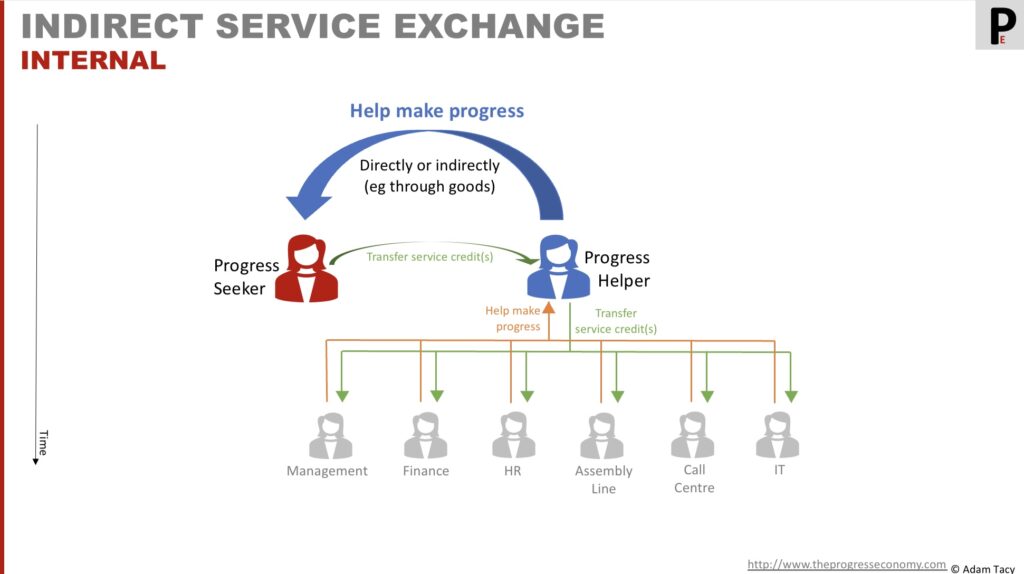
However, when we zoom out we can see a special case of transitive indirect service exchange at play, which we call internal direct exchange.
Each employee/department is applying their skills and knowledge to help the organisation help the progress seeker. Most likely the seeker is giving servce credits to the organisation, which then distributes those across departments/ emloyees.
network indirect exchange
A similar situation to internal indirect service exchange happens in ecosystems – where a group of progress helpers co-ordinate to help a progress seeker. Sometimes behind a progress seeker acting as a façade; sometimes linked from a progress seeker but direct with the seeker (for example external party credit card payment on e-commerce sites).
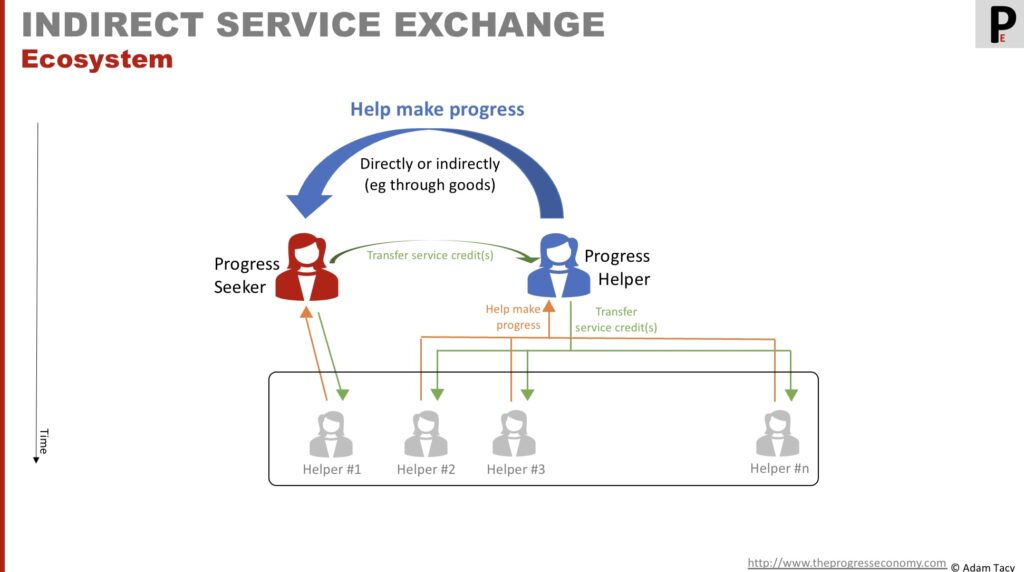
An observable instance of direct exchange in the commercial world is many-party platforms, where each party applying its capabilities to help the other make progress. Apple’s success in the iPhone era rests on a direct, reciprocal exchange with developers. Apple offers tools, APIs, billing systems, platform stability, and global visibility. Developers provide the functionality, innovation, and niche expertise that make the platform compelling and differentiated.
Salesforce and its global consulting partners form another clear example. Salesforce provides the technical platform, brand, and market demand; partners supply the domain expertise, customisation, and integration skills that make the platform usable in real organisational contexts.
In both cases there is also an exchange with end customers – the seeker “buying” an app, or the business purchasing Salesforce licenses – that is an indirect exchange we’ll come to momentarily.
Let’s progress together through discussion…