Tag: ServiceExchange

(re-) Discovering that service is the true nature of exchange isn’t just clarifying, it reveals powerful levers for innovation.


Capabilities

What we’re thinking

The Progress Economy evolves us from value-in-exchange thinking, but everyday you experience handing over cash in exchange for products – is the progress economy fundamentally flawed?

No, it is not. We just need to, again, evolve our thinking a little.

What we actually exchange is service – where service (singular) is defined as applying capabilities to help another actor make progress. This need/possibility for exchange comes about because the distribution of capabilities needed to make progress is uneven across all economic actors. Rather than each actor trying to develop the capabilities they need themselves, it is often easier to get help (service) from an actor that already has those capabilities.

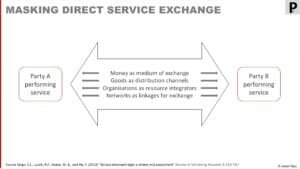
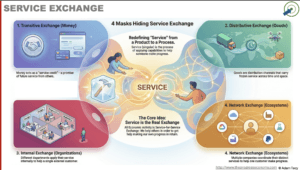
But this direct exchange of service may not happen directly between two actors; it is inefficient to have to find direct matches for every aspect of progress sought. Often the direct exchange is masked by it being indirect

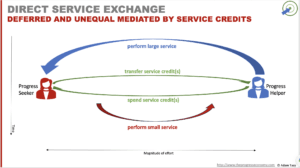
The most common indirect exchange is transitive – I perform a service for actor A but don’t want Actor A’s service, rather I want a service from Actor B. This is enabled and temporal/magnitude differences mediated by service credits – and you might not be surprised to discover that money is a wildly successful implementation of these service credits.

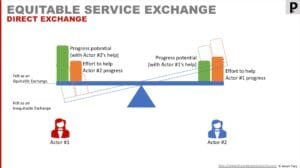
Actors involved in an exchange are keen to believe the exchange is equitable, i.e. the effort they receive in getting help to make progress is sufficiently similar to the effort they give.

Other forms of indirect exchange include distributive – how service is frozen in goods – internal exchange – for example between departments in an organisation- or network exchange – like that between parties in an ecosystem who need to work together to provide the service offered.

Service Exchange captures the outer of 4 layers of contextual hierarchy.

Why this matters

We see price signalling the amount of effort requested in exchange – which may be given in terms of number of service credits – rather than a manufacturers signal of value.

The decision to “buy” (engage a proposition) becomes a balance between progress potential a progress Seeker sees they could possibly make compared to their emotional progress hurdle relating to how much effort in service they need to give (often elsewhere) in order to equitably exchange for the service they will receive.

This opens up business model innovation – subscription, subsidised, freemium etc

  • Context hierarchy

    The progress economy is a hierarchical model of value creation reimagined through making progress. It comprises four key contexts: progress, progress attempts, progress propositions, and service exchange. By understanding progress as the core, resources as fundamental, propositions as solutions, and (mostly) indirect service exchange – helping others progress – as the model fairness, we unlock a dynamic framework for innovation and growth.

    Explore more »

  • Service Credits

    What we’re thinking Service credits are value-less promises of future service representing a measure of effort. They mediate temporal and magnitude differences in service exchange and lubricate transitive indirect exchange. Money is a successful implementation of service credits; bitcoin, shells, rocks have been alternatives. …editing below this point They have no inherent value and can

    Explore more »

  • Service Exchange

    Rediscovering that service is the true nature of exchange isn’t just clarifying, it reveals powerful levers for innovation. What we’re thinking We live in a world where service (singular) exchange – helping others make progress in order to get help making our own progress – is the true engine of economic activity. Yet we comfortably

    Explore more »

  • Equitable Service Exchange

    What we’re thinking Should you pay less is supermarkets when using a self-service checkout? After all, you are putting in more effort compared to using manned checkout. Is making your friend a meal a fair exchange for them helping you move house? Service exchange does not need to be equal; it just needs both parties

    Explore more »

  • Inequitable exchange – a progress hurdle

    THE IDEA Since service is fundamental basis of exchange, helpers expect an equitable level of effort of service from the seeker in exchange for engaging their proposition. A seeker feeling this level as too high is a hurdle to progress. (note that service credits may replace direct exchange of service; in which case the level

    Explore more »