Value recognition
What we’re thinking Value emerges through progress…but is the value that progressively emerges, well, valuable? Or, to put another way, how does a seeker feel to: get 80km of a 100km journey; learn some Mandarin Chinese; half hang up a picture? It turns out the answer is: it depends. Whilst value incrementally emerges as progress is made – from none at progress origin to maximum at progress sought – the progress seeker needs recognise it for it be become something of substance. Like accountants recognise revenue. A seeker’s recognition schedule often differs from when value emerges. It might be milestone…
Equitable Service Exchange
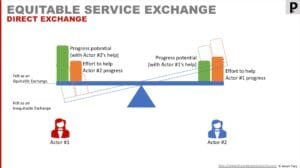
What we’re thinking Should you pay less is supermarkets when using a self-service checkout? After all, you are putting in more effort compared to using manned checkout. Is making your friend a meal a fair exchange for them helping you move house? Service exchange does not need to be equal; it just needs both parties to feel it is equitable. That is to say each party is comfortable the effort they themselves put in to help the other party progress is reflected in their progress potential when engaging the other’s help. In the case of transitive indirect exchange the effort…
Inequitable exchange – a progress hurdle
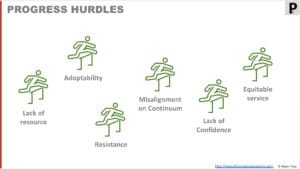
THE IDEA Since service is fundamental basis of exchange, helpers expect an equitable level of effort of service from the seeker in exchange for engaging their proposition. A seeker feeling this level as too high is a hurdle to progress. (note that service credits may replace direct exchange of service; in which case the level of effort must be given in service elsewhere but the seeker’s feeling of magnitude is still the same) Progress hurdles Just a quick recap of progress hurdles, they are: progress hurdles – factors that if felt, uniquely and phenomenologically, by a progress seeker as too…
Lack of confidence – a progress hurdle
What we’re thinking The greater the confidence a seeker has in a progress proposition and/or a progress helper, the lower this progress hurdle is. We’re talking about brands, brand extensions and seeker’s experiences. Editing below here Seekers must have confidence that an offering will assist them in making progress. In both the actual proposition and in the helper. And this usually starts based on the seeker’s individual lived experience. Explore lack of confidence hurdle >> That’s to say, prior interactions with the helper and/or offering, or similar offering, can provide confidence. And if they are now attempting to make same…
Continuum misalignment – a progress hurdle
What we’re thinking We know propositions sit on the progress proposition continuum – between enabling and relieving propositions. A seeker also takes a position for every progress attempt. The further apart those two positions are, the greater the misalignment on the continuum progress hurdle. A seeker looking for a fully relieving proposition will perceive a fully enabling proposition as having a high barrier to progress. Editing below here Our next hurdle concerns itself with the progress continuum. That tells us all propositions fit somewhere between an enabling and a relieving service. The differentiator being who drives the activities. Towards the relieving…
Resistance – a progress hurdle
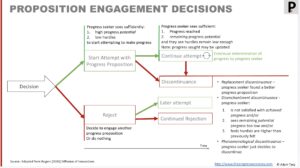
What we’re thinking Not all propositions are going to be welcomed by all seekers. Kleijnen et al identify a hierarchy of resistance – postponement, rejection and opposition, to which we insert none – that we’ll use as the resistance progress hurdle. They also identify factors that contribute to each levels, giving a framework to reduce this hurdle. A seeker’s resistance to a proposition needs to be low enough for them to engage. And it goes hand in hand with the adoptability progress hurdle. Resistance to a proposition Innovation theory is typically built on the premise that all innovation is good,…
Adoptability – a progress hurdle
What we’re thinking We’re leveraging some of Rogers’ innovation adoption theory as a progress hurdle. Specifically his adopter types and his five perceived attributes affecting adoptability of innovations – complexity, relative advantage, compatibility, trialabilty and observability. A seeker has to feel they can adopt a proposition to begin engaging it to attempt progress. This goes hand in hand with the resistance progress hurdle. And a seeker’s adopter type gives an insight into how high they see this hurdle. Adoptability If a seeker cannot envision themselves using your proposition, the likelihood of engagement diminishes, resulting in you missing out on service…
Lack of capability – a progress hurdle
What we’re thinking Often progress seekers lack the resources needed to make progress: skills, knowledge, tools, maybe strength, time, etc. This is the fundamental progress hurdle in the progress economy – the lack of resources progress hurdle. Seekers may be innovative and create new resources, or reuse existing resources in novel ways. Or they may turn to a progress propositions (which offer supplementary resources). Whilst the intention of progress propositions is to reduce this hurdle, they may not fully lower it and may even introduce new lack of resources. Helpers are incentivised to minimise this hurdle by their need to…
Progress Potential
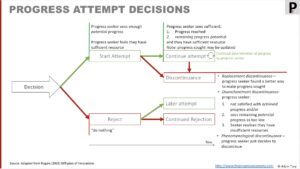
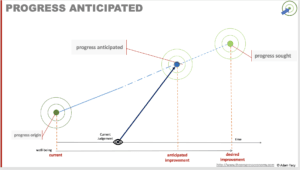
What we’re thinking Progress potential is the progress state that an actor phenomenologically judges, at particular moment in time, could be reached in a progress attempt. It is regularly judged by progress seekers as part of their decision process to start and continue progress attempts, alone or with propositions. Progress helpers predict it for their propositions, where it becomes known as progress offered. And, in some cases, helpers judge progress potential with a particular seeker during attempts, influencing whether they withdraw access to their resources. Since value emerges through progress, progress potential is a prediction of future value. Innovation should…
Progress Reached
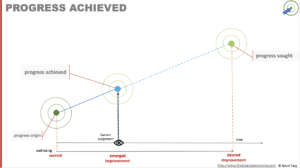
What we’re thinking Progress reached is the progress state that an actor phenomenologically judges to have been reached at a specific point during a progress attempt. These judgements relate to value in two ways. First it indicates how much value an actor feels has emerged by that point. Secondly, we find that for emerged value to be meaningful to the actor, they need to recognise it (like accountants recognise revenue). Predominantly it is the seeker that judges progress reached. Though in some cases a helper may in parallel judge progress reached. They may withdraw from helping if they feel progress…