
Direct service exchange is the natural consequence of the uneven distribution of capabilities across actors in an economy
What we’re thinking
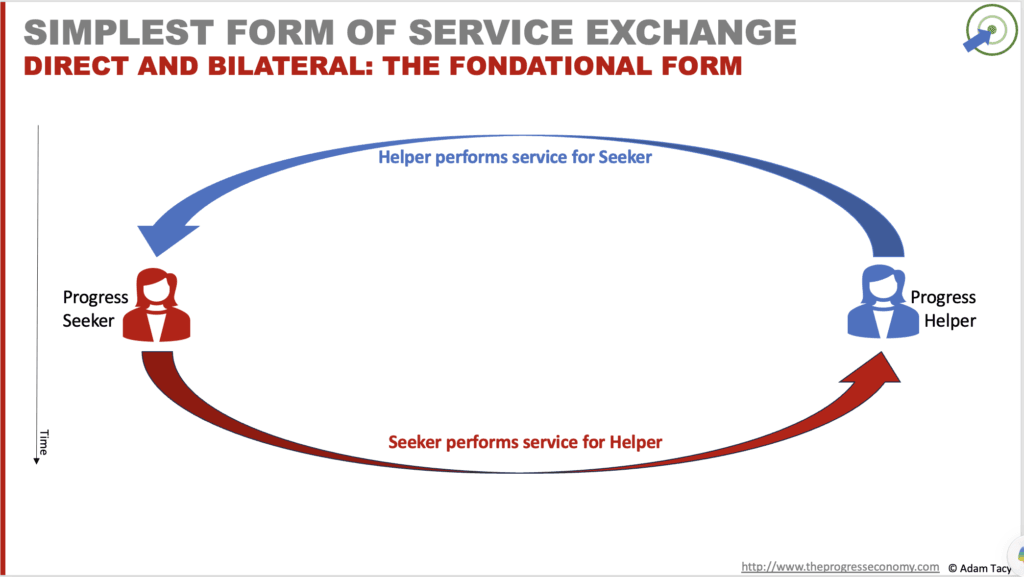
The most basic form of service exchange is direct service exchange: I help you make progress and you help me make progress in return.
The challenges with such a direct exchange are threefold:
- the two involved actors need to discover each other
- they both need to have capabilities matching what the other needs
- both need to agree/accept the others restrictions on when and where the service is provided.
Assuming those are overcome, we need the concept of service credits to mediate differences in magnitude of efforts applied by both actors and any delay in reciprocal service provision.
(Note: the three challenges at the top are addressed through observing indirect service exchange, lubricated by service credits.)
Why this matters
Direct exchange, whilst less observed, sets the foundation for understanding service exchange.
A consequence of thinking in terms of service exchange is that we disengage from considerations of value exchange. Instead, we begin to think in terms of effort applied in provision of service. Price finds a new home. Not as a measure of value, but as an upfront indication of how much effort a Progress Helper expects to be given in reciprocal service for performing their service.
That we accept differences in magnitude of effort reflects our desire for equitable exchange, rather than equal exchange; introducing the inequitable exchange progress hurdle.
Service credits are introduced as a means of mediating temporal and magnitude differences. We’ll later expand the role of service credits to lubricate indirect exchange (finding that value-in-exchanger emerges as masked direct exchange, and money as a successful implementation – but we need to build towards that).
Participating in an exchange becomes a phenomenological decision by both actors based upon equitable exchange, balanced with their individual and phenomenological judgements of progress potential, reached, and achieved. The progress decision cycle is born.
Recap of service exchange
Service exchange is the true driving engine of exchange in our economies (or “fundamental basis of exchange” as Vargo & Lusch put it). It occurs because:
- all actors in the economy are trying to make progress with every aspect of their life
- making progress requires the application of capabilities, and applying those capabilities requires effort.
- capabilities are unevenly distributed across actors in the economy
If you’re jumping in right here, it is worth reviewing what we mean by service – the application of capabilities to make progress – and capabilities – a quality of a resource that is used in making progress, like skills, knowledge, strength, availability, etc.
The simplest form of service exchange is direct exchange, which we explore in this article. Indirect exchange is more commonly observed in modern economies, and it often masks the service nature of economic activity
What is direct service exchange?
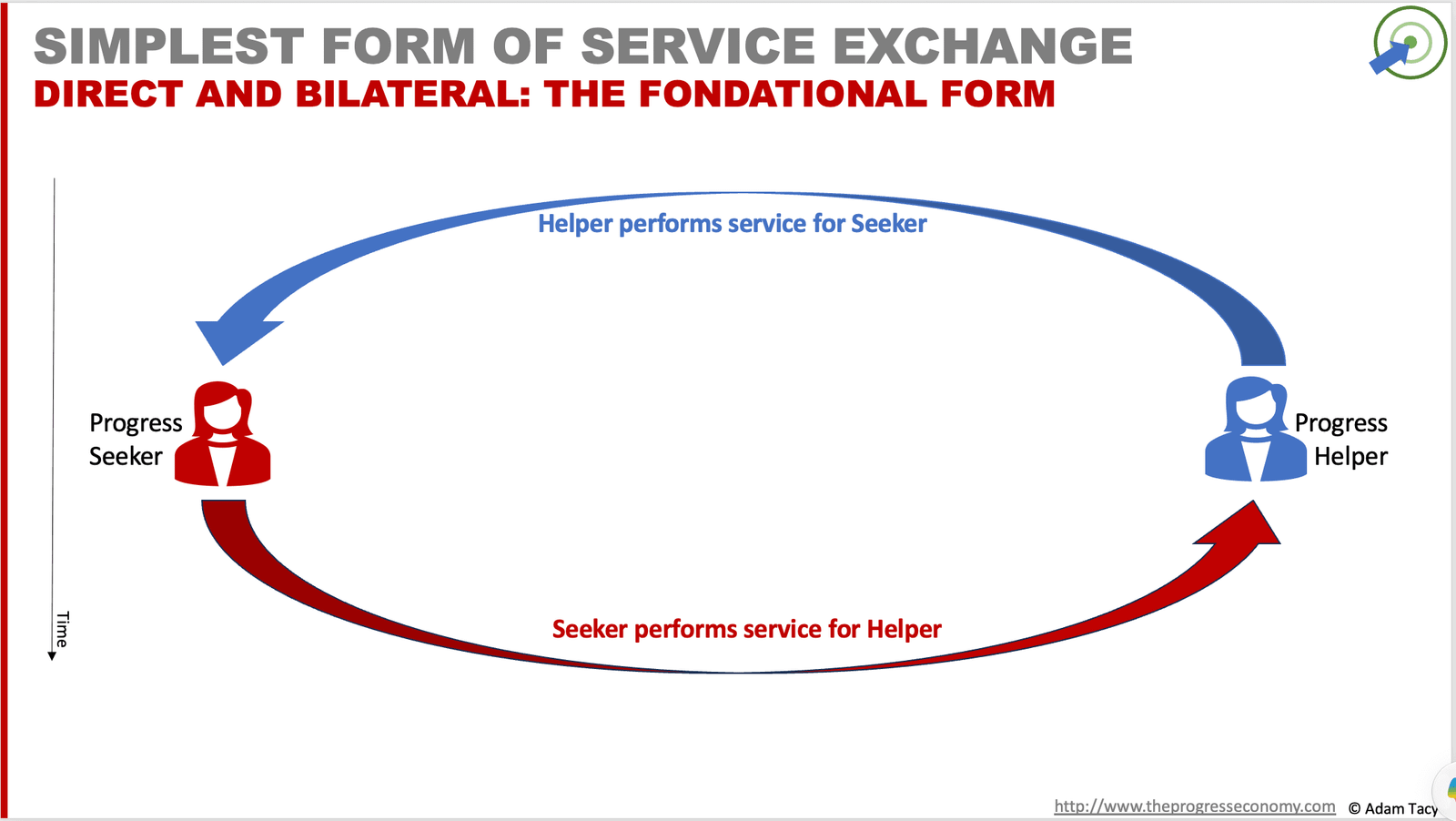
Direct service exchange is a straightforward concept: you help me make some progress, and I help you make some progress (or vice versa, or in parallel). Or more formally: when two actors agree to apply their respective capabilities to help each other make progress.
We can visualise such an exchange with the following diagram:
There are many forms this type of exchange can take.
For example a friend may help another friend move house in return for that friend cooking them a nice meal. Or, an accountant might prepare a digital agency’s accounts in return for the agency building the accountant’s website. Each helps the other by directly applying capabilities the other lacks.
What they exchange need not be, and is unlikely to be, identical in nature, effort or form. One provides accounting expertise; the other provides digital development. What is important is the progress each actor can make with the help of the other, and their view of the effort they have to put in.
Deciding to exchange has two dimensions:
- what is my progress potential if I engage your help?
- what total effort do I need to expend to make my progress and perform the reciprocal service?
For those that are still be tempted to discard service in exchange as a hypothetical that never happens – we, after all, generally believe we experience paying cash for products. We will slowly build up to how this behaviour fits into service exchange perspective. That starts with appreciating some challenges with direct service exchange.
The direct service exchange discovery challenge
Direct exchange brings a discovery problem; the two actors need to find each other, and they both need to have capabilities that match what the other needs.
However, don’t start thinking we are describing a barter economy (if they ever truly existed).
Finding an actor to directly exchange with is challenging, but not impossible. Discovery can be solved in today’s digital world as we see on sites like Fiverr and Etsy where hard to find capabilities are made more visible (although the exchange is ultimately indirect). And indirect exchange, such as transitive exchanges, will considerably reduce this constraint.
How does each actor judge their potential counterpart can help? They judge if their progress potential is increased.
Judging Progress Potential
Let’s say, for now, two actors find each other. They are both offering progress propositions, which are built on helping another actor move from an assumed progress origin to an offered progress sought. A Seeker judges their progress potential with each proposition.
Progress potential is an actor’s unique and phenomenological judgement of how far a proposition could move them towards their progress sought, given their current progress origin and the six defined progress hurdles. To make this judgement, the Seeker compares the:
- proposition’s origin with the Seeker’s current origin
- proposition’s progress offered with the Seeker’s progress sought
- Seeker’s judgement of the heights of the proposition’s six progress hurdles with the Seeker’s maximum acceptable heights
Since this is direct exchange, both actors act as Progress Seekers judging the other as a Progress Helper.
If they both judge the other increases their potential progress from progressing on their own, the first dimension of the engagement decision is fulfilled. They then turn to the second dimension: total effort commitment required.
Judging effort required to make progress
Making progress requires the application of capabilities, and applying those capabilities requires effort.
When making progress independently, without the help of any Seeker in that attempt, we need to use capabilities to which we already have access, or develop those capabilities as part of the attempt. The effort involved is then simply our own.
When we engage another actor through service exchange, our effort commitment has two components.
- effort you must still apply to make progress
- effort you need to apply in giving reciprocal service.
The extent of the first component depends partly on the proposition offered by our Progress Helper. In The Progress Economy, every progress proposition sits somewhere on a continuum between enabling and relieving service, according to who performs the majority of the progress-making activities. An enabling proposition leaves the Seeker responsible for most of those activities, whereas a relieving proposition transfers more of them to the Helper. Even with a highly relieving proposition, however, the Seeker will generally need to contribute some effort of their own to make progress.
Second, there is the effort required to provide reciprocal service. By engaging a Progress Helper, we are also undertaking to help them make progress by applying capabilities they do not possess. Providing that service requires us to commit effort of our own.
An actor’s total effort is therefore the combination of the effort involved in making our own progress and the effort required in helping the other actor make progress (performing the reciprocal service). This may be greater or smaller than the effort we would have expended by making progress independently.
Imagine that you want to renovate your kitchen. You could undertake much of the work yourself, using capabilities you already possess, or engage a carpenter. The carpenter might substantially reduce the effort you need to apply to the renovation, but you have to provide accounting services in return. Depending on the effort involved in both activities, your total commitment could be greater than if you had undertaken the renovation independently.
Importantly, we do not necessarily seek to minimise this total effort. The other consideration in our decision is the progress potential created by the exchange. If engaging a Helper requires more effort from us but offers the potential for substantially greater progress, we may consider that an entirely acceptable proposition. What matters is not simply how much effort we must expend, but whether the progress we expect to make justifies the effort we commit.
So, you might willingly accept that higher total effort because the carpenter enables a better outcome, reduces the time required, or helps you achieve something you could not accomplish alone.
To help actors manage these reciprocal commitments, we introduce service credits. We will build up their use by starting with a simple problem associated with direct exchange: the commitments made by each actor may be fulfilled at different times, creating a need to track them. We will then see how this tracking mechanism can also mediate differences in the effort required to provide reciprocal service, leading us to our definition of price.
Tracking temporal differences
There’s often a temporal gap in a service exchange. I might help you move this weekend, but I might not need your help in return for many months. I might not even know yet when I will need your help in return (or what help).
To mediate these temporal differences, we need a way of recording promises of future service performance. When I perform a service for you, you give me a service credit that I can redeem (with you) for your service provision at a later point in time.
In The Progress Economy, we’ll call these conceptional promises “service credits“.
Our direct exchange diagram now resembles the following figure:
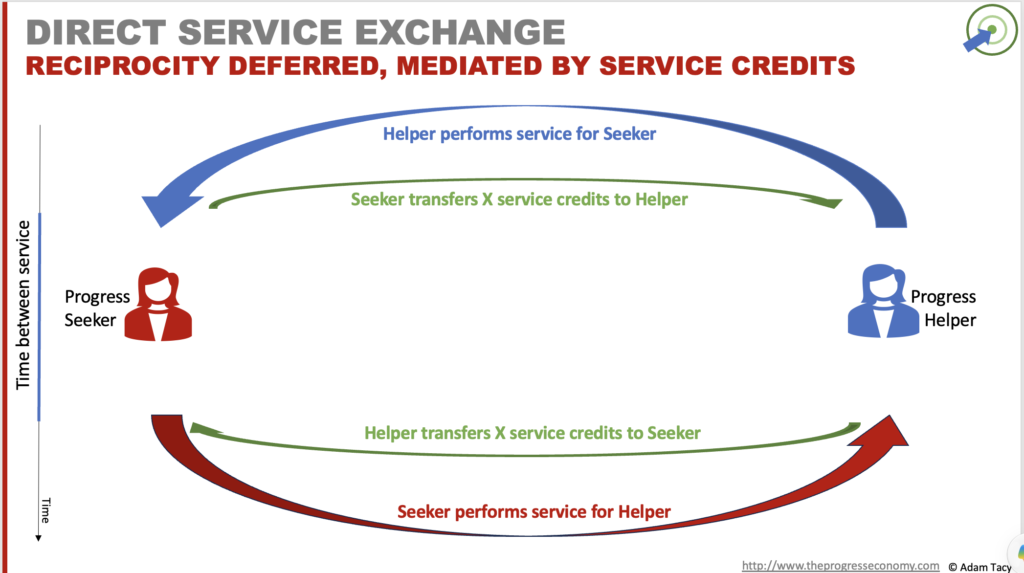
At this point, we are not concerned with how these service credits are implemented. They could be a mental note in both actors’ minds, a physical note on a piece of paper, an entry on a central or distributed register/ledger, to physical tokens (stones, cash, etc), or something else.
The formality of service credit implementation will often depend on the degree of familiarity and trust between the parties, as well as the magnitude and duration of their commitments.
In its simplest form, a service credit records a claim to a future service performance from the actor who has agreed to provide reciprocal service. The credit therefore represents a claim held by one actor and a corresponding obligation held by the other. In direct exchange, the Seeker issues the credit to the Helper when the first service is performed. As we explore indirect exchange, we will see how this arrangement develops: credits are issued centrally, allowing actors to transfer credits they already hold rather than having to issue new ones each time they exchange service.
But not all service performance requires the same level of effort.
Handling magnitude of effort differences
The view that one service credit equals one performance of service breaks down quickly due to views of fairness. Does cooking me a meal equate to helping you move a five-bedroom house?
Not really if we look at the effort involved in performing the service. Helping you move may mean two days of my effort, you cooking a meal, maybe a couple of hours.
How do we handle differences in magnitude of effort?
One way to accommodate differences in the magnitude of service is to agree different numbers of service credits, taking account of the effort involved in providing each service. In our example, we might agree between ourselves that helping you move house earns two service credits, while me cooking a meal for you earns one. The agreed credit allocation recognises the difference in the services provided without claiming to measure their progress objectively.
Our diagram now looks like the following, where there is a balance of service credits.
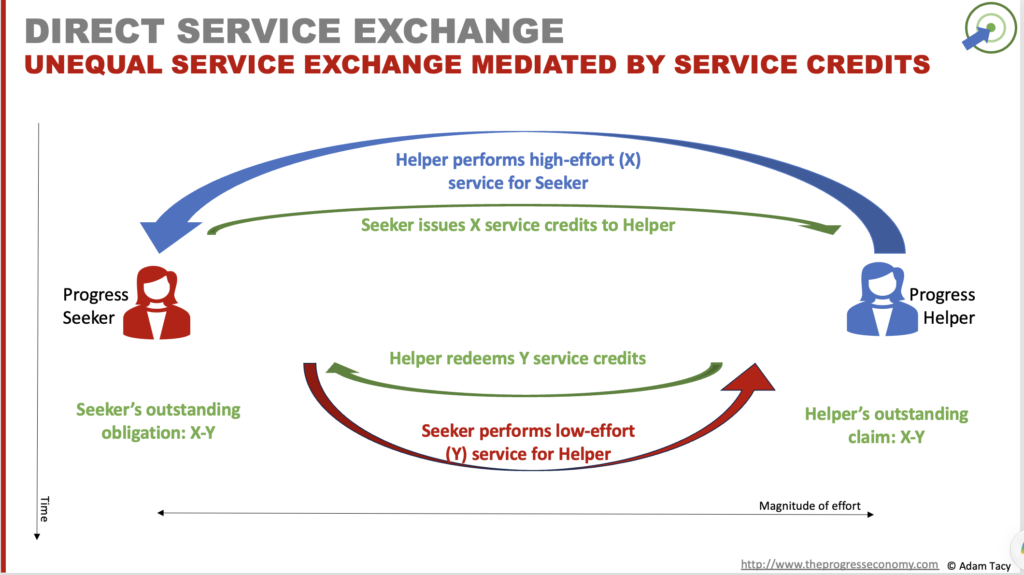
When the Seeker has provided one meal, the Progress Helper still has one service credit left. They can redeem that at a later time for another performance of the service.
Service credits provide a means of recording agreed exchange terms; they do not objectively measure the progress enabled by the service.
Agreeing to recognise differences in effort does not mean that every difference must be accounted for. Actors may recognise that performing one service requires considerably more effort than another and still consider the exchange equitable without adjusting the credits exchanged.
Equitable (not equal) exchange
I’m sure you have helped a friend move before and not worried too much if the return service is a bottle of wine, a home-cooked meal, or the offer to help you move.
Our judgement of whether a service exchange is equitable is phenomenological. The effort involved in providing two different services can be difficult to compare, particularly when the capabilities applied and activities performed are very different. Actors may recognise that one service requires considerably more effort than another, yet still consider the exchange equitable. What matters is not whether the contributions are objectively equal, but whether both actors consider the exchange equitable in the circumstances, taking into account the effort they must commit and the progress they expect to make.
The exchange needs to be felt by both actors as an equitable service exchange. When an actor judges the proposed exchange to be inequitable, the terms themselves can become a progress hurdle – the inequitable exchange progress hurdle – preventing them from engaging with an otherwise attractive proposition.
Cooking a meal in exchange for a weekend of help might seem fair to some friends; other friends might see it differently.
The role of Price
This brings us to the topic of price. In the value-in-exchange view, we saw that price often is interpreted as representing value (McKinsey: “value is seen as the highest amount a customer will pay”)..
In the Progress Economy, price signals the number of service credits a Helper requires in return for applying their capabilities to help a Seeker progress. The price reflects the Helper’s return the Helper expects to receive.
Price therefore expresses the Helper’s terms for providing service, rather than objectively measuring either the effort involved or the progress enabled. The Seeker must decide whether those terms are acceptable, taking into account the progress potential of the proposition and the effort they need to commit in return for help.
This does not require actors to barter one service directly for another. Service credits allow the terms of exchange to be expressed in a common form, which can then be negotiated.
At this point, we are still discussing bilateral exchange; we will have more to discuss about how service credits are issued and redeemed when looking at indirect exchange.
Why direct exchange is less observable
Direct service exchange helps us understand the underlying nature of economic exchange, but it is not necessarily the form we recognise most readily in modern economies. As service credits become transferable between actors, the original bilateral relationship is no longer required. A Helper who has provided service to one actor can use the resulting claim to obtain service from someone else, who may in turn use their credits with another actor.
This is the foundation of indirect service exchange. Instead of requiring two actors to possess complementary capabilities and reciprocal needs, exchange can extend across networks of actors, each applying the capabilities they possess to help others make progress. The reciprocal relationships remain, but they become distributed across multiple actors and transactions.
Money makes this structure particularly difficult to see. We experience paying for a product or service as a one-way transaction: money leaves our account and an offering comes in return. Yet, viewed through the Progress Economy, the transaction represents access to capabilities applied by others to help us make progress. The money we provide enables those actors to obtain capabilities from others, continuing the chain of service exchange.
From the perspective of the Progress Economy, money can be understood as an implementation of service credits: amechanism through which claims arising from service exchange can be transferred and used across a much wider networkof actors. How this works, and how money comes to fulfil this role, is the subject of the next article.
Direct exchange is important because it allows us to see the underlying relationships that become less visible as exchange extends across networks. By understanding its mechanics, we can begin to understand the wider economy as a system of actors applying their capabilities to help one another make progress.
Go to indirect exchange.
Let’s progress together through discussion…