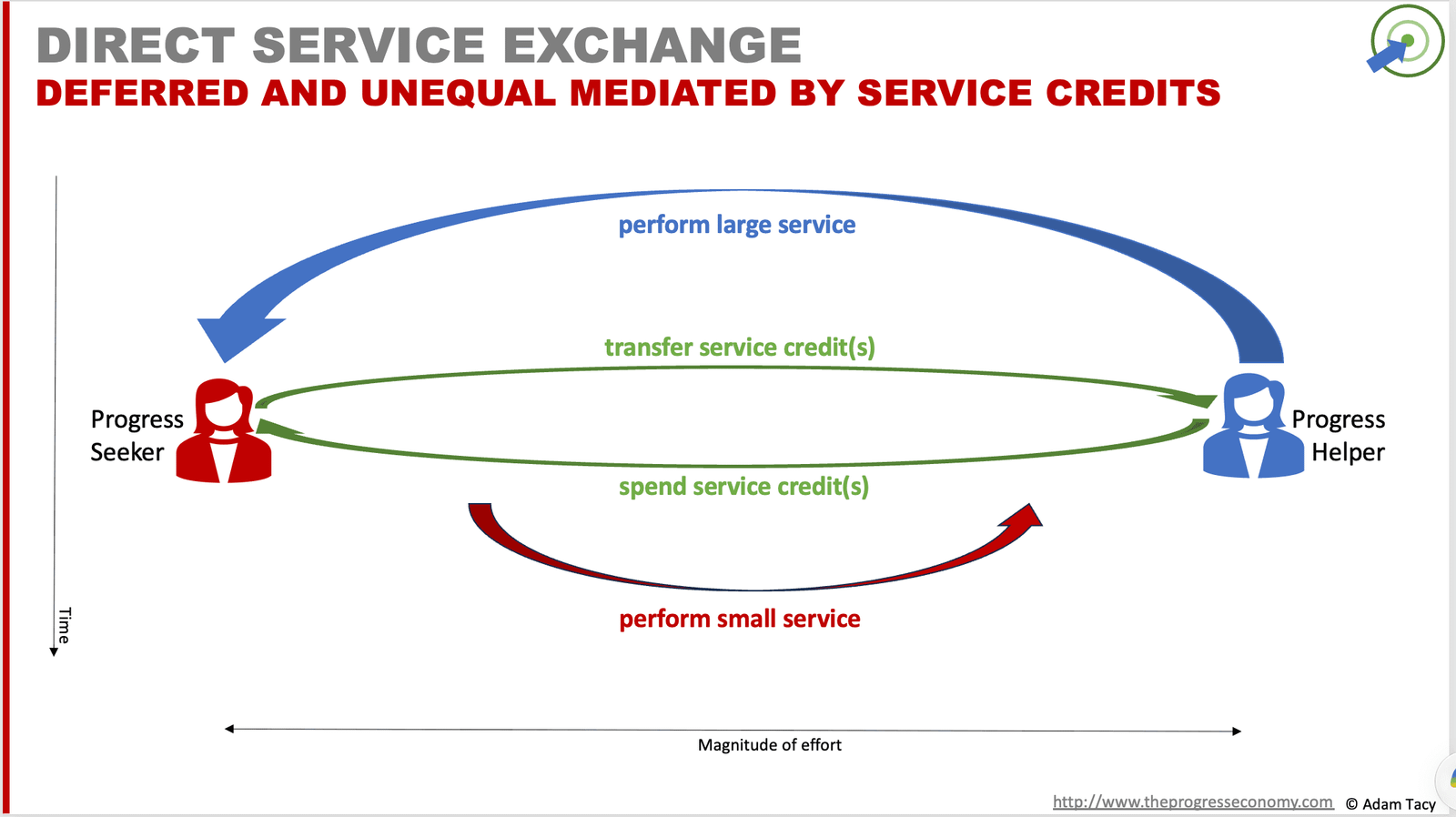

Direct exchange is the natural result of unequal capability distribution; but is rarely observed.
What we’re thinking
The unequal distribution of capability required to make progress drives the exchange of service (application of capabilities to make progress).
It’s most basic form is direct exchange between two parties, however that is less observed in the world.
Why this matters
Understanding direct exchange informs us of how exchange works, why direct exchange is less observed in the wild, and the foundations that allow indirect exchange – which often masks service as fundamental basis of exchange – to occur.
Draft
Direct service exchange is a straightforward concept: you help me make some progress, and in return, I help you with some progress you are seeking.
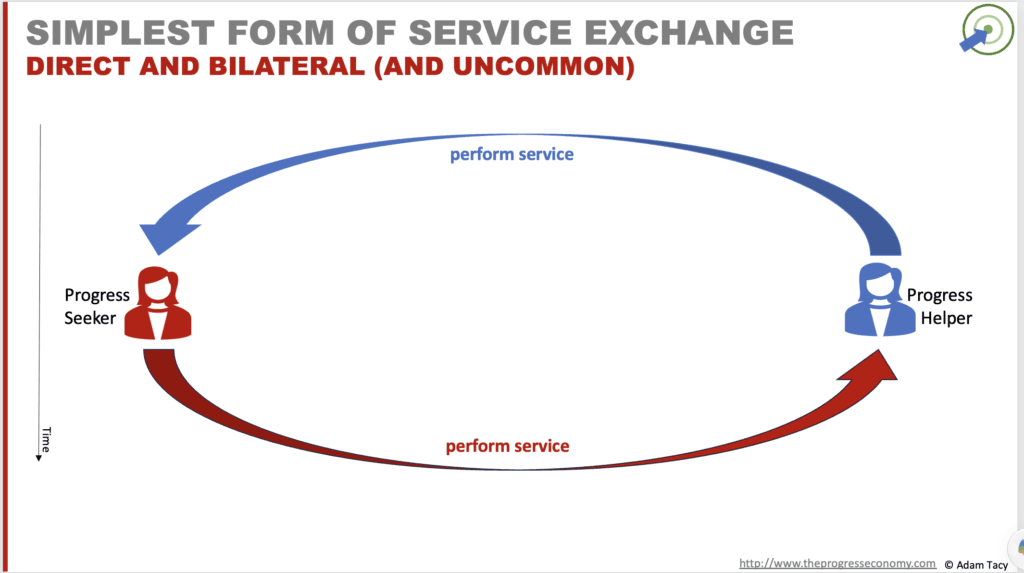
Such a direct exchange relies on individuals having capabilities to swap and them finding each other to engage in this exchange. For example friends helping each other move house, participating in getting rounds of drinks during nights out, or doing favours for others.
Direct exchange also exists in the commercial world.
In particular actors in platforms have direct exchange. Each applying its capabilities to help the other make progress. Apple’s success in the iPhone era rests on a direct, reciprocal exchange with developers. Apple offers tools, APIs, billing systems, platform stability, and global visibility. Developers provide the functionality, innovation, and niche expertise that make the platform compelling and differentiated.
Salesforce and its global consulting partners form another clear example. Salesforce provides the technical platform, brand, and market demand; partners supply the domain expertise, customisation, and integration skills that make the platform usable in real organisational contexts.
In both cases there is also an exchange with end customers – the seeker “buying” an app, or the business purchasing Salesforce licenses – that is an indirect exchange we’ll come to momentarily.
Frist, direct exchange allows us to simply explore to traits of exchange. The exchange might be separated in time and the efforts involved might have different magnitude.
Tracking temporal differences: Service credits as IOUs
There’s often a temporal gap in an exchange. By that I mean I might help you move this weekend, but you might not need my help for months.
To mediate these temporal differences, we need a tracking system – a register of service IOUs. We’ll call these “service credits“. They are promises of future service. When I provide a service to you, you give me a service credit that I can redeem (with you) at a later point in time.
These service credits can take various forms, from a mental note among friends to a formal contract, entries on a central or distributed register/ledger, to tokens/IOU notes you carry with you. The formality of such service credit implementation increases with the level of unfamiliarity or trust required between the parties involved.
Aligning magnitude differences
Simplistically, one unit of service could be represented by one service credit.
But, outside of an altruistic society, that breaks down due to views of unfairness. Does you cooking me a meal (or rather you applying your culinary skills for my benefit) equate to me helping you move a 5-bedroom house?
To answer that, we need to introduce the concept of equitable service exchange. Both parties need to agree that the effort they are swapping is equitable (fair). It doesn’t have to be equal, just fair.
So it certainly could be the case that we both feel you cooking me a meal in exchange for me helping you move is sufficient. It’s clearly not equal; but if everyone involved feels it is equitable, great. Or we could agree that you cooking me 4 meals is equitable, or 2 meals, or some not yet defined future help.
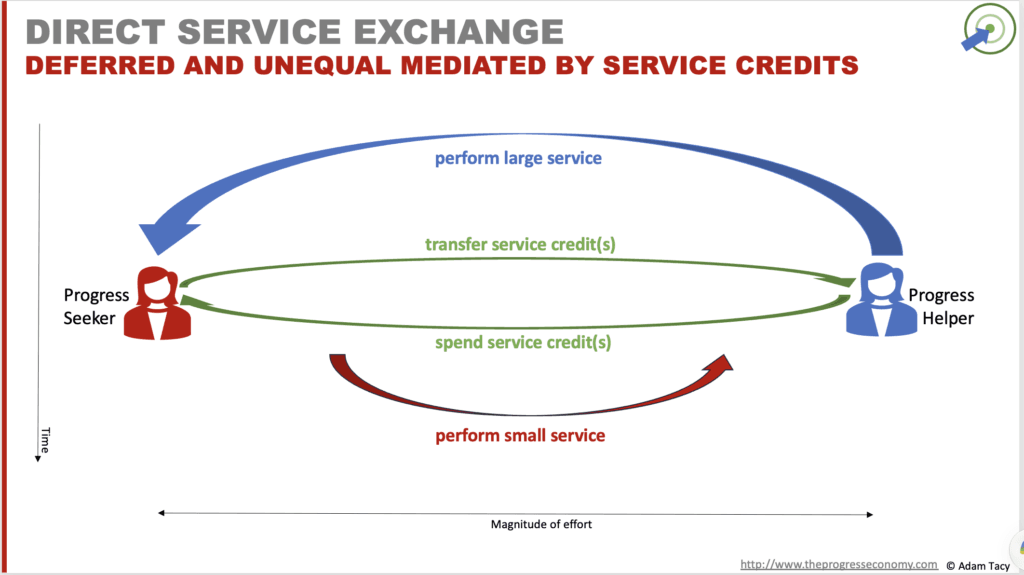
As with temporal differences, we can mediate magnitude differences through service credits. Now we associate a number of service credits with each service being exchanged.
Let’s progress together through discussion…