
What we’re thinking
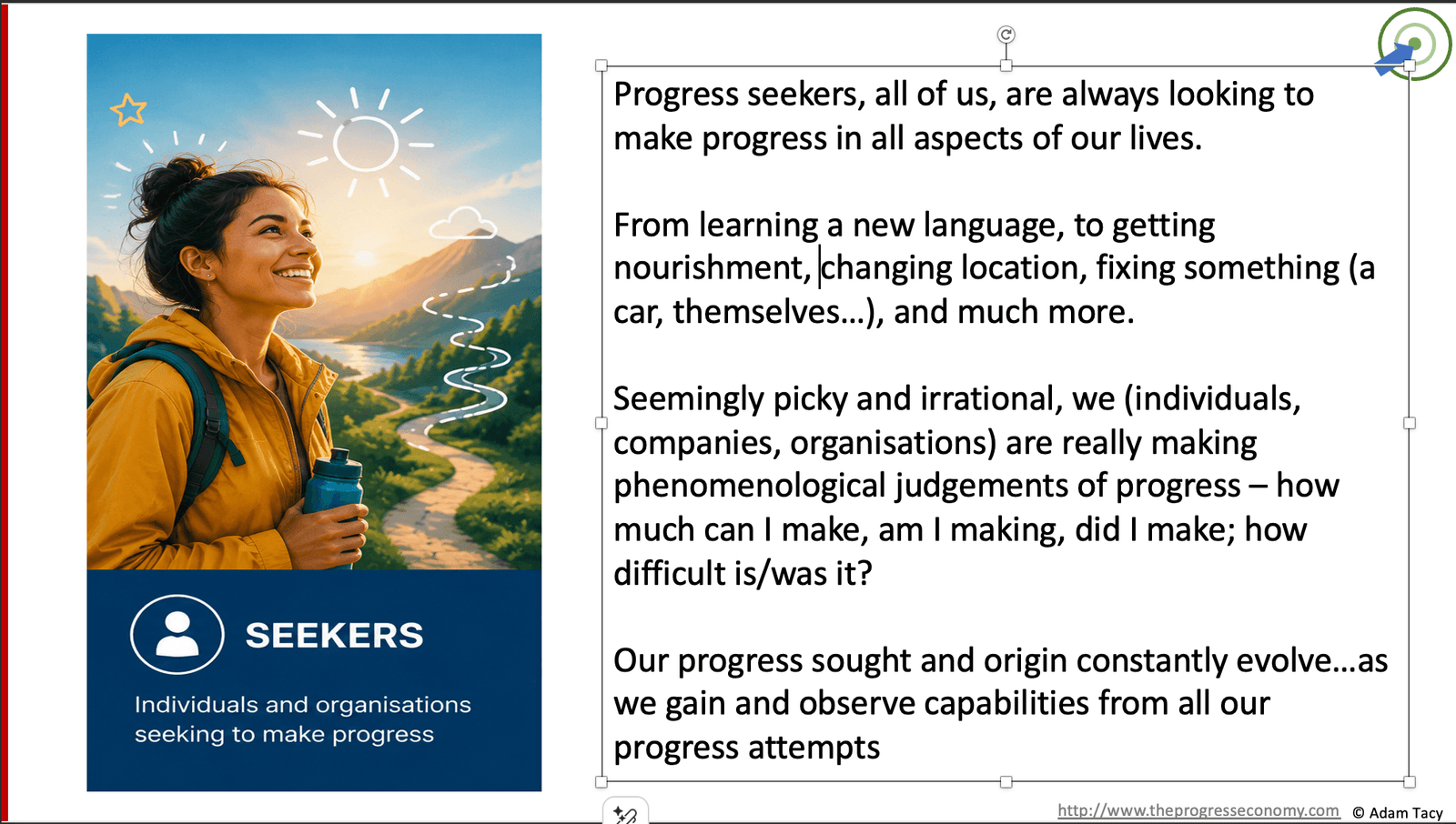
Progress Seekers – often shortened to Seekers – are looking to make progress in all aspects of their life. From learning a new language, to getting nourishment, impressing someone, changing location, fixing something (a car, themselves…), building something, enjoying themselves, and much more.
They are the primary actor in the progress economy – in fact, every actor is a Seeker in some form. Seekers are the predominant judgers of progress and recognisers of improvements in their well-being. These are all phenomenological judgements.
Why this matters
Without Seekers, there is no progress, no judgements of progress, no progress comparisons (which lead to various notions of value), no need for Helpers, no service exchange, no economy.
Seekers determine their progress sought, and journeys to that are defined by the Seeker’s current progress origin. They decide what journeys to attempt, continue, or abandon; as well as if progress can be, is being, and was sufficient to improve their well-being. These phenomenological judgements are why progress looks so different to different Seekers, even the same Seeker on different attempts.
As progress is made by applying capabilities – skills, knowledge, strength, availability, wealth, to name a few – the capabilities a Seeker has is paramount. Lacking the capabilities needed to make a progress journey is the foundational hurdle to the Seeker making progress. They may look to supplement their capabilities with those offered by a Helper’s progress proposition.
What are Seekers?
Customers, Clients, Consumers, are just some of the more generic names organisations use to describe who they are selling to. More specific names are passengers, guests, users, students, patients and so on.
Those names all revolve around the organisation doing something to the recipient. They make the definition repeated to a transaction.
Progress Economy thinking reverses that. The “recipient” is the primary actor. As such, we afford them the name Progress Seeker – or Seekers for short. And all actors in the economy are fundamentally Progress Seekers.
Evolving Role of the Customer
Traditional service literature has largely approached the role of Seekers from a service provider–centric perspective..
Bitner et al “Customer contributions and Roles in Service Delivery” (1997) were among the first to highlight the customer’s active role in shaping service outcomes and influencing their own satisfaction and value received. They identified customers as a:
Bitner et al (1997) “Customer Contributions and Roles in Service Delivery”
- productive resource;
- contributor to quality, satisfaction and value; and
- competitor to the service organization
Their framing presents the customer as a “partial employee of the service provider”, with the provider primarily responsible for delivering the service and the customer contributing as required.
Payne et al introduce us to the concept of “a series of activities” in their paper on “Managing the co-creation of value”, defining them as being performed by the customer.
The customer’s value creation process can be defined as a series of activities performed by the customer to achieve a particular goal.
Payne, A. F., Storbacka, K., and Frow, P. (2006) “Managing the co-creation of value”
Bettencourt, Vargo, and Lusch (2014) expanded this to be a joint approach lead by the customer:
the customer is a job (co-)executor who acts in conjunction with the firm to provide service to get a job done
Bettencourt, Vargo & Lusch (2014) “A Service lense on Value Creation”
This insight evolved in the literature into the broader concept of value co-creation, and, further, aligns closely with job-to-be-done thinking.
Further elaborating on the role customers, are Storbacka and Lehtinen (2001) who see customers having multiple roles:
a customer (payer), a consumer, a competence provider, a controller of quality, co-producers and/or co-marketers.
Storbacka and Lehtinen (2001) “Customer Relationship Management: Creating Competitive Advantage Through Win-win Relationship Strategies”
Finally, Bitner et al’s third point reminds us that Seekers can also be competitors to a helper’s proposition – in that they sometimes chose to do the job (make the progress) themselves. Back to Bettencourt, Vargo & Lush (2014),
While the customer always participates in value creation, the customer can have a more or less active role in the service provision itself….
Bettencourt, Lusch, and Vargo. (2014) “A Service Lens on Value Creation”
…thus, in matching its resources and capabilities, a company must decide where on a continuum of “enabling” to “relieving” service it will be because this impacts the service role of the customer.”
The Progress Economy View
The Progress Economy inverts Bitner et al’s relationship: the Seeker is the primary driver of progress, and the Helper may take on the role of partial or even full employee of the Seeker.
Progress is made by performing progress-making activities. Those activities may be performed by the Seeker, the Helper, or some combination. We interpret making progress as always a joint endeavour. Where the Seeker predominantly judges if progress could be, is being, and was made sufficiently to improve their well-being.
Bitner, Lusch and Vargo’s view of the firm deciding where on the “enabling” to “relieving” continuum it positions its service gains an extra leg in that that determination must align with Seeker wishes/expectations (see Progress Continuum, as well as the Continuum Misalignment progress hurdle).
This matters significantly when designing progress propositions. It is essential to understand which progress-making activities the Seeker can perform (having the capabilities); and, just as importantly, which they want to perform.
Judgements by Seekers are phenomenological – based on lived experiences and current experience, This simply explains why progress looks different to different Seekers. Even why progress looks different to the same Seeker on different attempts. Seekers – you and I – are wonderfully fickle and complicated!
Let’s progress together through discussion…