
What we’re thinking
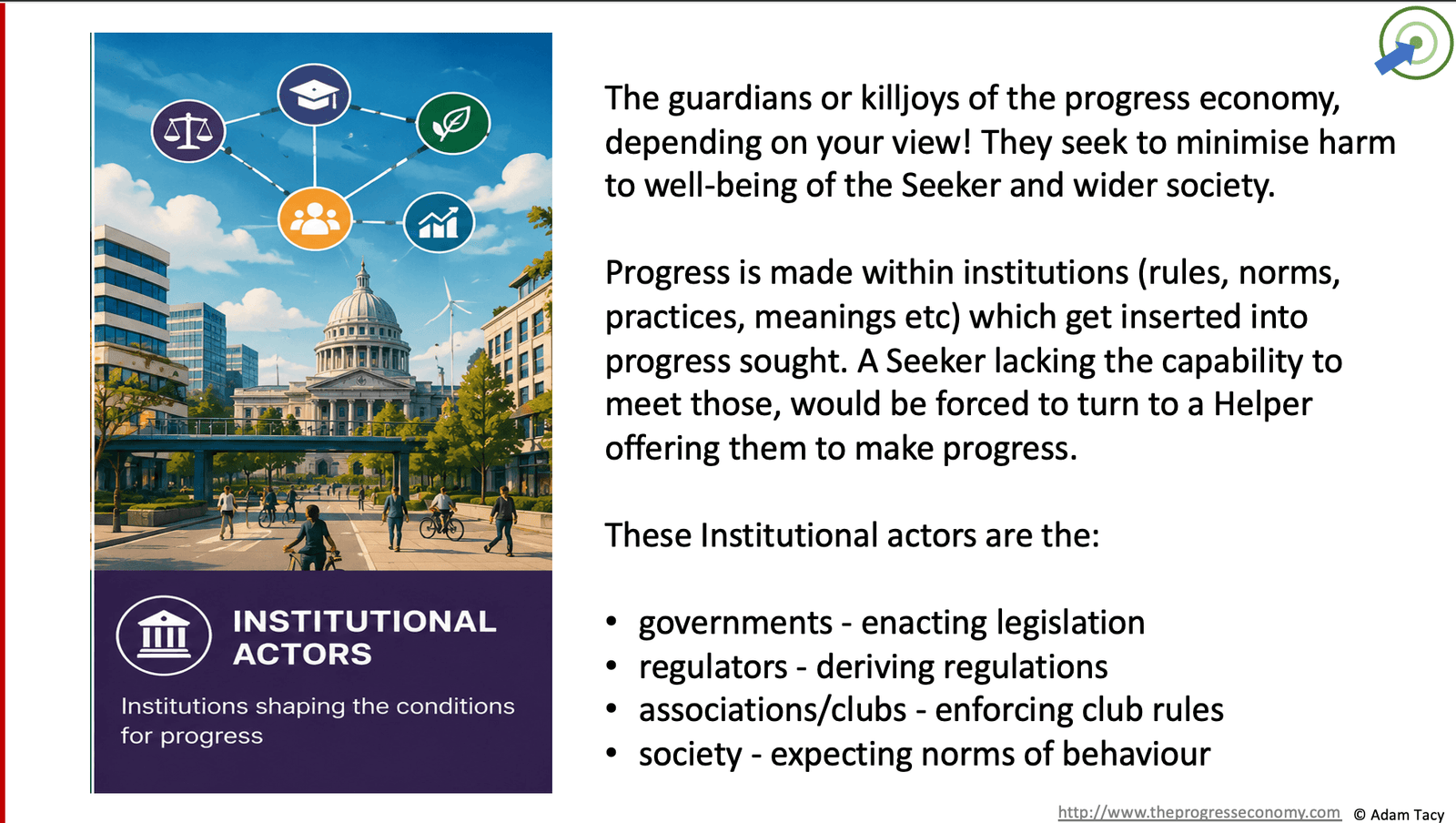
Institutional Actors create, maintain, interpret, monitor, and enforce institutions – “the rules, norms, meanings, symbols, practices, and similar mechanisms that help coordinate behaviour among actors.”.
Why this matters
Left to their own devices, Seekers may pursue progress that has a direct, or accidental, detrimental impact on their own well-being, and/or the well-being of the society in which progress is being attempted.
institutional actors control these institutions, which are considered as injected into a Seeker’s progress sought (note, not into a Helper’s progress offered – the Helper may of course offer the capability to fulfil the institution where the Seeker lacks).
Institutional Actors, and examples of associated institutions, include:
- Legislation, by Governments
- Rules and standards. by regulators
- Licences, qualifications and codes of practice by Professional bodies and associations
- Constitutions, rules, and accepted practices, by a clubs and membership organisations
- Shared expectations and social norms, by communities and society
The last actor shows that Institutional Actors do not need to be a designated controlling body; peers can act together without being centrally co-ordinated to create and enforce institutions.
Example
A Seeker wishes to install a gas boiler to meet their functional progress sought of “being warm” and contextual progress of “at home”.
There is a danger if the gas installation is not performed correctly. Leaking gas may hurt the seeker; that gas exploding may damage institution is that this should be done safely and by a certified gas installer. Government often acts as an Institutional Actor to make law requiring the installation to be by a certified installer; and a trade boy often acts as the Institutional Actor that certifies the engineer – implying they have the necessary skills and knowledge (two examples of capabilities) to perform a safe installation.
The institutions get inserted into a Seeker’s progress sought, Now they seek “being warm” with non-functional progress shaped to include “safe” and context shaped to be “at home, installed by a certified gas engineer”.
If the Seeker is certified themselves, then they have the necessary capabilities to progress. If not, there is a progress hurdle, which can be closed by engaging a Helper offering a resource mix with resources (most likely an employee) that has those capabilities.
Let’s progress together through discussion…