Lack of capability – a progress hurdle

The foundational hurdle. If a Seeker lacks capability they likely struggle to progress. Helpers offer supplementary capabilities in an attempt to lower this hurdle..
Location – a resource mix element
Editing below here Secondly there are those physical resources where progress is made. Such as buildings. The hospital where operations take place, for example. And we can think of elements in this category in terms of Bitner’s servicescapes. innovating physical resources Servicescapes can always be innovated. And often this will be tied to non-functional progress – feelings – though not exclusively. And Bitner’s model highlights plenty of space where we can hunt for ideas. Another large topic of innovation is where we convert goods to physical resources. Shortly we’ll talk about this under the guise of servitization / product as a…
Goods – a resource mix element
Editing below here Goods are examples of operand resources. Remember that in order to make progress with these types of resources, they must be acted upon. They are usually physical, tangible objects. Although we can have digital goods such as digital films, music, and e-books, etc. The distinguishing feature of goods in the progress economy is that ownership of them is permanently transferred from the progress helper to the progress seeker. And it is important to appreciate that goods are simply another component of the progress resource mix. We don’t see any goods vs services debate (as we do in traditional thinking).…
Data – a resource mix elementData –
Editing below here
Systems – a resource mix element
Editing below here When we talk about systems in the progress resource mix, we’re once more referring to outward-facing systems rather than internal. That is, systems with which seekers interact in order to attempt making progress. The new client interfaces of the updated den Hertog model above. And we find that systems can be either an operant or an operand resource. For instance, a word processor is a system acting as an operand resource. It needs to be acted upon to make progress (“be valuable” if we allow ourselves to be lazy with definitions for a moment). Whereas a telephone…
Employees – a resource mix element
What we’re thinking Employees are the human resources of the helper. As operant resources they act on other resources in an attempt to make progress. Some employees may be offered in the progress resource mix, such as: nurses, teachers, cleaners, traffic wardens, consultants, sales team and so on. Typically the capabilities carried by employees leveraged in resource integration progress-making steps are their skills and knowledge. But can also include physical capabilities like strength, or the network the employee has etc. editing from here Employees – carriers of capability Employees are one of two operant resources a progress helper might offer…
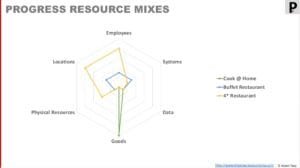
Progress Resource Mix

The main component of a proposition is the progress resource mix – some combination of employees, systems, data, goods, retained goods, and locations.