fixing innovation
re-firing growth
Beyond Value Podcast:
The Progress Economy
» Stop asking “how do I add value?”
»Start asking: “how do I enable better progress?”
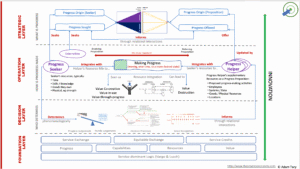
progress » progress attempts » progress propositions » progress economy
The Problem
» Growth is stalling
» Innovation is failing
» everyone agrees that innovation drives growth
» you’re investing more in innovation than ever…yet you’re getting less growth
» your teams are out there selling…but you’re missing growth expectations
» you’re not alone…something is structurally wrong
» the very concept that has driven our previous explosive growth – chasing value – has structural limitations that are now holding us back
The world is facing a decade of stagnation — the “Tepid 20s”.
International Monetary Fund
Only 6% of executives are satisfied with their innovation initiatives
McKinsey
few suppliers…are able to answer…how you define and measure value?
Anderson and Narus
The Needed Shift
» From adding value
» To improving well-being
» …through enabling progress
…value really emerges for customers when goods and services do something for them
Grönroos, C.
Value creation is ultimately about improving the well-being of actors.
Vargo & Lusch
Progress: moving, over time, to a more desired state (operationalises improving well-being)
The Progress Economy
» embedding value is an incomplete map; to a destination we struggle to define, agree and measure.
» it’s time for an evolved approach: a shift to value-in-use thinking, where we don’t add value, we offer to improve well-being
» and we operationally do that by enabling better progress
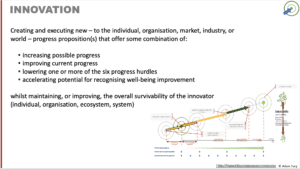
» progress reveals a clear operating system of our world, an actionable definition of innovation, and a set of levers to systematically drive innovation and sales activities
» value? that is comparisons of well-being, made before, during, and after progress
» welcome to The Progress Economy
» executive implications
CEO
signature question: “Are we helping Seekers make better progress than anyone else?”
➠ align your organisation’s vision, purpose and narrative around enabling (better) functional, non-functional and contextual progress rather than producing outputs
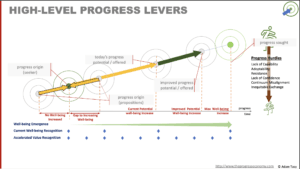
➠ push closer to what customers really want: reaching their progress sought, with six lowest progress hurdles and quickest progress recognition
CMO
signature question: “Do our Seekers clearly see how our propositions help them make meaningful progress?”
➠ improve your organisations capability to identify customers’ progress sought and progress origins; transition messaging from product benefits to the progress your organisation helps make
➠ helping reach progress sought = max value for customers; but that progress sought (and starting progress origin) constantly evolve: innovate or die
CInO
signature question: “How can we innovate continuously to enable better progress for Seekers?”
➠ organise innovation and R&D around i) helping customers make better progress and existing progress better, ii) reducing one or more of the 6 progress hurdles and iii) accelerating their progress recognition schedule (that they interpret as a view on value)
➠ apply the progress levers to move innovation/product design from a game of chance to systematic success
COO
signature question: “Is our organisation operationally configured to enable progress efficiently and effectively?”
➠ design operations to deliver and adapt propositions that meet constantly evolving customer origins and progress sought
➠ implement a Progress Owner role – a supercharged product owner, responsible for i) understanding customers’ evolving progress origin/sought, ii) improving customers’ progress (innovation), and iii) executing progress proposition(s) (execution)
CFO
signature question: “Are we enabling the organisation to perform marketing, innovation and execution to the highest possible manner, sustainably and equitably?”
➠ reframe investment around cost-to-enable-improved-progress and maximising service exchange – size * number – though often through service credits (typically in the form of money)
➠ open the door to business model innovation
the purpose of an organisation is to attract service exchange (to help it reach its progress sought)…as such, it has three, and only three functions: marketing, innovation and execution
» case studies
Enabling the circular economy
The circular economy will only take off once we change our view of value (as in the Progress Economy) …more »
Self checkout – profit over progress

Progress thinking helps us understand why self checkouts are failing (and where they suceed) …more »