Deciding to engage a progress proposition
Editing below here. Understanding why and how a progress seeker decides to engage with a progress proposition – the engagement decision process – is critical to unlocking growth and innovation. Knowing the hurdles, for example, gives us a zone for innovation to reduce them. Comfortingly, our engagement decision process builds on top of the progress decision process. It is still a two-phase process. The first phase is to decide to engage. Then there are continuous decisions to keep engaging. And these decisions are still based on progress seekers’ unique and phenenological determinations: However, there are two differences: Four of these…
Deciding to make progress
Editing below here The progress decision process identifies the decisions a progress seeker makes, and when, as they attempt to make progress on their own. That is to say without the help of any progress propositions. (For the more impatient…the engagement decision process builds on this process reflecting that progress propositions introduce additional progress. Reducing progress hurdles is a hunting ground for innovation). The decision process flows directly from our definition of progress. Which is: progress – moving, over time, through a series of activities, to a more desirable state Where progress seekers attempt to make progress through a series…
Understanding Progress
Anchor your thinking around Seekers’ progress and minimising progress hurdles, and you will outperform on innovation, sales, and growth, compared to those stuck on product features and focusing on value. What we’re thinking Progress – moving over time to a more desired state – is a new philosophy for understanding how the world works, solving the challenges our traditional value-first view gives us. Imagine a world where innovation lands, sales resonate, and growth accelerates – not because we focused on value, which is surprisingly hard to actionably define, but because we focus on what we are truly looking for: progress. Value, it…
Tag: Progress
Anchor your thinking around Seekers’ progress and minimising progress hurdles, and you will outperform on innovation, sales, and growth, compared to those stuck on product features and focusing on value.
What we’re thinking
Progress – moving over time to a more desired state – is the new philosophy for understanding how the world works, solving the challenges our traditional value-first view gives us.
Imagine a world where innovation lands, sales resonate, and growth accelerates – not because we focused on value, which is surprisingly hard to actionably define, but because we focus on what we are truly looking for: progress. Value, it turns out, emerges from progress comparisons.
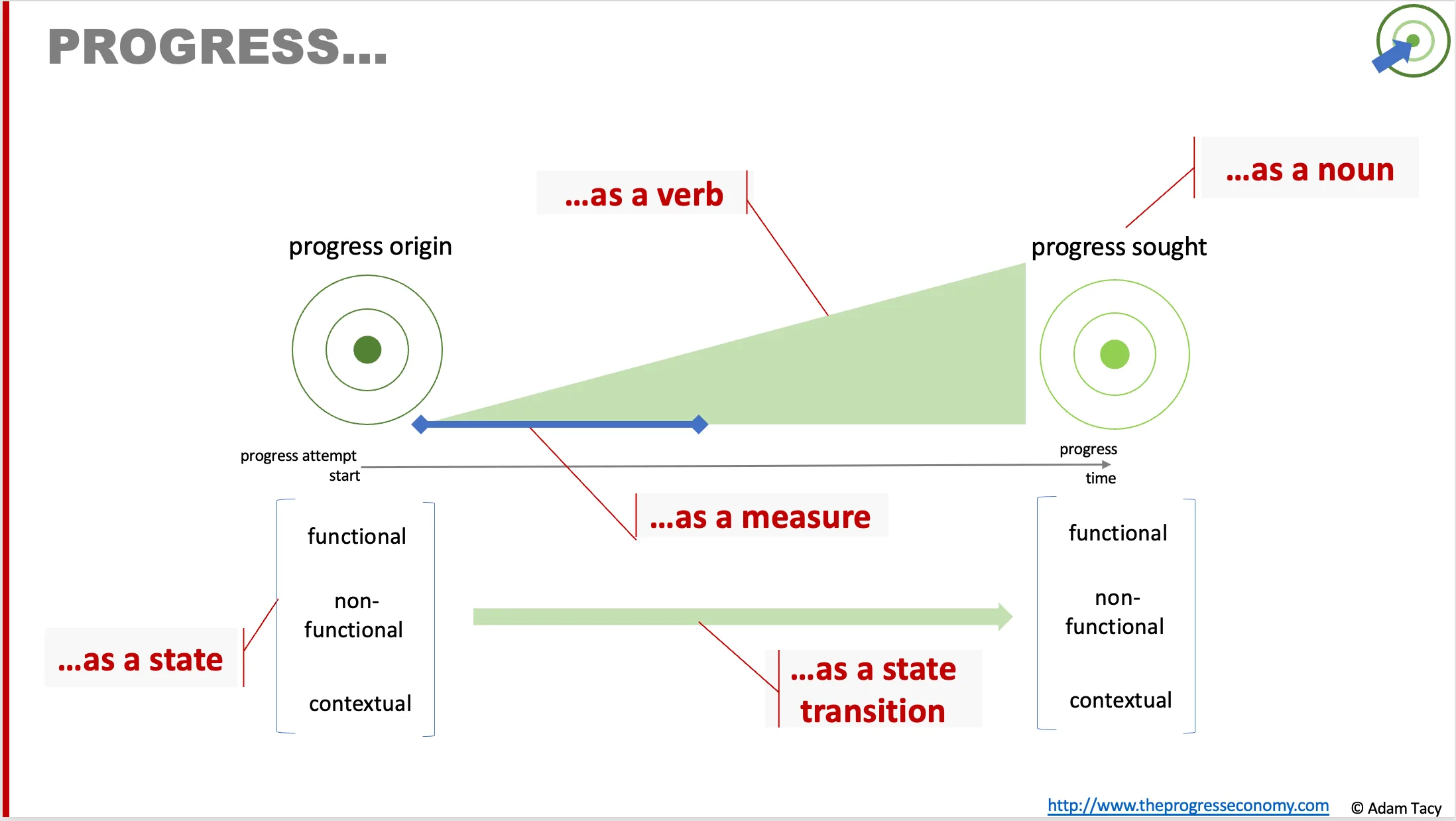
Progress is the beating heart of the progress economy. We’re all trying to make progress in every aspect of life: with our bodies, possessions, mental state, information, and intangible assets. We seek to get fitter, move faster, fix things, learn more, travel, reach goals – or simply get through the day more effectively. Progress is everywhere.
It is a:
- state comprised of three dimensions: functional, non-functional, and contextual/li>
- verb – moving over time to a more desired state
- state transition – an alternative way of looking at progress as a verb
- noun – it’s beneficial to name several states, such as progress origin, progress sought, progress offered, progress reached, progress potential
Why this matters
This framework reveals the engine behind everything from Jobs-to-be-Done and Christensen’s Innovator’s Dilemma, to Blue Ocean Strategy, Drucker’s innovate or die, Levitt’s warning of marketing myopia, the why behind Agile, and how to minimise the blind spots in our traditional value-in-exchange model (such as circularity); and much more.
Progress gives us the clarity and tools to better uncover innovations, craft sharper go-to-market strategies, and build offerings that resonate more deeply with the people we serve.


