Tag: HelpingProgress

Stop asking “What product should we build?” and start asking “What capabilities do our customers lack that hinders them making progress they seek, and how can we package those into the resource types they are looking for?”


Capabilities

What we’re thinking

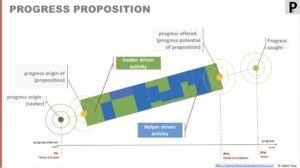
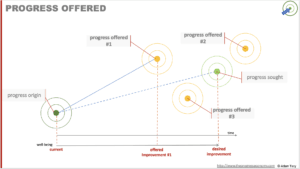
When a Seeker lacks some or all capabilities needed to make a progress attempt, they may look to engage a progress proposition – a collection of supplementary capabilities.

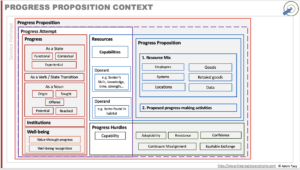
Helping make progress captures the 3rd of 4 layers of contextual hierarchy.


Propositions consist of:

  • proposed set of progress-making activities (perhaps better recognised as instructions, recipe, manual etc
  • proposition specific collection of capability carrying resources (employees, systems, data, locations, goods, physical resources)

Propositions sit on an enabling-relieving continuum reflecting who will perform the majority of the progress-making activities

Why this matters

A proposition introduces five additional progress hurdles – adoptability, resistance, lack of confidence, continuum misalignment and inequitable exchange. All of which the Seeker needs to judge are low enough to engage the proposition. This is reflected in an updated decision process.

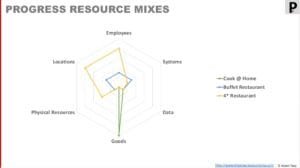
Posiiton on the continuum usually informs the resource mix, with, for example, reliving propositions being heavier with employees/systems and enabling propositions heavier with goods/locations

Altering progress-making activities, position on the continuum, or the resource mix are all innovation levers.

  • Context hierarchy

    The progress economy is a hierarchical model of value creation reimagined through making progress. It comprises four key contexts: progress, progress attempts, progress propositions, and service exchange. By understanding progress as the core, resources as fundamental, propositions as solutions, and (mostly) indirect service exchange – helping others progress – as the model fairness, we unlock a dynamic framework for innovation and growth.

    Explore more »

  • Deciding to engage a progress proposition

    Editing below here. Understanding why and how a progress seeker decides to engage with a progress proposition – the engagement decision process – is critical to unlocking growth and innovation. Knowing the hurdles, for example, gives us a zone for innovation to reduce them. Comfortingly, our engagement decision process builds on top of the progress

    Explore more »

  • Exploring Progress Proposition

    Stop asking “What product should we build?” and start asking “What capabilities do our customers lack that hinders them making progress they seek, and how can we package those into the resource types they are looking for?” Savvy leaders unlock sales, innovation, and growth by repeatedly and purposefully aligning their proposed resource mix and progress-making

    Explore more »

  • Progress Proposition Continuum

    Seekers look to be enabled, relieved, somewhere in-between; propositions are enabling, relieving, somewhere in-between. The positions tells us a lot about non-functional and contextual progress, progress hurdles and successful resource mixes. Understand the position of your Seeker and your proposition on the proposition continuum – innovate to close the gap, or, slide along the continuum

    Explore more »

  • Progress Resource Mix

    Enterprises/ecosystems offer a mix of resources for a seeker to integrate with when attempting to make progress. This service mix comprises a specific combination of: goods, physical resources, systems, and people. Altering the blend of the service mix is a source of innovation.

    Explore more »