Putting Progress Attempts in Context

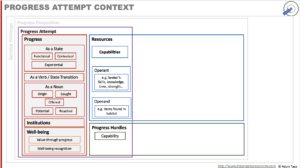
This context builds on the progress context to describe how Seekers attempt to make progress.
Lack of capability – a progress hurdle

The foundational hurdle. If a Seeker lacks capability they likely struggle to progress. Helpers offer supplementary capabilities in an attempt to lower this hurdle..
Progress Attempts
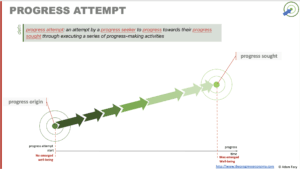
Seekers make progress attempts – a series of progress-making activities – in order to make their progress journey.
Capabilities – the power behind progress
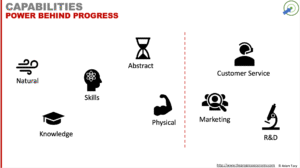
Capabilities – like skills, knowledge, availability, strength – are the power behind progress: better capabilities, better progress; lacking capabilities is the foundational progress hurdle.
Resources – carriers of capabilities
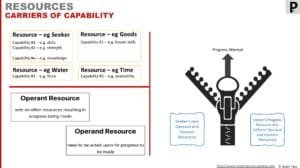
Resoures carry capabilities; and one resource may be swapped for another if it carries the same capability (for example, an AI system for a compliance tam).
Operant Resources
Operant resource – such as people – act upon other resources in order make progress. In many cases they are the source of competitive advantage.
Operand Resources
Operand resources need to be acted upon in order for progress to be made.
The Progress Economy
your new operational model for innovation and growth
»
MakingProgress
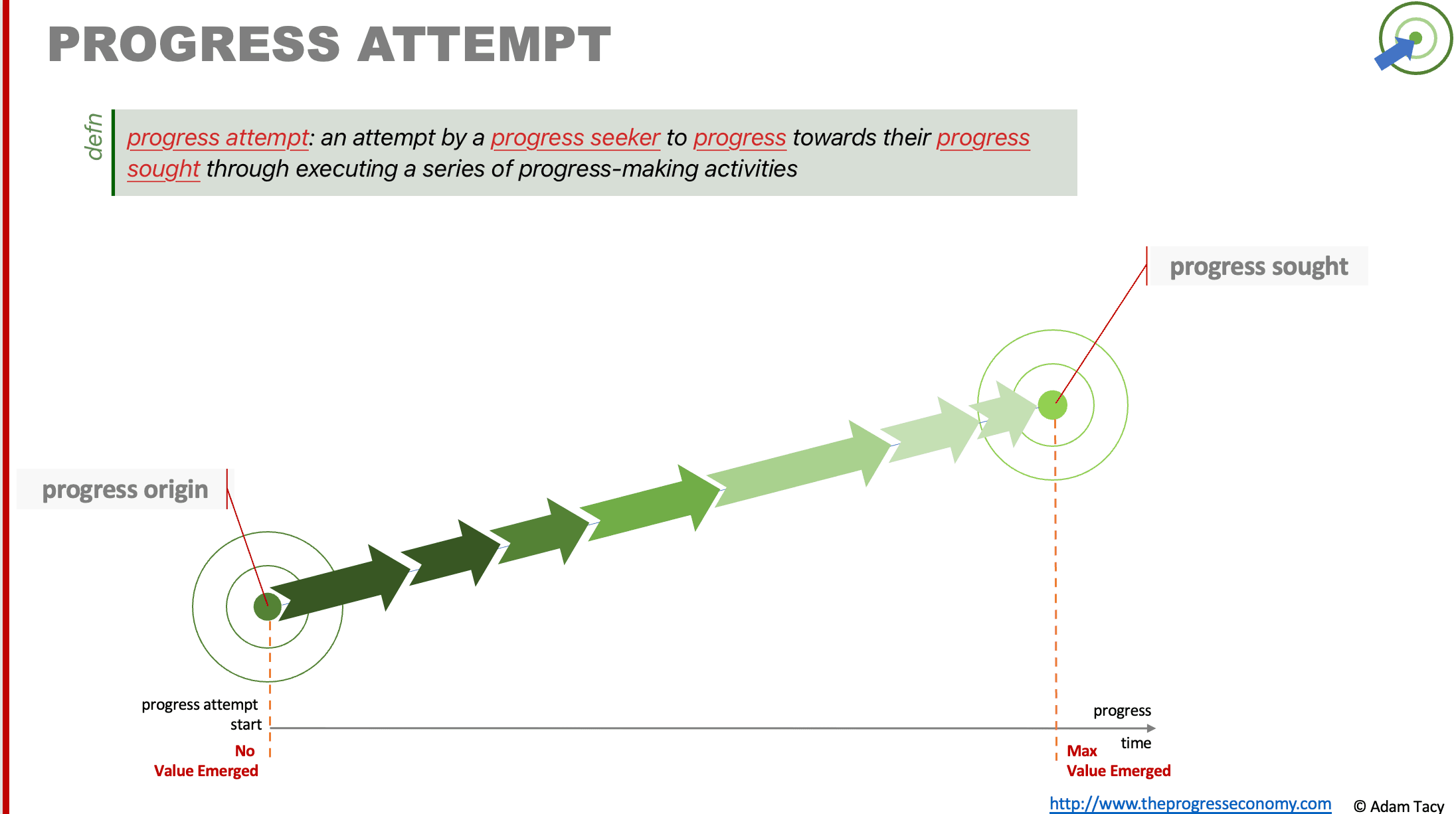
Seekers attempt to make progress to their more desired state, from their current origin, by integrating capability-carrying resources – including the Seeker – in a series of progress-making activities.
At least one resource must act on other resources in order for progress to be made. That resource(s) is classified as an operant resource. In most cases, the Seeker fulfils that role (recall at present we are talking about the Seeker making progress without any help in this section). The resources that need to be acted upon for progress to be made are classifies as operand resources..
This distinction between capability and resources highlights an important principle. Resources matter not because of what they are, but because of the capabilities they carry. A tool, technology, service, employee, partner, or process is valuable only insofar as it contributes capabilities needed for progress making.
As a consequence, resources are often substitutable. One resource can replace another provided it carries the capabilities required for the task at hand. A customer may substitute software for labour, automation for expertise, or a service provider for internal resources. The physical resource changes, but the capability available to the progress-making system remains largely the same.
Difficulties making progress arise when the necessary capabilities are not accessible to the Seeker. In such circumstances, the Seeker faces an increased capability hurdle. Something that Progress Helpers try to reduce when helping make progress.