
To minimise the limitations chasing value brings we need to offer to improve well-being, that is to say “how do we enable better progress?”
Editing below here
What we’re thinking
We’ve identified solving our innovation problem requires a mind shift from chasing added value to improving well-being by enabling better progress. But what does that mean?
Why this matters
Our progress-first definition of innovation:
- resonates with what customers (and, in general, all actors) want – an increase in well-being
- operationalises the act of innovation – progress gives us the language, progress levers give us the tools
- provides valuable insights into decision making – well-being is judged via comparisons of progress
Now we can design for improved progress rather than depend on chance. Turning Christensen’s call to “compete against luck” into a practical reality.
The real question for innovators is “how do we help Seeker(s) make better progress?”
Innovation: Enabling progress
Our traditional definitions of, and approaches to, innovation are based on “adding value”. Here, for example, is the International Standards Organisation’s (ISO) 2025 definition:
Innovation: new or changed entity realizing or redistributing value
ISO 56000 (2025) – Innovation Management – Fundamentals and Vocabulary
I would imagine your definition is (currently) similar.
This value we are adding, realising, redistributing, is seen through the value-in-exchange model. Here, value is progressively added during the manufacturing process, exchanged at a point of sale, and then used-up/destroyed by the end customer.
That has been a wildly successful model; building industries and economies.
But it has many blindspots that are increasingly impactful on our innovation efforts. And others have argued value itself is difficult to define and agree upon.
Given these points, it should not be surprising that our innovation activities – when focussed on chasing added value – lead to our innovation problem (where 94% of executives are not happy with innovation initiatives). Sadly, we often accept this problem, since “innovation is hard”.
What we need to do is think and act differently. Instead of chasing added value, we should chase improving well-being.
Increasing Well-being vs value
Well-being is a state of mind. Improving it shifts us from a value-in-exchange model thinking – a goods dominant logic – to one based on service-dominant logic. We are concerned with achieving outcomes not outputs.
We cannot exchange well-being, so we have to think differently. Increasing well-being invites a collaborative journey approach. Measuring it may be abstract – becoming happier – or more concrete – moving 100km. Innovation naturally evolves to finding ways to increase well-being beyond what is possible today.
(high level) innovation outcome: increasing well-being that was not previously possible
Though I suspect at this point you might be questioning how is this a better definition than chasing “adding value” which I’ve criticised.
To answer that, I need to bring the notion of improving well-being is made by moving towards a more desired state. This is progress.
More pointedly, progress is the actionable language of improving well-being; and well-being is judged, phenomenologically, as comparison of progress.
Progress: operationalising improving well-being
In practice, improving well-being means enabling progress: moving over time to a more desirable state. This more desirable state we call progress sought. Like every progress state in the progress economy, progress sought comprises three, equally important, dimensions: functional, non-functional and contextual.
progress: moving, over time, to a more desirable state
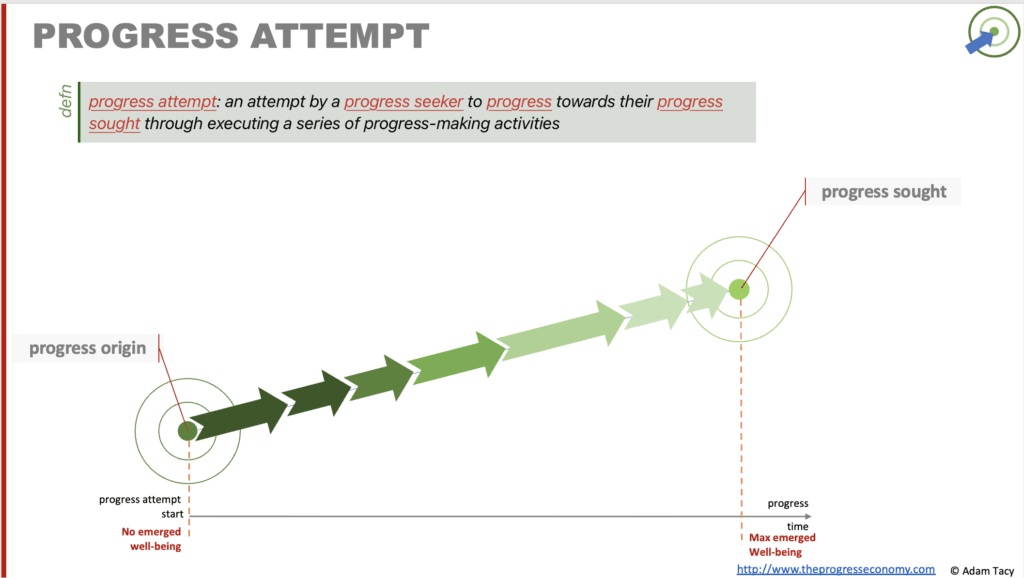
Everyone is trying to make progress with every aspect of their lives. They do so in progress attempts from their current progress origin to their progress sought. We visualise that on a progress diagram, such as above.
Conceptually, well-being progressively improves as progress is made. We’ll call this: emerged well-being. And this emerged well-being is the Seeker’s phenomenological comparison of progress reached against their progress sought. Naturally, there is no emerged well-being at the progress origin. Whereas there is maximum emerged well-being when their progress reached matches their progress sought.
Whilst It is predominantly the Seeker that judges progress and increase in well-being, the helper does so too. Not least the Helper may judge too little progress is potentially being made and withdraws their capability.
Important for our innovation discussion is to note that emerged well-being needs to be periodically recognised by the Seeker for it to be meaningful to them. We call this well-being recognition – and is similar to how/why we recognise revenue in accounting.
Given the above, it is quite reasonable to believe that all progress Seekers (individuals, customers, guests, patients, etc) want to:
- get closest to their progress sought (for all three dimensions: functional, non-functional, and contextual) from their current progress origin
- whilst experiencing the lowest height of all six identified progress hurdles
- achieving the earliest, and then ongoing highest frequency of, well-being recognition
The outcome of innovation should therefore maximise the above.
Let’s progress together through discussion…