
Can you innovate to enable Seekers get closer to their progress sought than they can today?
What we’re thinking
One of the four innovation outcomes is a proposition that offers increased progress potential.
That is to say, a proposition that enables a Seeker to get closer to their progress sought. And that might mean starting closer to their current progress origin.
Increasing progress potential
An outcome of innovation is a progress proposition that enables a Seeker to get closer to their progress sought than is currently possible
Our first innovation outcome is the one that most likely springs to mind – increasing the progress possible towards progress sought. That could be for any combination of a progress state‘s three dimensions of functional, non-functional and contextual).
Extending progress offered towards progress sought
Here’s how that looks on our conceptual progress diagram.
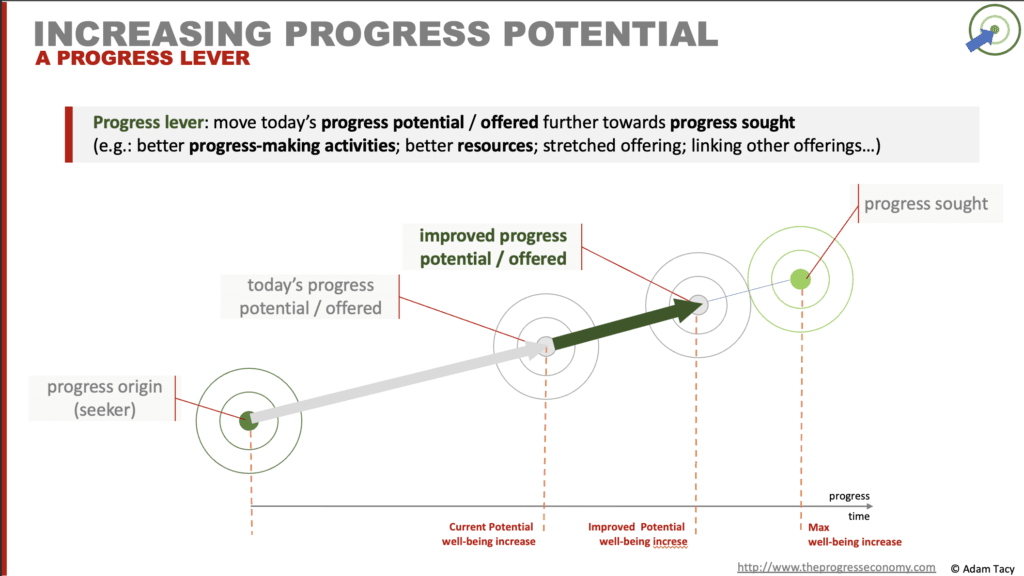
By increasing any combination of the progress potential/offered progress dimensions the Seeker has potential to get closer to their progress sought. And that means offering a potential improvement in well-being.
Aligning progress origins
Equally important when looking to reach progress sought – but often not addressed – is starting closer to the Seeker’s current progress origin.
If your proposition’s origin is too far to the right of the Seeker – ie the offered capabilities are insufficient – then the on-ramp may be too high. In such case the Seeker may judge their progress potential with your proposition is too low (even if you’re offering to help them reach their progress sought).
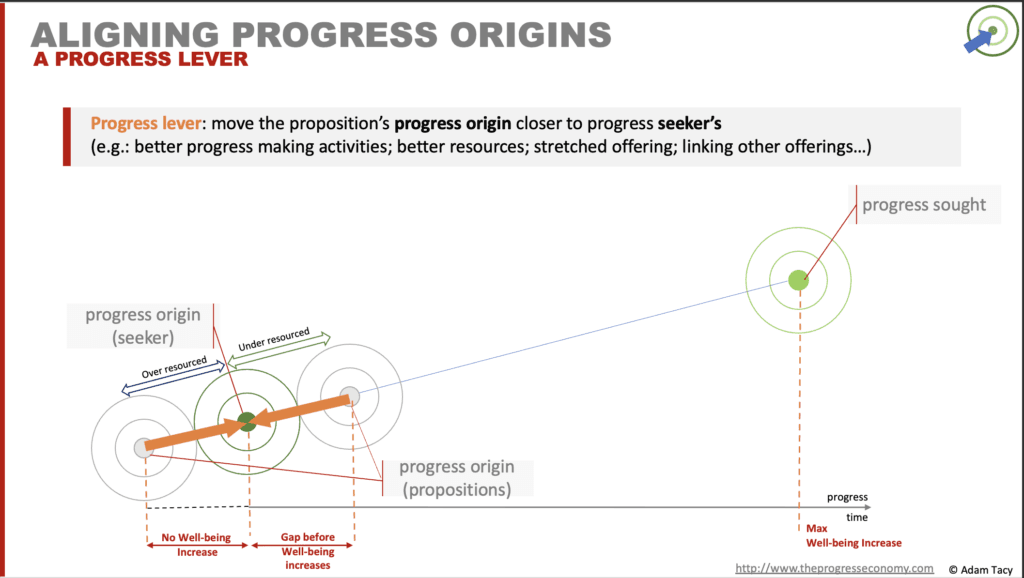
On the other hand, if your proposition’s origin is too far to the left of the Seeker’s – i.e. you’re offering too much capability – they may judge the equitable exchange hurdle as too high (what are they paying for?). Worse, if you make the proposed progress-making activities mandatory, for example as part of a process in a system, then you likely frustrate the Seeker. You’re adding no progress help (and therefore no increase in well-being). In fact, you may be contributing to the destruction of well-being!
Associated progress levers
From this discussion we can see two progress lever immediately fall out:
| progress lever | discussion |
|---|---|
| extending progress offered towards progress sought | How can you help your Seeker get closer to their progress sought than they currently can? ➠ The use of drones by Ukraine has radically altered defensive (and offensive) warfare |
| aligning your proposition’s progress origin | How can you help your Seeker start making progress? Or remove unnecessary, to them, capability? ➠ Canva offer to help Seekers with no design experience create material (unlike, say, Adobe that caters to experienced designers) |
And there lurks a powerful insight here when we combine this thinking with the knowledge that Seekers are not all exactly the same. We should look to segment Seekers on their progress sought, and less obviously on their progress origin.
This doesn’t necessarily mean you have to create offerings for all combinations of segments, it allows you to focus your creative efforts – it’s a progress lever.
| progress lever | discussion |
|---|---|
| segmentation based on three dimensions of progress state | Not all Seekers need the same help (supplementary capability), are you clear who you want to help? ➠ Segmentation on functional, non-functional and contextual progress is powerful to get understanding; |
| targeting an unmet segment | Are there segments (based on progress sought/origin) that are either unmet? ➠ Blue Ocean Strategy, again using elements of the progress state dimensions, is a way of identifying unmet progress |
| targeting a poorly met segment | Are there segments that are poorly met? ➠ The ideas of disruptive innovation (as per Christensen) can be leveraged here. Is there a non-mainstream segment that incumbents over offer progress to, for which you have a new proposition that is cheaper and meets that segments needs (which you can then improve and chase more demanding segments) |
There are additional progress levers that reveal themselves once you begin the journey of thinking about the scope of your proposition and Seekers’ progress sought and origin, including:
| progress lever | discussion |
|---|---|
| chaining propositions on behalf of a Seeker | Can you may act as a front to other propositions that need chaining together to help a Seeker make best progress? ➠ Online retailers often do this, seamlessly linking payment and delivery service offerings towards the buyer |
| piggy-backing on existing propositions (dual use / taking advantage) | Can you use your existing proposition to help enable different progress? ➠ Swedish Busgoods use their scheduled bus service to additionally deliver goods to collection points on the bus route in the sparser populated region of Sweden |
| unbundling propositions to offer choice | ➠ Online retailers may do this – offering choices of payment and delivery methods to Seekers |
| unbundling propositions to enable progress | ➠ Amazon do this with their cloud services; originally unbundling their commerce platform into cloud services |
Finally, you should expect a Seeker’s progress sought and progress origin to continuously evolve. Every progress attempt they make, across all areas of their life, builds new expectations (stretching their expectations of progress sought) and new competences (shifting their progress origin).
As a result, your proposition’s progress offered and assumed origin will inevitably drift out of alignment with the Seeker’s reality. If that drift goes unaddressed, your proposition becomes steadily less attractive. You’ll lose exchanges; and the ability to survive. This is the dynamic behind Drucker’s famous rallying call: innovate or die.
| progress lever | discussion |
|---|---|
| “innovate or die” | Seeker’s progress sought, and origin, constantly evolve due to experiences and capabilities they gain from all the progress attempts they are involved with. ➠ unless your proposition also evolves it drifts and becomes progressively less attractive |
What a rich landscape in which to systematically, and successfully, innovate!
We can also innovate to make how we progress today i
Ediyingbelow here
Extending progress offered
The most natural way of extending progress possible is to innovate existing progress offered towards the Seekers’ progress sought.
Take Tesla. Their innovation journey is fundamentally about meeting Seekers’ progress sought of “zero-emission mobility” within the context of “familiar usage patterns”. Early electric vehicles, of this cycle, had limited range, which meant progress on “familiar usage patterns” was largely unmet.
Tesla’s introduction of a supercharging network, along with faster charging technologies, slowly extended usable range and helped Seekers get closer to the contextual progress they are seeking. Subsequent innovations in battery capacity, software-based route planning, charging convenience, etc, further closes the gap between Tesla’s progress offered and Seekers’ progress sought.
There is a tendency to think in terms of functional progress sought in this approach. That is not necessary, as improving non-functional and contextual progress offered is also valid (though often thought of as our 2nd category – making today’s progress better).
Aligning progress origins
But Seeker’s also struggle to reach their progress sought if a proposition’s origin is too far away from their own currentorigin. In other words, if the on-ramp to the journey is too far away.
Canva provides a clear example of reducing the gap between the progress origin of the Seeker and the proposition. They innovated to align their progress origin with design novices, offering professional-quality outputs through a radically simplified interface. This allowed anyone – from a small business owner to a social media manager – to create high-quality graphics without hiring a designer or learning advanced tools like Photoshop. Their target Seeker is not a design professional, who may find the tooling too basic or too constraining. These Seekers are probably more suited to the likes of Photoshop.
On the other hand, your innovation may be providing too many capabilities (often surfacing as a higher inequitable exchange progress hurdle). Are you underestimating your Seeker’s existing capabilities and trying to help them do things that are already easy to them?
From both these perspectives we get another insight (and lever): Seekers should be segmented based on progress origin and/or progress sought (ra ther than the common demographics approach),
Chaining propositions
Achieving the above can come from offering to chain propositions together (yours and others).
We see this often in the online B2C retail market. Here the Seeker’s progress sought is broadly to discover a goods they desire (to help them in some other progress sought) and have it at as quickly as possible in their hands.
A Helper observing the full journey will realise this requires a place to discover (an online store), logistics (sourcing, warehousing, delivery), and payment propositions.
Very few Helpers provide all as their own solution. Many use an external payment processor, and 3rd party delivery. However, they work hard to link those propositions together, buying or allying with 3rd parties, in a seamless way for the progress Seeker. Imagne buying something online and then having to organise your own collection and delivery!
Amazon famously shifted this model by making its own delivery capability, allowing tighter control over speed, reliability, and customer experience – better aligning with Seekers’ non-functional progress sought of “fast, predictable delivery.”. Are there parts of your Seekers’ progress journey that you better control?
This is a modern expression of Williamson’s transaction cost economics: make, buy, or ally. Still driven primarily by the notion of avoiding hold-ups, although now those hold-ups are related to hindering Seeker’s progress rather than production economics/hold-ups.
This same bundling dynamics is visible in B2B markets. Enterprise SaaS providers have increasingly bundled once-separate capabilities into a single progress proposition. For instance, Slack’s integration with Zoom and Google Drive reduces friction for teams by embedding collaboration, meetings, and file sharing in one place – aligning progress offered with teams that want to stay in-flow without switching tools.
In manufacturing and industrial settings, this principle is visible in how capital equipment providers now think about aligning progress.
- Bundling capabilities: Siemens, GE, and other OEMs now bundle predictive maintenance and remote monitoring into their industrial equipment offerings. This aligns with Seekers’ progress sought of “maximising uptime” and “reducing unplanned downtime.” It also helps close the progress origin gap for customers who lack internal analytics capabilities.
- Ecosystem alignment: Mining and construction equipment makers like Caterpillar and Komatsu increasingly integrate with telematics providers, data platforms, and even third-party service networks to help Seekers make progress toward safety, productivity, and sustainability goals.
Even logistics providers are innovating at the level of progress alignment. Maersk’s “integrator” strategy bundles port-to-port shipping, customs clearance, warehousing, and inland transport into a single proposition. This helps shippers whose progress origin was fragmented – dealing with multiple vendors – by reducing complexity and aligning with the progress sought of “visibility and reliability across the whole supply chain”.
Unbundling progress
In contrast, other retailers have taken the opposite approach and unbundled delivery. They allow Seekers to choose at checkout (buy) who they want to handle last-mile delivery. In Sweden, for example, consumers can select between legacy Post Office services (often delivering to a pickup agent), self-collect automated lockers, or eco-delivery via bicycle – reflecting progress sought such as “I want delivered to my door” or “I want to pick up at a convenient location on my time wish” or “I want a more sustainable option.”
Other companies are unbundling their own propositions to give enterprise customers more control. AWS, Azure, and GCP have progressively decomposed monolithic offerings into microservices, letting Seekers compose infrastructure to their exact needs – offering “just enough” capabilities and aligning more precisely to their progress sought and origins. This helps Seekers avoid overbuying capacity they cannot yet use, or underbuying and creating capability gaps.
Piggy-backing on propositions
Innovation here can also emerge in surprising places. In northern Sweden, buses have long transported goods between remote towns as a way to utilize existing transport capacity. ICA, a major Swedish supermarket chain, has taken this further with ICA Paket — using spare capacity in its supply chain to transport parcels from select retailers to ICA stores for pickup. This not only improves asset utilisation for ICA but also helps Seekers make progress by offering them a convenient, trusted location for parcel collection as part of their normal shopping routines.
Targeting a niche
Managing ”innovate or die”
These examples show that aligning progress origin/offered with Seekers’ states is not just a matter of tweaking features – it can reshape your boundaries as a firm, shift alliances, and reconfigure ecosystems. The innovation question arises: where can/should you bundle, unbundle, or reconfigure capabilities to better match Seekers’ evolving journey?
The key is to always keep all three dimensions of Seekers’ progress sought – functional, non-functional and contextual – in mind. Too often, innovation efforts are internally driven, building features or capabilities that don’t map to real progress sought.
Let’s progress together through discussion…