The Progress Economy

fixing innovation, sales, and firing up growth


Innovation is about making current progress in a better way and/or making better progress - reducing gaps in the progress journey and/or reducing progress hurdles. The progress economy reveals a number of progress levers that help make innovation more systematic
Dr. Adam Tacy MBA avatar

Last Modified:

Tags:

The real question for innovators is not “how do we add value?” but “how do we enable better progress?”. Deliver what progress seekers truly want: better progress (functional, non-functional, contextual) with lower progress hurdles and quicker well-being recognition.


What we’re thinking

We’ve identified solving our innovation problem requires a mind shift from chasing added value to enabling progress (resulting in improved well-being). Taking a progress-first view reveals four clear innovation outcomes, wrapped in an actionable definition.

Be gone chasing ill-defined ”added value”, so long mismatched expectations, and farewell innovation theatre.

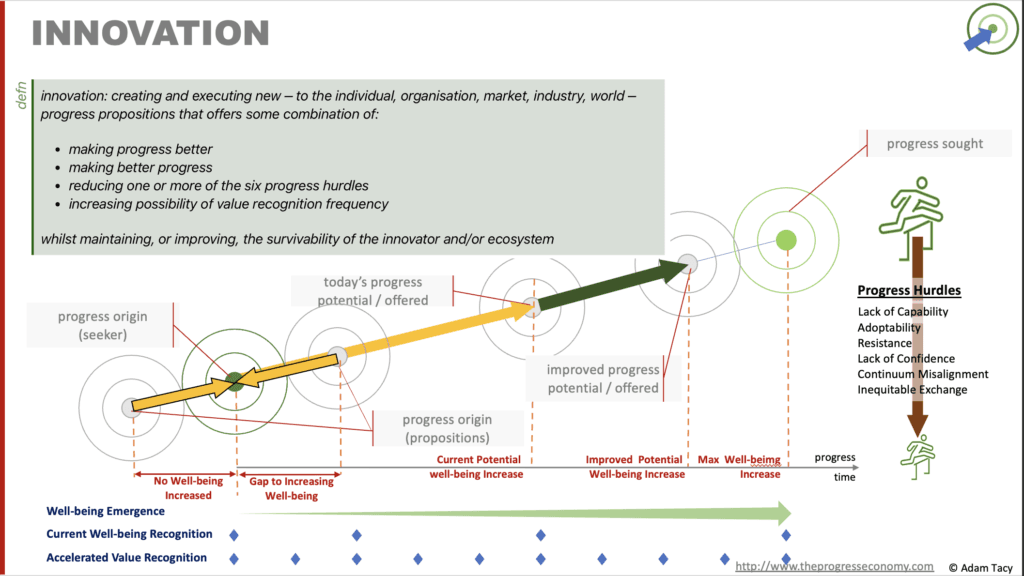
Say hello to creating and executing new – to the individual, firm, market, industry, world – progress proposition(s), that offer some combination of better progress, lowered hurdles, and accelerated increased well-being recognition frequency:

innovation: creating and executing new – to the individual, organisation, market, industry, world – progress propositions that offer improved progress potential through some combination of:

  • increasing possible progress
  • making today’s progress better
  • lowering one or more of the six progress hurdles
  • accelerating potential for well-being recognition frequency

whilst maintaining, or improving, the survivability of the innovator and/or ecosystem

Why this matters

By grounding innovation outcomes on progress we align with what Seekers truly want: best progress (towards their functional, non-functional, and contextual progress sought, with lowest progress hurdles and fastest benefit recognition (seeing that progress made is meaningful to them). Solving the innovation problem, revitalising sales, and reigniting growth.

This shift importantly reveals a set of progress levers that operationalise innovation, making it more systematic and targeted. We design for progress rather than depend on chance. Turning Christensen’s call to “compete against luck” into a practical reality.

We also discover that innovation and sales are two sides of the same coin.

The real question for innovators is “how do we help Seeker(s) make better progress?”

Innovation: Enabling progress

Our traditional definitions of, and approaches to, innovation are based on “adding value”. Here, for example, is the latest from the International Standards Organisation (ISO):

Innovation: new or changed entity realizing or redistributing value

ISO 56000 (2025) – Innovation Management – Fundamentals and Vocabulary

I would bet money that your definition is (currently) similar.

However, I’ve argued value is difficult to define and agree upon. Chasing added value is the root of our innovation problem. We are often failing, but hide that behind “innovation is hard”. Our value-first view is inevitably based on the value-in-exchange model. That model has been wildly successful, but has many blindspots that are increasingly impactful.

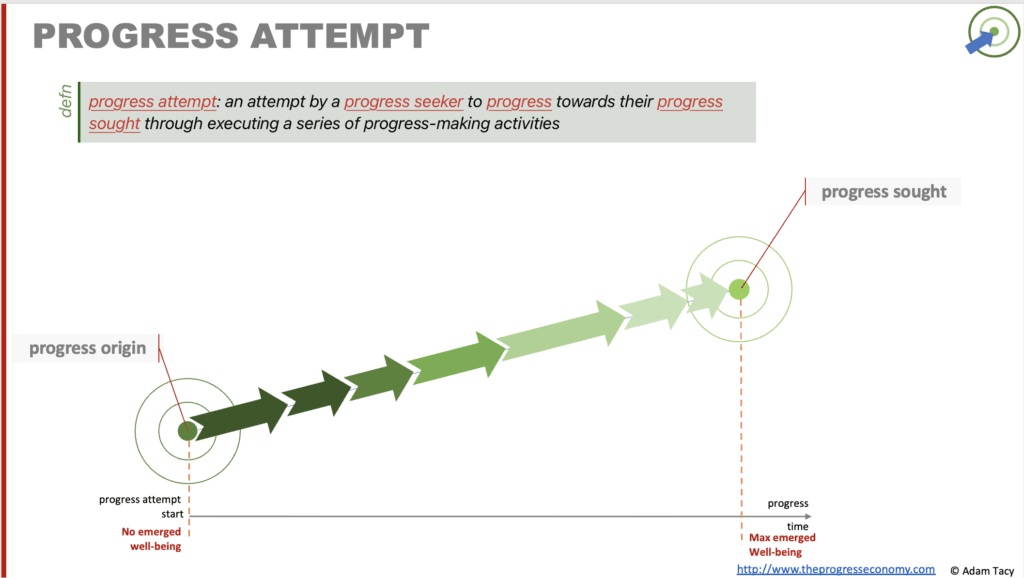
Instead of chasing value, we should chase enabling progress. Everyone is trying to make progress with every aspect of their lives. Progress is defined as the act of moving over time to a more desirable state of progress sought (from a current starting point of progress origin).

progress: moving, over time, to a more desirable state

Enabling better progress increases well-being. Primarily of the Seeker, since reaching their progress sought gives maximum increase in their well-being, and also the Helper (since they get the service exchange – often indirectly – they need). Well-being increases as progress is made – we call that emerged progress – but it needs to be recognised by the Seeker to be meaningful to them (like we recognise revenue in accounting).

From this, it is quite reasonable to believe that all progress Seekers want to:

  • get closest to their progress sought (for all three dimensions: functional, non-functional, and contextual)
  • whilst experiencing the lowest height of all six identified progress hurdles
  • achieving the highest frequency of well-being recognition as they progress.

What holds them back is lack of capability (skills, knowledge, strength, natural power, time etc).

Defining Innovation in a progress-first world

Our progress-first perspective leads us to seeing the outcome of innovation outcome as being no more complex than increasing well-being.

(high level) innovation outcome: increasing well-being

We do so primarily by reducing the lack of capability.

You could argue this is no better a definition than what I’ve criticised as chasing “adding value”. But here is where we can apply our thinking around progress. We can see increasing well-being as enabling better progress, ie improving progress potential That means it is some combination of:

  • increasing progress that is possible (towards progress sought)
  • making progress that is possible today in a better way
  • lowering one or more of the six progress hurdles
  • accelerating potential for well-being recognition frequency

These four outcomes are at the heart of our progress economy’s innovation definition:

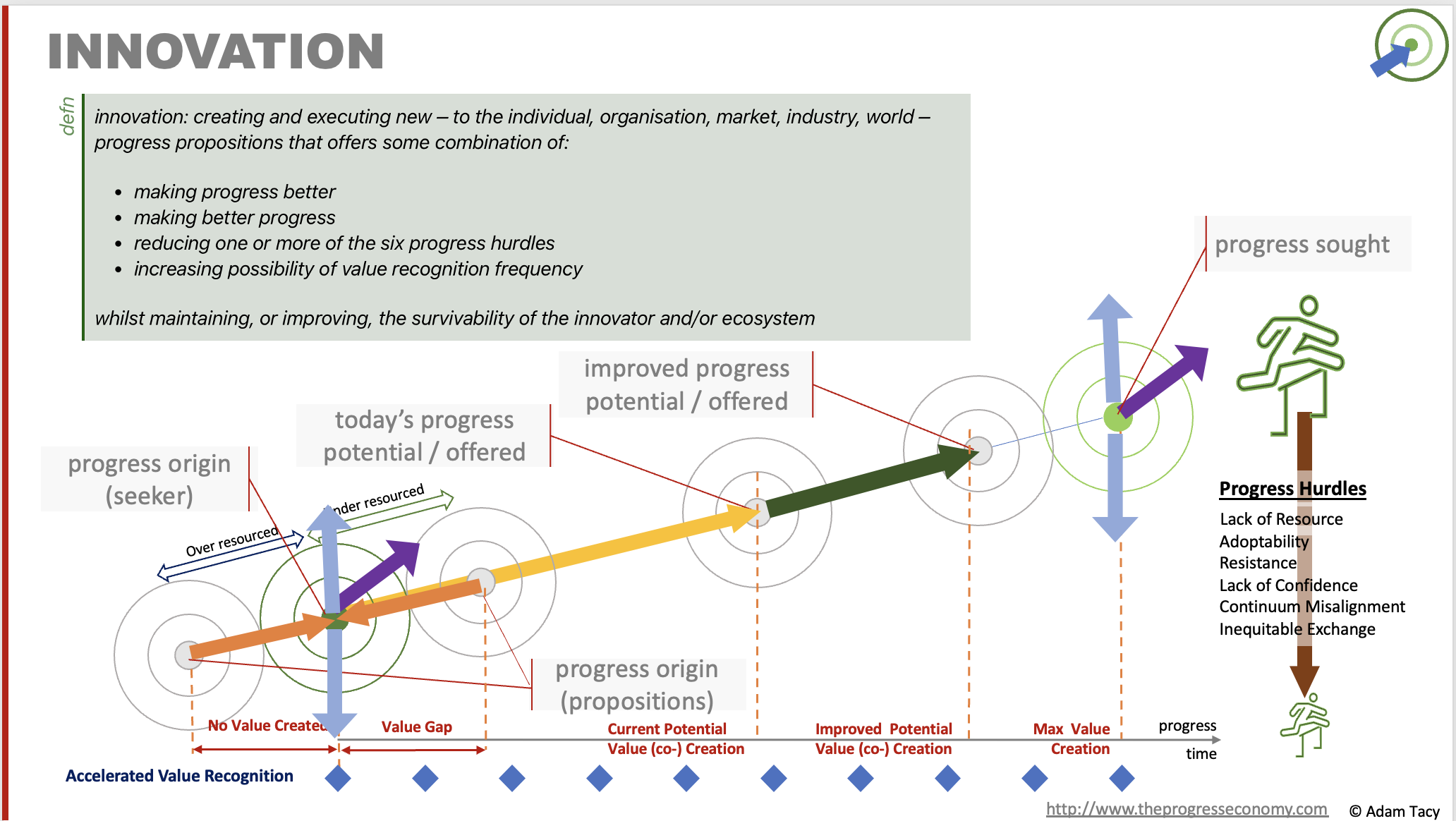
innovation: creating and executing new – to the individual, organisation, market, industry, world – progress propositions that offer improved progress potential through some combination of:

  • increasing possible progress
  • making today’s progress better
  • lowering one or more of the six progress hurdles
  • accelerating potential for well-being recognition frequency

whilst maintaining, or improving, the survivability of the innovator and/or ecosystem

We top and tail our definition with two important aspects. Innovations are new propositions (offers to help), and the entity offering the proposition should not be adversely impacted.

Let’s expand the components of our exciting new definition.

Innovation: Creating and executing progress propositions…

The first part of our definition tells us that innovation creates progress propositions. This means they hold only potential to help make progress. The amount of that is ultimately determined by the Seeker prior to, and during, engagement. With that judgement includes how:

  • close to their progress sought they feel they can reach with the proposition
  • close is the proposition’s progress origin to their own current progress origin
  • low are the six progress hurdles

Propositions are offers to help someone make progress towards a state of progress offered. Usually from an assumed starting point (the proposition’s progress origin). As such, they meet our definition of service (singular). And they are bundles of supplementary capabilities – specifically a resource mix and a proposed set of progress-making activities.

Definition of service in the progress economy
Definition of a progress proposition

(we should remind ourselves that in the progress economy goods freeze service; so they can be unfrozen in acts of resource integration when and where needed).

Consider Peloton. It does not simply sell a bike; it bundles:

  • a bike (goods)
  • live-streamed classes (proposed progress-making activities)
  • gamified leaderboards and an online community (systems/data)

This combination appeals to Seekers looking to improve fitness (functional progress sought) in a more engaging way (non-functional progress sought) whilst at home (contextual progress sought) than they might with a bike out on a street on their own.

A proposition maybe extended by others to meet differing progress sought. Taking Pelaton again, some gyms offer Peloton classes, appealing to those Seekers whose contextual progress sought gives a constraint that “at home” is not possible/wanted.

What is interesting is that the definition of a progress proposition provides a rich tapestry for systematically exploring innovation. Now is a good moment to introduce progress levers.

Introducing progress levers

Progress levers are key to transforming innovation from a game of luck to a systematic, successful, approach. They are aspects of the progress economy we can leverage to focus our creative energy when enabling better progress.

Several of these levers reveal themselves from our progress proposition definition. The following table gives some examples.

progress leverexample
addressing progress offeredTesla continuously pushes (non-functional) progress offered closer towards a sought “zero emissions mobility” with longer range batteries and faster charging

can you better align with your Seekers’ progress sought? (getting them closer gets interpreted as better increase of well-being)
addressing progress origin
(of the proposition)
Canva aligns its offering’s starting point with design novices, making professional-quality outputs accessible to those who have limited design skills without the need for hiring separate design experts.

can you better align to your Seekers’ progress origin? (reduce frustration, capture missed markets)
updating progress-making activitiesDomino’s reinvented its pizza-making and delivery process with AI forecasting and real-time order tracking, turning “waiting for food” into a transparent, predictable experience.

Stripe removed the complexity of payment gateway integration, enabling businesses – even startups – to accept online payments in hours rather than weeks

can you make the journey better? (reduce complexity, improve experiences, etc))
improving individual elements of the resource mixDelta Airlines invested in employee training and mobile gate tools, enabling faster, more personalised service.

what elements of your resource mix could you improve? (more enabled employees? more reliable goods? better use of data? etc)
altering the resource mix offeredSpotify enables those searching for entertainment by swapping out goods (CDs, vinyl) for digital goods, whilst also altering the ownership model (goods for resources).

what elements in the resource mix can you swap for others? (often reflects a need to move along the enabling-relieving progress continuum to align with Seekers changing positions, eg the “shift” to the service economy, or the increasing use of AI)
addressing more of the progress journeyAmazon extended their own offering across Seeker’s progress journey by replacing 3rd party delivery service with their own to control quality of next/same day delivery.

what parts of the journey can you cover, or ally with others to cover? should you unbundle your offering to help wider target Seekers. Should you bundle offerings or leave Seekers to bundle themselves?

Progress levers also help explain innovation theories, such as why Drucker’s “innovate or die” is so compelling. Or the mechanics behind Christensen’s disruptive innovation. Or why Blue Ocean Strategy is useful. They also give us the insight that segmentation is powerful when based on progress sought/origin.

I also include in our definition that innovations need to be executable. If we can’t implement and execute the proposition, then it can’t help the progress Seeker.

Time travel might perfectly satisfy a Seeker’s progress sought to go back in time and fix something, but it rarely translates into an executable proposition. In edge cases we could leverage the effects of general relativity. More likely, we give the illusion of time travel: introducing an “undo” function, or delaying sending an email to give a user a chance to stop it. Those are more realistic implementations.

Pages: 1 2 3 4

RELATED ARTICLES

SHARE YOUR THOUGHTS

Let’s progress together through discussion…