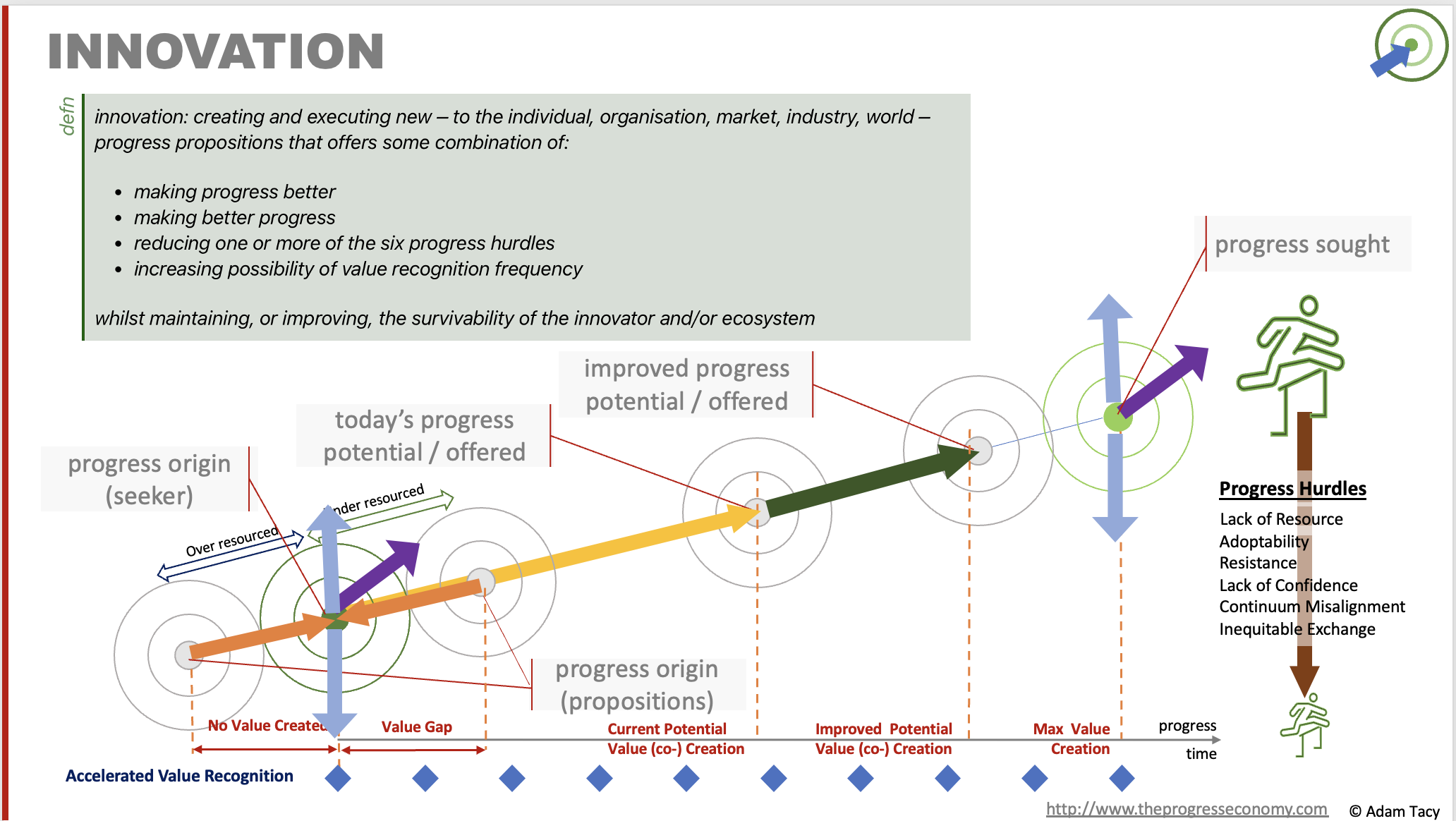

…that offer to improve well-being through combination of:
An innovation must offer (and deliver) a beneficial outcome for the Seeker – a real improvement in their well-being. In a progress-first view, that means one thing: enabling better progress.
A new proposition must therefore be something a Seeker can credibly judge as offering greater progress potential than the alternatives available to them. When we translate that judgment into the language of the progress economy, it resolves into four distinct innovation outcomes:
- increasing progress potential
- improving today’s progress
- lowering progress hurdles
- accelerating well-being recognition
We can visualise these outcomes on the following progress diagram.
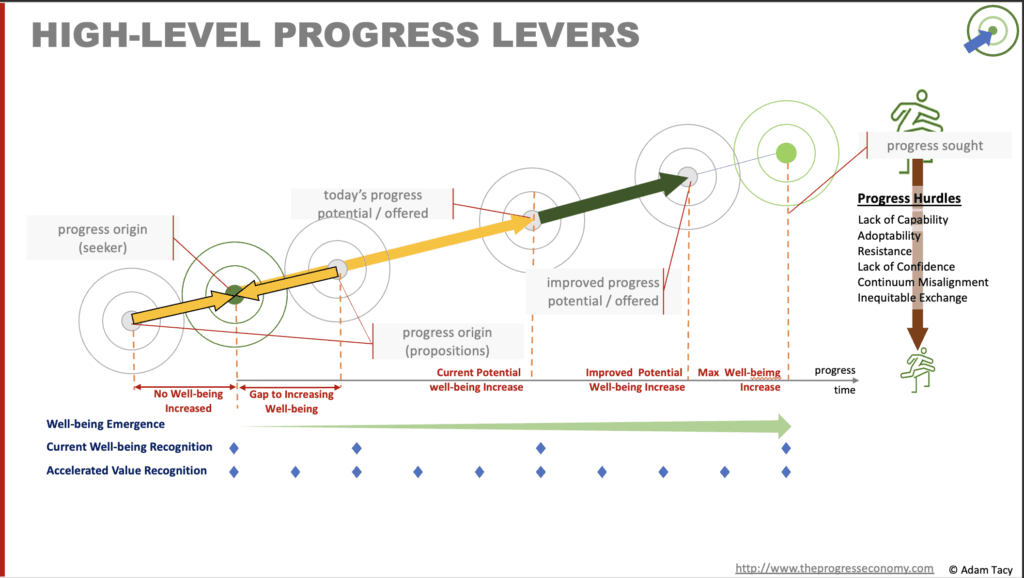
And you might not be surprised to learn these are high level progress levers. Here’s a high-level overview of them along with links to deeper exploration.
Increasing progress potential
Zoom enabled remote teams to work together as if co-located, not just improving conference calls but redefining what was possible and making it simple to start
How can you get the Seeker closer to their progress sought than they currently can? This covers all three dimensions of progress – functional, non-functional and context – though often it is easier to view this in terms of functional progress. See “improving today’s progress” for the converse.
Interestingly, the progress economy shows us that it is not just about reaching closer to progress sought. Another lever is aligning the proposition progress origin with the current origin of the Seeker. If the proposition’s origin is too far from the Seeker’s, then they may judge the proposition is not usable, even if it offers to get them closer to their progress sought.
What we are essentially doing is looking at the scope of a proposition compared to the Seeker’s progress journey. Therefore other levers, such as combining propositions, acting as a facade to other propositions, offering choices (eg delivery or payment). It also suggest strongly we should segment by progress to be more appealing to Seekers.
Improving today’s progress
Uber made the existing process of hailing a taxi faster, more transparent, and more reliable.
for example, reducing friction, improving reliability, or simplifying complexity in how progress is currently made.
Lowering progress hurdles
Stripe lowered the cost of online payments (through removing the technical and contractual hurdles) , allowing businesses of any size to start taking payments in hours instead of weeks
hurdles slow down, or prevent, Seekers from reaching their progress sought, lowering them is very helpful. These progress hurdles are: (lack of capability, lack of confidence, adoptability, resistance, inequitable exchange, misalignment on continuum.
Accelerating well-being recognition
Agile approaches do this by guiding seekers to prioritise and retrospect in smaller “sprints” rather than having to wait until the end.
helping Seekers feel they can recognise emerged well-being earlier and with greater frequency. (emerged well-being is a progress comparison of progress reached and progress sought. It needs to be recognised for it to have meaning a Seeker. This is similar to revenue recognition in accounting).
There are two cautions worth noting when we consider these outcomes.
Outcomes are often interdependent
First, these outcomes are often interdependent. If we, for example, enable more progress we typically need to offer more capability, an action that likely increases the inequitable exchange progress hurdle (in simple terms, price). Similarly, reducing one progress hurdle, may raise another. Everything needs to be considered as a whole.
Relentlessly focus on identified progress sought
Second, we must relentlessly focus on understanding the Seeker’s progress sought and their current origin. It is entirely possible to create ineffective propositions in the progress economy if we ignore this (or are too slow in delivering and the progress journey has moved on – see ”innovate or die”. Or we can miss/loose Seekers if we misunderstand their progress sought/origins.
There’s one final part of our definition, and this one shifts the focus from the Seeker to the Helper.
Let’s progress together through discussion…