
Restructuring below here
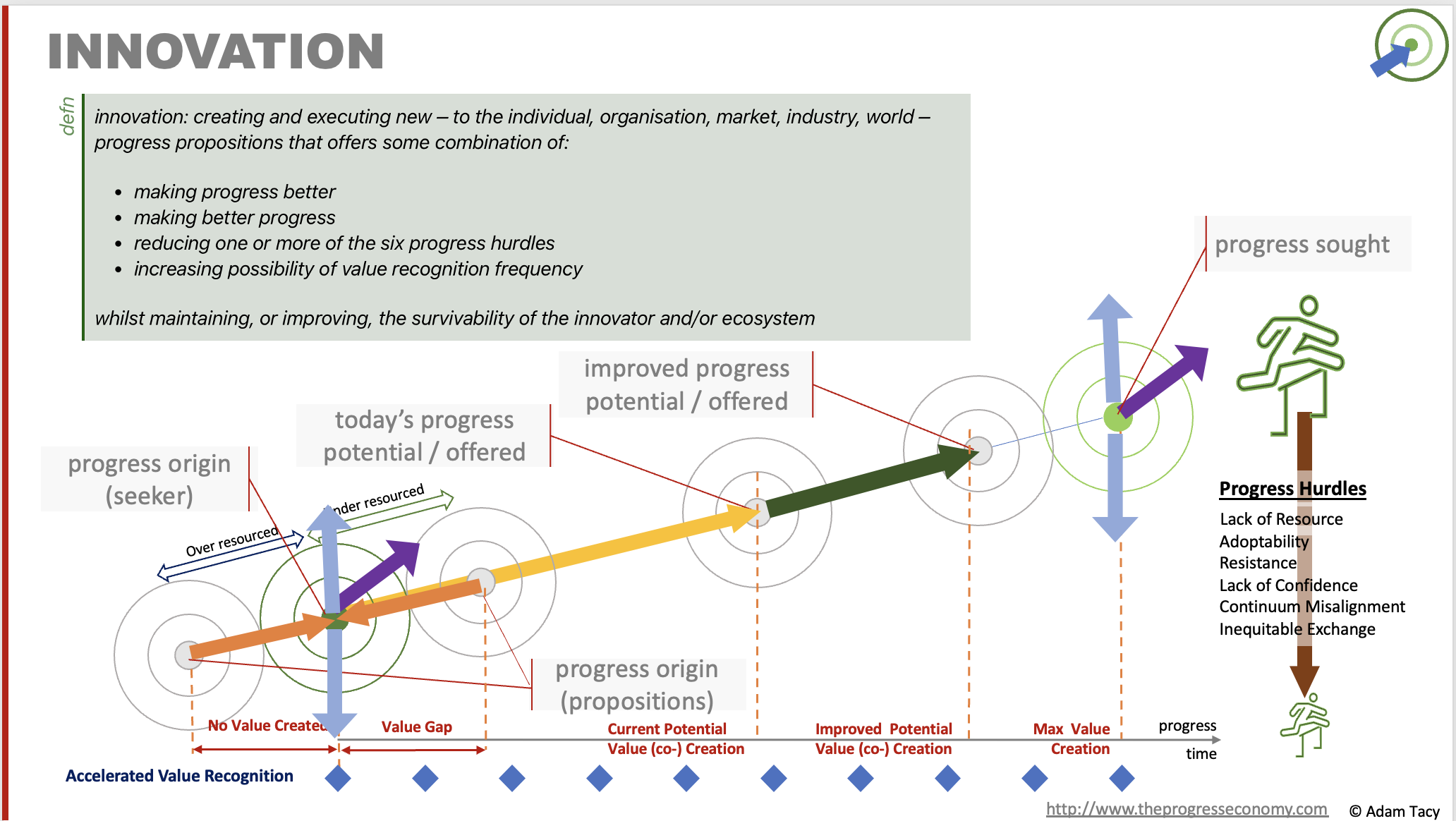
…whilst maintaining, or improving, the Well-being of the innovator
Just as an innovation must improve the Seeker’s well-being, executing it must not diminish the well-being of the Helper.
Generally, this means the Helper receives sufficient service effort from the Seeker – typically in the form of service credits – to cover the transitive and internal service exchanges required to deliver the proposition, plus any surplus they require. Put more simply, they must generate enough inflow to cover their outgoings and profit needs. That simplification holds in most cases, though important subtleties remain.
This is the practical condition on service exchange and on business model innovation (reducing the inequitable exchange progress hurdle).
There are only limited situations in which a Helper can expend more effort than they receive and still maintain, or even improve, their well-being. Sometimes the Helper willingly accepts fewer service credits because the shortfall is offset by other forms of well-being This is effectively a subsidised model.
Goodwill is one. Here, the shortfall is covered by perception and reputation.
Venture capital provides another example, where early-stage “losses” are covered by investors with the (ideally informed) expectation of future return. This preserves the well-being of the Helper and eventually restoring and increasing the well-being of the VC (assuming one or more of their investments succeeds).
When we think in terms of service exchange rather than value-in-exchange, entire categories of business model innovation come into focus. Subscription models shift one-off exchanges into recurring flows. Subsidised models—freemium or cross-subsidisation—become structurally intelligible. Ecosystem models emerge, where one Helper absorbs effort so others can thrive. These patterns are often obscured when survivability is viewed solely through transactional cash exchange.
Finally, remember that a Helper may itself be a service system – a network or an ecosystem. Innovation, in that case, must sustain or enhance the well-being of the system as a whole, not just its individual participants. One or more participants may not “survive”, being swapped out for others.
Restructuring below here
Wrapping up
Shifting our mindset from adding value to enabling progress is essential to solving the innovation problem, revitalising sales, and reigniting growth.
By grounding innovation in an actionable definition we align with what Seekers truly want – best progress (functional, non-functional, and contextual), with lowest progress hurdles and fastest value recognition.
This shift surfaces a coherent set of progress levers that make innovation more systematic and targeted, giving you the ability to design for progress rather than depend on chance – turning Christensen’s call to “compete against luck” into a practical reality.
)
Let’s progress together through discussion…