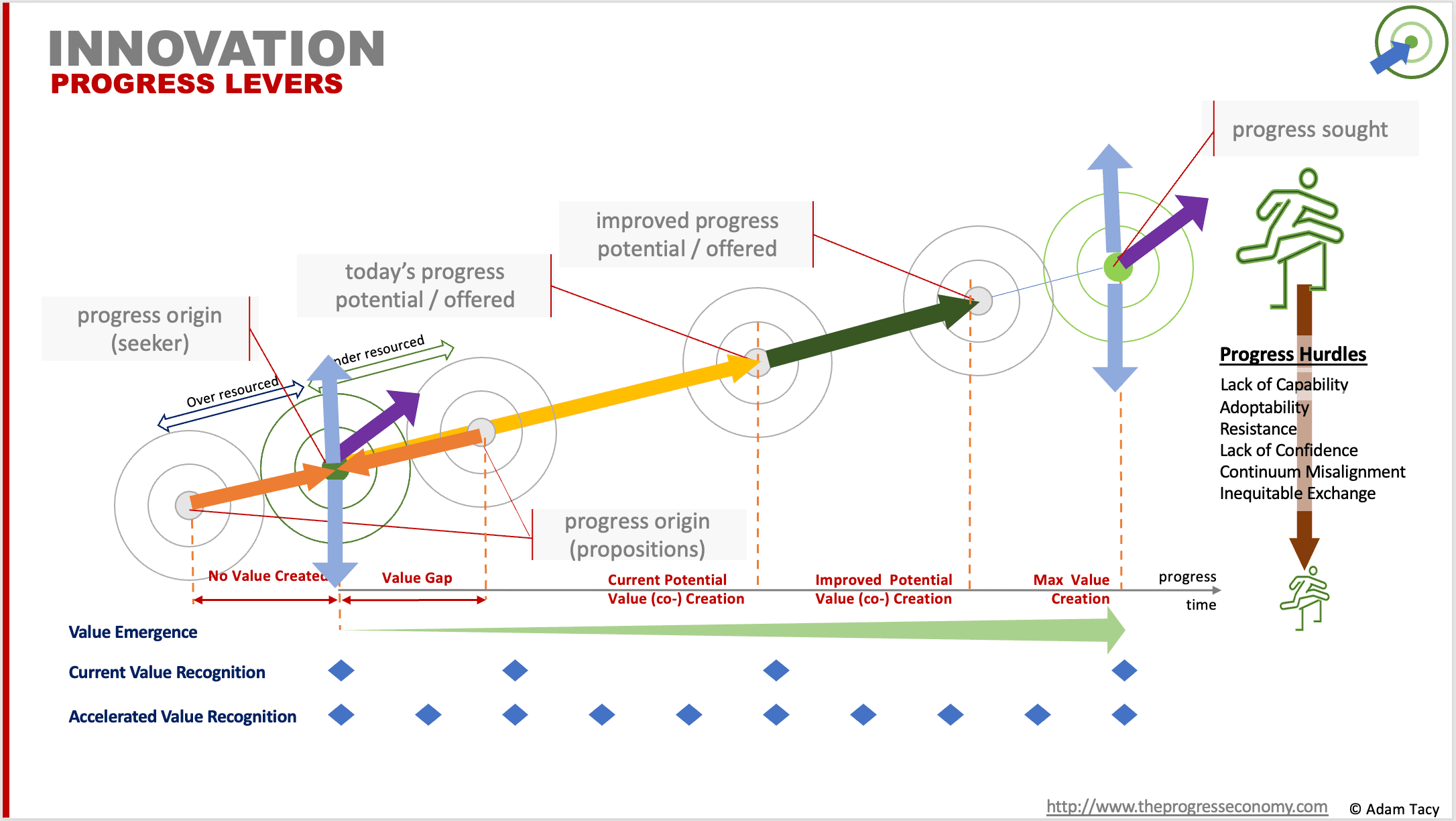

Progress levers focus creativity, turning innovation (and sales) from a gamble into repeatable creative success. Which levers are you pulling?
What we’re thinking
One of the most powerful benefits of the progress economy is the clarity it brings to innovation. It reveals a definition that is concrete, operational, and actionable, and which identifies four specific high-level outcomes:
- making progress better
- making better progress
- reducing one or more of the six progress hurdles
- increasing frequency of well-being recognition
We’ll now call these progress levers – aspects of the progress economy where leaders can deliberately focus creative and commercial effort. Used intentionally, these levers move innovation (and sales) away from chance and toward a more systematic and successful discipline.
Better still, as we explore those high-level levers through seeing progress as an operating model for economic activity, additional, more granular levers come into view. We find levers such as sliding along the enabling-relieving proposition continuum, updating resource mixes, aligning better with Seeker’s progress origin, segmentation by progress, and many more.
Why this matters
Innovation remains stubbornly difficult. Whilst creativity matters, without direction and grounding, it easily devolves into what Steve Blank aptly calls innovation theatre.
Progress levers provide direction. They allow leaders to channel creativity toward what Seekers actually care about: achieving the best possible progress toward their progress sought, encountering the fewest hurdles along the way, and recognising that progress as quickly and clearly as possible.
The strategic question becomes sharper: which progress levers will you pull to compete against luck and making innovation more systematic and successful?
Progress levers: competing against luck
Christensen urged us to “compete against luck,” describing jobs-to-be-done as a way of doing exactly that. The progress economy amplifies his insight. What Christensen framed as a “job” becomes, in our language, a structured journey defined by a Seeker’s progress origin, their progress sought, the progress attempts they make, and the hurdles that stand in their way.
We see Progress Seekers as constantly trying to move over time toward more desirable states across all aspects of their lives — functional, non-functional, and contextual. Yet progress often stalls because they lack capabilities: skills, knowledge, time, strength, and so on.
There is an uneven distribution of capabilities across the economy, which gives rise to service (singular) exchange. Actors apply their capabilities for the benefit of others, and in return seek help for the progress they themselves are trying to make. Much of this exchange is indirect, typically mediated through service credits – of which money has proven to be a remarkably effective implementation.
Viewed this way, sales and innovation become two expressions of the same activity: enabling a Seeker to make better progress than they could achieve currently. Fundamentally that is through offering supplementary capabilities, in the form of a progress proposition.
But, innovation (and sales) is not a case of simply magicking up capabilities. It is progress levers that give Christensen’s injunction to “compete against luck” practical substance.
What are progress levers?
Progress levers are aspects of the progress economy where leaders can deliberately direct creative and commercial effort.
progress levers: aspects of the progress economy where we can deliberately focus creative effort to move innovation away from chance and toward a more systematic and successful discipline.
When used intentionally, these levers shift innovation – and sales – away from chance and toward a more systematic, disciplined, and ultimately more successful practice.
Examples are the four outcomes in our progress economy definition of innovation.
innovation: creating and executing new – to the individual, organisation, market, industry, world – progress propositions that offer improved progress potential through some combination of:
- increasing possible progress
- making today’s progress better
- lowering one or more of the six progress hurdles
- accelerating potential for value recognition frequency
whilst maintaining, or improving, the survivability of the innovator and/or ecosystem
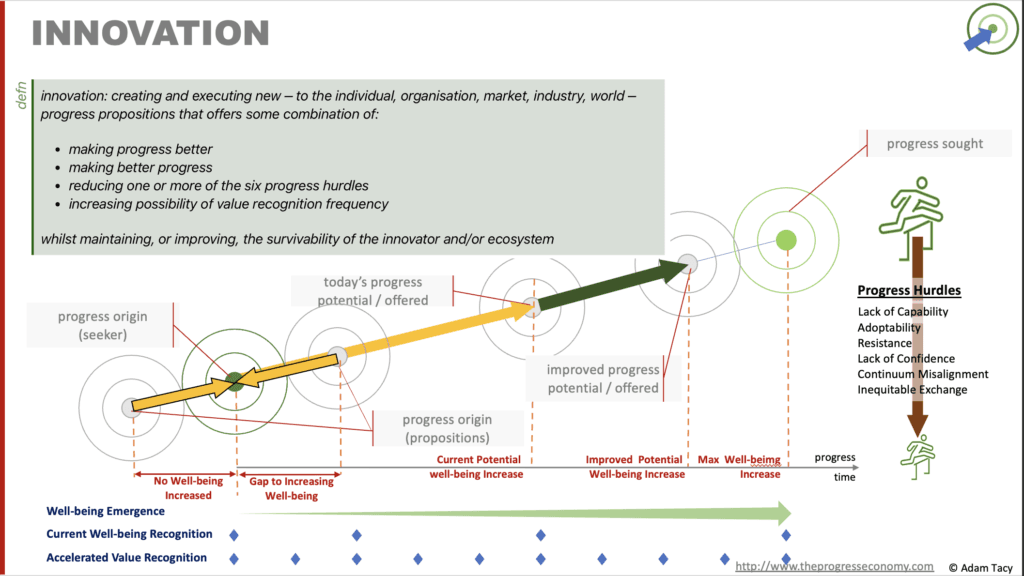
These are high level progress levers. When systematically innovating you can chose one or more of these as guiding principles for applying your creative effort. Are you looking to increase progress that is possible today, to make today’s progress better, to lower one ore more of the six progress hurdles and/or to accelerate well-being recognition?
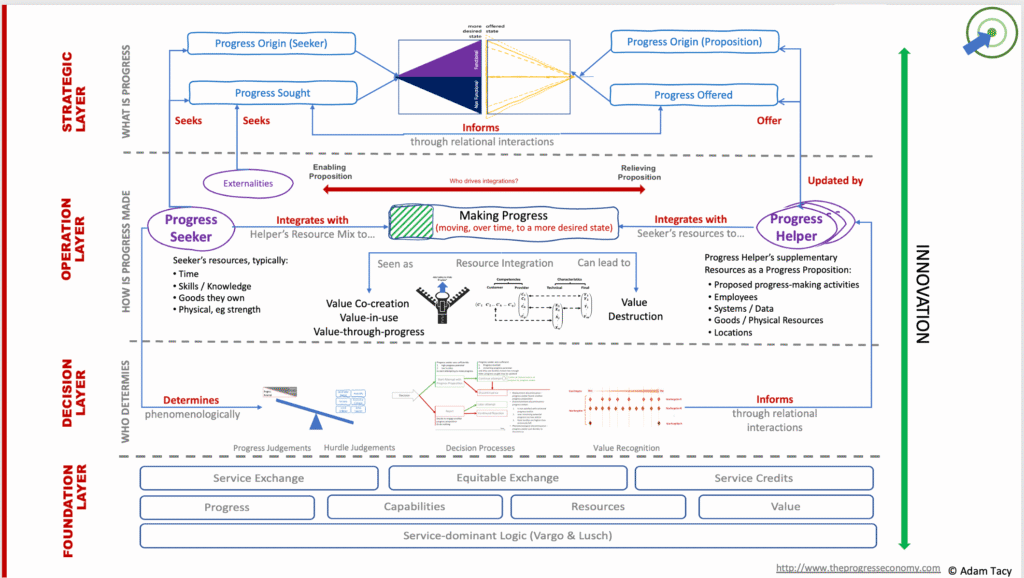
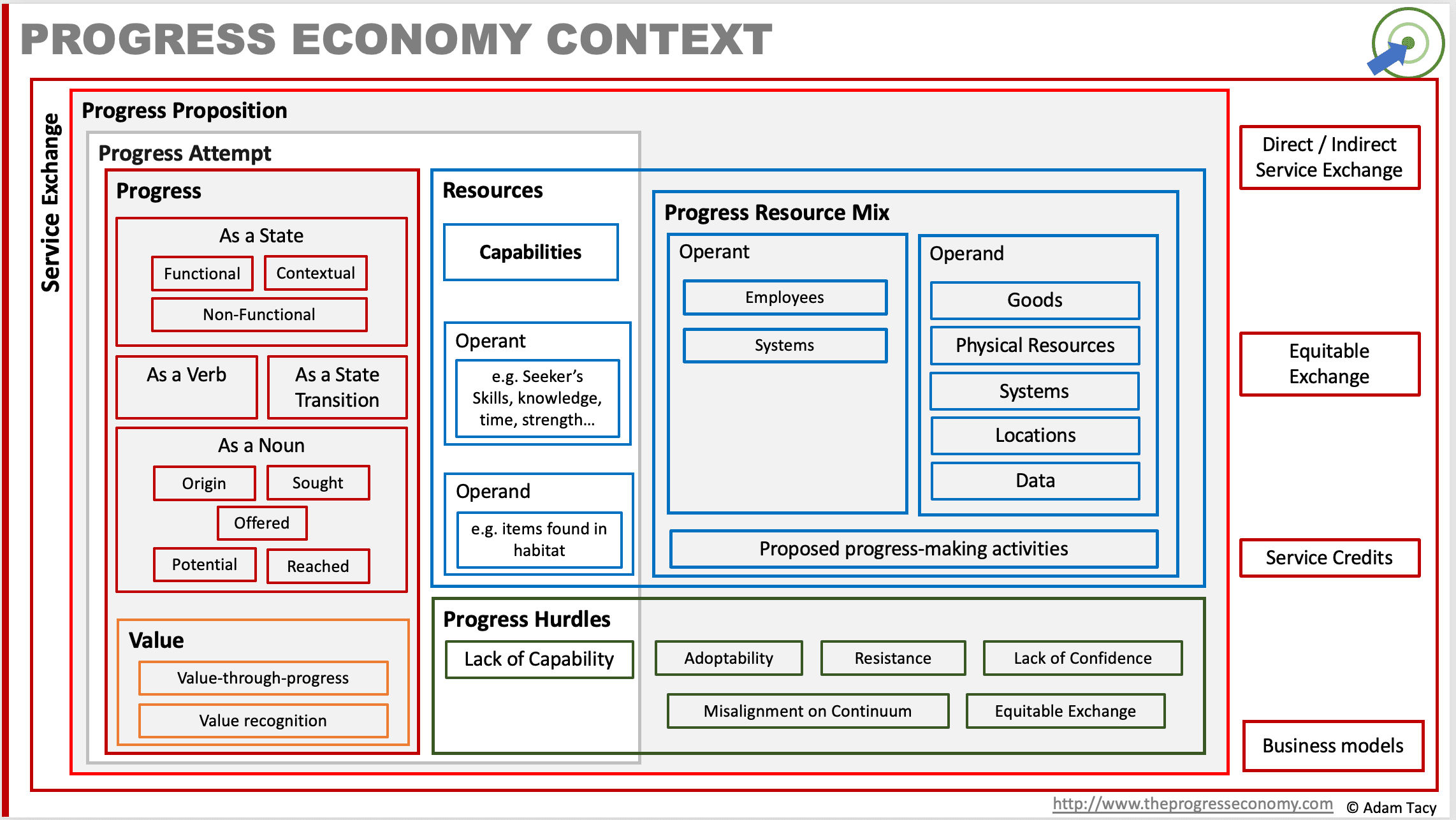
Underneath these are many practical levers proposing ways to achieve those outcomes. These are revealed from seeing progress as the framework and operating model of economic activity.
Examples
Some examples of these more detailed progress levers are in the following table.
| progress lever | example |
|---|---|
| addressing progress offered | Tesla continuously pushes (non-functional) progress offered closer towards a sought “zero emissions mobility” with longer range batteries and faster charging ➠ can you better align with your Seekers’ progress sought? (getting them closer gets interpreted as better increase of well-being) |
| addressing progress origin (of the proposition) | Canva aligns its offering’s starting point with design novices, making professional-quality outputs accessible to those who have limited design skills without the need for hiring separate design experts. ➠ can you better align to your Seekers’ progress origin? (reduce frustration, capture missed markets) |
| updating progress-making activities | Domino’s reinvented its pizza-making and delivery process with AI forecasting and real-time order tracking, turning “waiting for food” into a transparent, predictable experience. Stripe removed the complexity of payment gateway integration, enabling businesses – even startups – to accept online payments in hours rather than weeks ➠ can you make the journey better? (reduce complexity, improve experiences, etc)) |
| improving individual elements of the resource mix | Delta Airlines invested in employee training and mobile gate tools, enabling faster, more personalised service. ➠ what elements of your resource mix could you improve? (more enabled employees? more reliable goods? better use of data? etc) |
| altering the resource mix offered | Spotify enables those searching for entertainment by swapping out goods (CDs, vinyl) for digital goods, whilst also altering the ownership model (goods for resources). ➠ what elements in the resource mix can you swap for others? (often reflects a need to move along the enabling-relieving progress continuum to align with Seekers changing positions, eg the “shift” to the service economy, or the increasing use of AI) |
| addressing more of the progress journey | Amazon extended their own offering across Seeker’s progress journey by replacing 3rd party delivery service with their own to control quality of next/same day delivery. ➠ what parts of the journey can you cover, or ally with others to cover? should you unbundle your offering to help wider target Seekers. Should you bundle offerings or leave Seekers to bundle themselves? |
| sliding along the progress continuum | The “shift to the service economy” is a well discussed phenomenon, with several identifiable reasons. In the progress economy this is not a radical overhaul, rather it is a slide from enabling to relieving propositions. ➠ what proposition can you make more relieving, if you can spot that is what the Seeker is looking for? Beware, some Seekers are looking to slide the other way for non-functional reasons, such as mastery, sense of achievement etc. |
Welcome to the progress lever gallery
I’ve collected the currently identified progress levers into the following /tag/progress-lever/ – a one-stop shop to browse and inspire you to use them.
Creating from here downwards
Operationalising innovation: applying progress levers
Progress levers are meant to be used intentionally. We want to shift innovation – and sales – away from chance and toward a more systematic, disciplined, and ultimately more successful practice. Using them operationalises innovation.
Examples
Servitisation replaces goods with physical resources where ownership transfer does not occur, as Rolls-Royce did with “power by the hour”. Digitisation lowers employee intensity while increasing systems – as Slack did when replacing fragmented communication tools with a unified platform. Artificial intelligence (AI) encapsulates knowledge and skills that Seekers augment themselves with, such as Salesforce’s Einstein AI recommending sales actions. Digital twins combine systems and interpretation resources to create real-time operational insight, as GE Digital does for industrial equipment. Shifting online (bricks to clicks) reduces physical locations, increasing scalability – as Shopify did for small businesses seeking to launch e-commerce storefronts.
Alternatives
What is the alternative? Quite simply, luck and what Steve Blank calls innovation theatre – activities that look good in annual reports and boosts morale inside the company, but ultimately lead to no impact on the top or bottom line. Hackathons, calls to action, individual insights, and more are how we perform innovation today. Often disjoint from the main operations of our organisations.
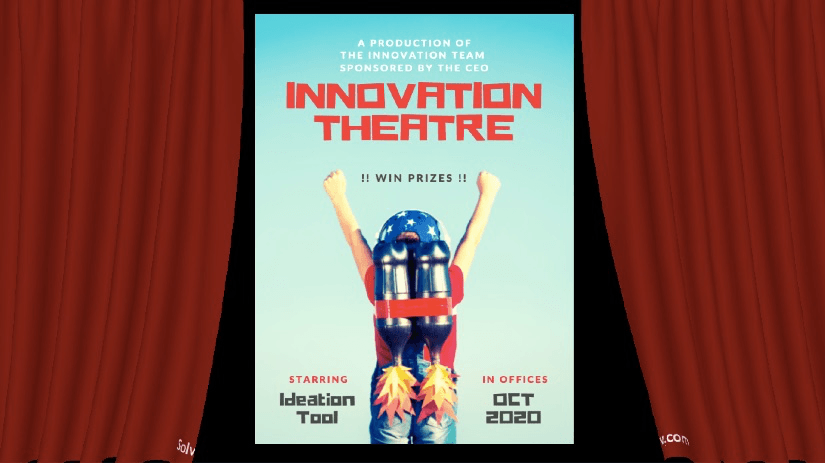
When our innovation activities deliver few/no tangible results, we are performing innovation theater.
Steve Blank (2019) “Why Companies Do ‘Innovation Theater’ Instead of Actual Innovation”
Whilst some of your innovation activities may uncover something, it’s more a game of chance. Wouldn’t you prefer to shift the odds in your favour? That requires seeing the world as progress-forward, understanding Seekers’ progress journeys, and using progress levers to target you creativity to better enable those Seekers improve their well-being.
Concepts explained by progress levers
Ever wondered why Drucker urges us “innovate or die” or what are the mechanics behind disruptive innovation or blue ocean strategy? We get insights into them through various progress levers.
- Recognising Seekers’ progress sought and progress origins evolve over time – due to experience from all the progress attempts they are making and observing – leads us to Drucker’s rallying call of “innovate or die”
- Segmenting by progress (sought and/or origin) is more powerful compared to traditional demographic segmentation
- Disruptive innovation, as defined by Christensen, is found in the mechanics of segmenting by progress and the inevitable chase of improving progress sought
- Blue Ocean strategy searches for uncontested combinations of functional, non-functional and contextual progress sought
- more…
So the question stands: which progress levers are you choosing to systematically, and successfully, innovate (or drive better sales)?
Wrapping up
Progress journeys – there are clear journeys where progress-making steps are known and clear; there are exploratory journeys made up of a set of clear journeys (ER room, for example); there are exploratory journeys where progress-making steps are unknown . There are journeys that might block other journeys (like being in ER…where am I in the progress, what can they offer to minimise blocking other journeys, eg offering WiFi was good)
Let’s progress together through discussion…