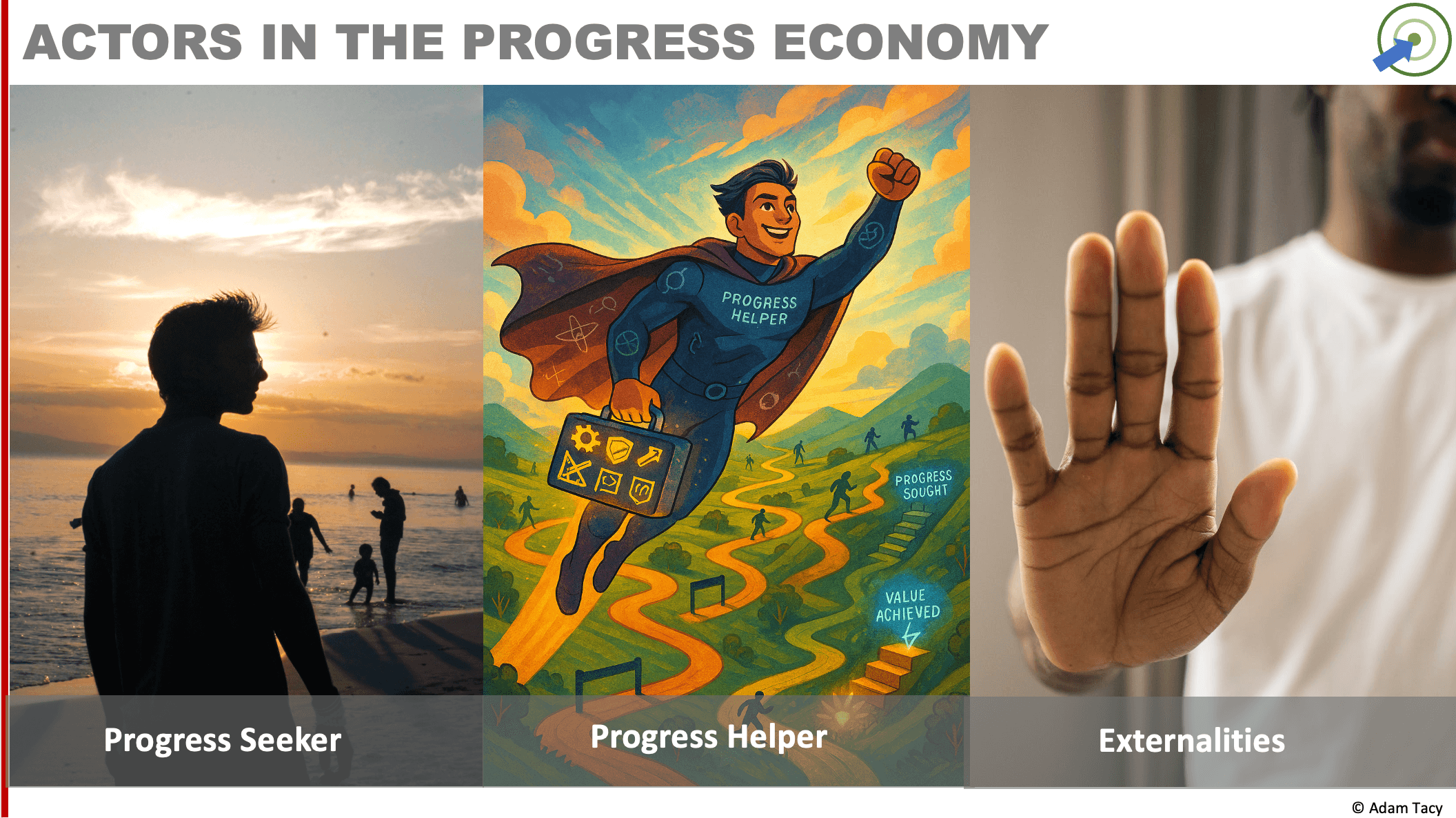

What we’re thinking
Externalities inject elements into a Seeker’s progress sought to protect society
Why this matters
Left to their own devices, Seekers may pursue progress that has a direct, or accidental, detrimental impact on society. Externalities counter that. It is important to note they inject safeguards into a Seeker’s progress sought, not a Helper’s progress offered,
Externalities

Enter our final actor: Externalities. Perhaps perceived as friction in the system, they serve a deeper purpose – embedding safeguards into a seekers progress journey.
Externalities insert mandatory progress elements into progress sought – typically within the non-functional or contextual realm – such as safety, fairness, or environmental responsibility.
Who are these externalities? They are the:
- governments – enacting legislation.
- regulators – giving regulations
- associations – enforcing rules/qualifications
- society – expecting norms of behaviour
And these elements might include:
- Regulatory mandates (e.g., seatbelt laws, deposit schemes to encourage circularity)
- Licenses and qualifications (e.g., gas engineers, medical practitioners)
- Social norms (e.g., driving safely near schools)
It’s important to note: we view these elements as being inserted into the Seeker’s progress sought. They’re not just mandatory requirements – they’re things the Seeker needs help navigating. And Progress Helpers should reflect how they support these elements in their propositions.
At first glance, inserting into progress sought, rather than progress offered, might seem counterintuitive. But remember – our core philosophy is that the Seeker is the one trying to make progress.
Take this example: a Seeker wants to install a gas boiler. In the UK, any gas work must be carried out by a certified engineer. That certification requirement is inserted as a contextual element of the Seeker’s progress sought. The Seeker now has several options: they could hire a certified engineer, or even pursue certification themselves. If we treat this solely as part of the progress offered, we miss the opportunity for innovative solutions.
Yes, constraints can drive innovation – but overreach can just as easily stall progress.
Let’s progress together through discussion…