
Indirect exchange
A potential challenge to this model of service exchange is your experiences. You rarely participate in bi-party service exchange. Does that mean our concept of service as the basis of exchange is incorrect? No. As service-dominant logic tells us, the service basis of exchange is often masked by indirect exchange.
Indirect exchange masks the fundamental basis of exchange
#2
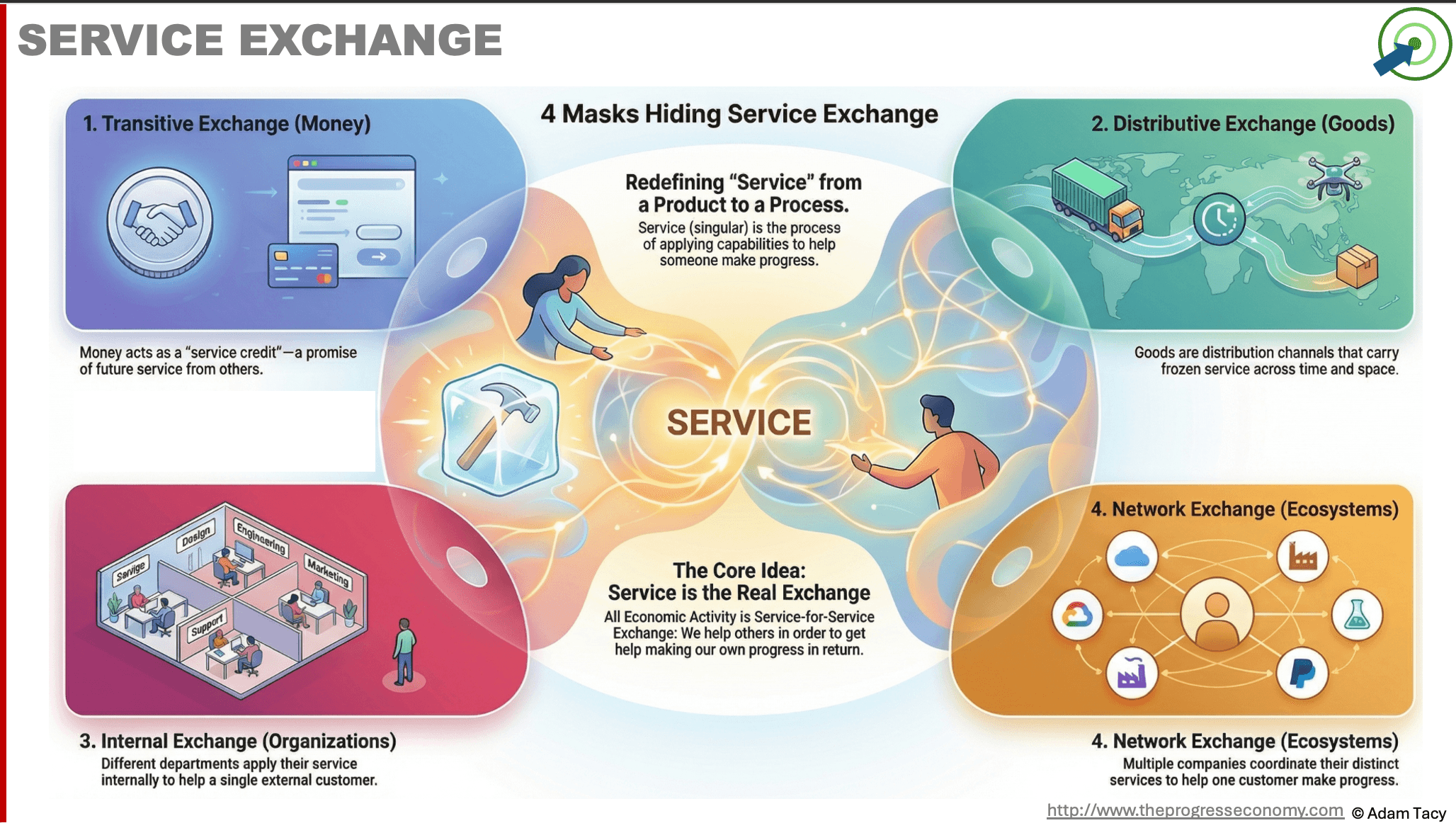
Vargo and colleagues identify four ways that indirect exchanges mask direct service exchange (“Service-dominant logic a review and assessment”).

We will call these the following:
- transitive indirect exchange – money (as an implementation of service credits) as a medium of exchange
- distributable indirect exchange – goods as distribution channels for service
- internal indirect exchange – organisations as resource integrators
- network indirect exchange – networks as linkages for exchange –
These are all lubricated and enabled by some form of service credits..
Let’s explore them in a little more detail.
Transitive indirect exchange – lubricated by service credits
Let’s say I help you progress and in return you give me a service credit. The original intent of that, in direct exchange, is that I will use that credit at a later date to call on your help.
Now, maybe there’s another progress helper that is willing to accept that service credit as a call on their help instead of me helping them progress. So I can get help from them by using the credit I received from helping you.
This is a transitive indirect service exchange; lubricated by service tokens.
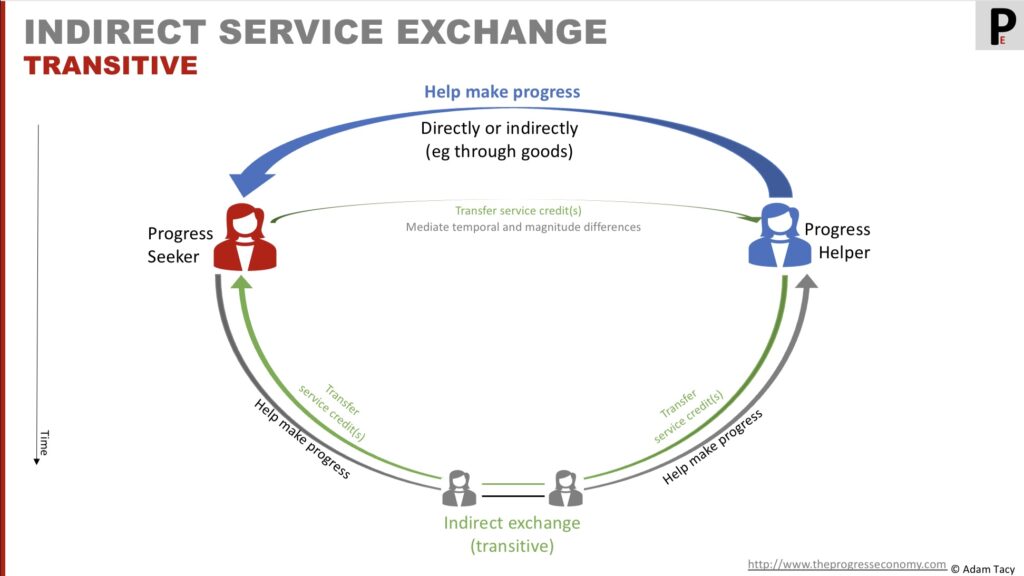
In reality, we would also need to mediate magnitude differences between service involved through service credits.
It doesn’t require all three parties to pre-agree what level of effort is involved with a unit of service credit; but the equitability service exchange progress hurdle brings that alignment.
That gives us another insight into price. Service credits now represent effort a seeker has to put into helping someone else to get the credits required for a service they want.
[A question to, perhaps, resolve later is if transitive indirect exchange is eventually circular]
Distributive indirect exchange – the curious case of goods
The use of goods also mask that service is the fundamental basis of exchange. We’ve already noted above that our current goods-dominant logic puts outputs first. Which implies those outputs (products: goods and services) have value embedded within them. So we exchange that embedded value for other items that have value, typically cash.
Goods, in our service-first world, function as a distribution mechanism for service. Again, service-dominant logic informs us:
Goods are distribution mechanisms for service provision
#3
In practice this means that the application of competence is frozen into goods, allowing it to be transported in time and space. Future acts of resource integration unfreeze those competencies.
A band playing music is a service—musicians applying their instrumental/vocal competences to help others make progress (for example, in enjoying themselves). Their performance can be frozen as a digital file by recording it, which can be distributed as a CD (traditional tangible goods) or streamed over the internet (as an intangible digital goods). When a listener presses play on Spotify or their CD player —a resource integration activity—the performance is unfrozen.
However, in our service-first perspective we see that goods freeze skills and knowledge allowing them to be distributed.
In this perspective, goods freeze skills and knowledge, allowing them to be distributed elsewhere. We still have service as the basis of it is just masked by distributive (often together with transitive) indirect exchange.
For example, pouring a glass of water from a tap/faucet is generally seen as using a service; whereas that bottle of water in the fridge is seen as a product. In the progress economy they are interchangeable resources.
Some services can be frozen, transported, and later unfrozen wherever the Seeker needs them. This is the role goods play in the progress economy. They act as distribution mechanisms for service. We inherit this from Vargo and Lusch’s service-dominant logic:
Goods are distribution mechanisms for service provision
#3
We can discover this by starting with a pure service: listening to your favourite band perform live. The musicians apply their skills and knowledge to their instruments for your enjoyment.
Record that same performance and you now have a goods. That goods might take the form of a vinyl record, a CD, or a digital file ready to stream. By recording it, we now have a form that allows the performance to be distributed to the moment and place you choose to press play on your playback device. When you do, you “unfreeze” the recorded performance and your experience starts/resumes.
This logic extends across all goods. A hammer, for example, freezes the manufacturer’s knowledge of how to drive one material into another together with their skills in creating a goods that can distribute that. When you swing the hammer at a nail, you unfreeze that embedded capability.
The key point here is that goods and service (singular) become interchangeable ways of enabling progress, rather than opposing categories. We get to address Levitt’s marketing myopia by addressing the customer wanting a 1/4 inch hole rather than a 1/4 inch drill. Offering a drill, another type of tool, a handyman, a training video are all ways of helping a Seeker make progress of obtaining a 1/4 inch hole.
There is an implication of this interchangeability. Moving from a relieving to enabling proposition shifts the burden of having the necessary capabilities for using the resource mix towards the Seeker. However, it also increases non-functional progress such as mastery and not being held up. In contrast, moving the other way relieves the Seeker of capability (lowers their lack of capability progress hurdle).
Internal indirect exchange
The third example of indirect masking is found in organisations. Organisations integrate and combine micro-specialisations into a progress helper. By that I mean various departments, assembly line workers, layers of management, etc. When we look, there are often limited, or no, direct service exchanges between these micro-specialisms.
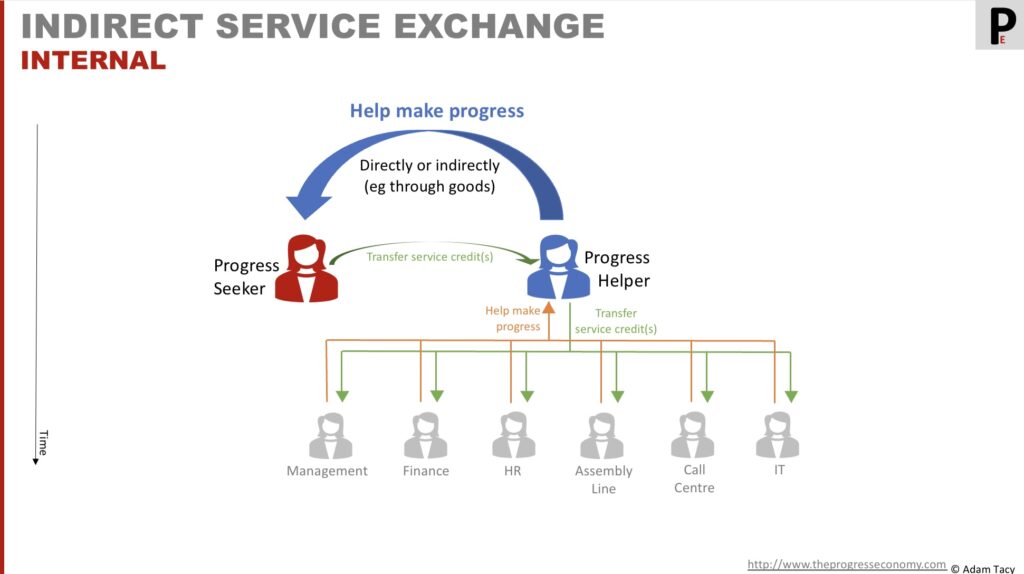
However, when we zoom out we can see a special case of transitive indirect service exchange at play, which we call internal direct exchange.
Each employee/department is applying their skills and knowledge to help the organisation help the progress seeker. Most likely the seeker is giving servce credits to the organisation, which then distributes those across departments/ emloyees.
network indirect exchange
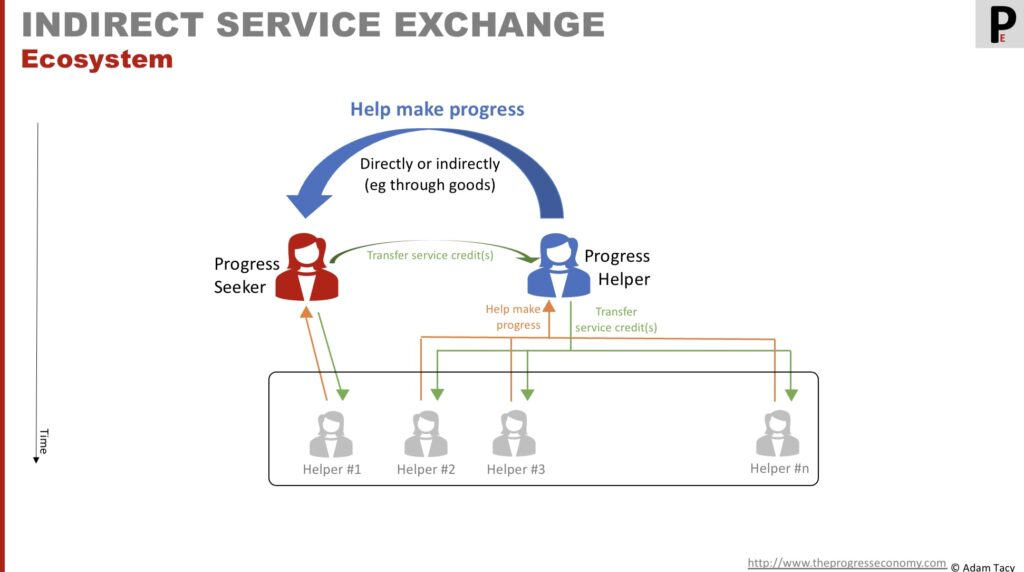
A similar situation to internal indirect service exchange happens in ecosystems – where a group of progress helpers co-ordinate to help a progress seeker. Sometimes behind a progress seeker acting as a façade; sometimes linked from a progress seeker but direct with the seeker (for example external party credit card payment on e-commerce sites).
Let’s progress together through discussion…