
What we’re thinking
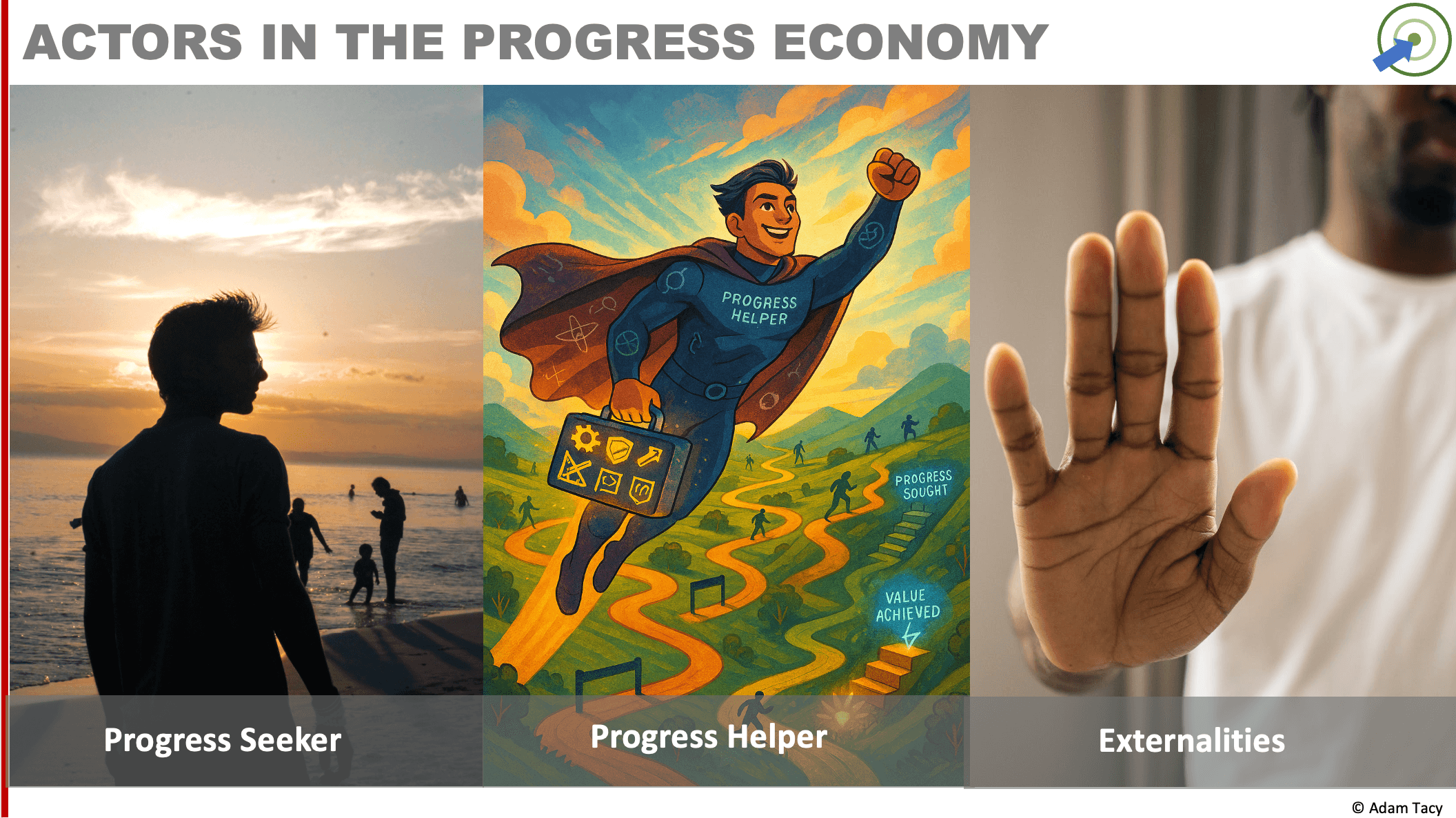
Progress Seekers – often shortened to Seekers – are looking to make progress – moving over time to a more desirable state of progress sought from their current progress origin – in all aspects of their life.
They are the predominant judgers of potential and actual increases in well-being leading them to attempt, continue, or abandon, progress attempts.
Why this matters
Critically, everyone is a Progress Seeker, including Helpers. Though Seekers often lack some or all of the required capabilities (skills, time strength, etc) to make a progress attempt. It is this unequal distribution of capabilities across the economy that powers The Progress Economy through service exchange – often indirect and mediated via service credits (money being a dominant form).
Progress SeekerS

Meet the complicated main actor of our progress economy: the Progress Seeker (often shortened to “seeker”).
Seekers are looking to make progress – moving over time to a more desirable state – in all aspects of their life.
From learning a new language, to getting nourishment, impressing someone, changing location, fixing something (a car, themselves…), building something, enjoying themselves, and much more.
For practical reasons, we often isolate specific aspects of a seeker’s progress at a time for analysis. No need to over complicate things!
Who are seekers? They can be individuals or organisations. And we can open up an organisation and see departments inside acting as seekers. Quite simply, every actor is a seeker of some progress.
Seekers are the primary judgers of value (which we see as comparisons of improvements in well-being). Their judgements lead them to starting, continuing or abandoning progress attempts. For example, do they feel their progress potential towards their progress sought is high enough? Or do they feel their progress reached, at any point on the journey, is in line with their expectations?
historic Role of progress Seekers
Traditional service literature has largely approached this from a service provider–centric perspective, which differs from the Progress Economy’s Seeker-first view, though both arrive at a similar foundational insight: the Seeker is an active participant in value creation.
Bitner et al (1997) were among the first to highlight the customer’s active role in shaping service outcomes and influencing their own satisfaction and value received. They identified customers as a:
Bitner et al (1997) “Customer Contributions and Roles in Service Delivery”
- productive resource;
- contributor to quality, satisfaction and value; and
- competitor to the service organization
Bitner’s framing presents the customer as a “partial employee of the service provider”, with the provider primarily responsible for delivering the service and the customer contributing as required.
In contrast, the Progress Economy inverts this relationship: the Seeker is the primary driver of progress, and the Helper may temporarily take on the role of partial or even full employee. Still, the key insight holds: Seekers are productive resources in their own progress-making attempts.
This matters significantly when designing progress propositions. It is essential to understand which progress-making activities the Seeker can perform; and, just as importantly, which they want to perform.
Bitner et al.’s second point is particularly relevant: involving Seekers increases their likelihood of achieving their desired outcomes.
Payne et al introduce us to the concept of a series of activities in their paper on “Managing the co-creation of value”, but define them as performed by the customer.
The customer’s value creation process can be defined as a series of activities performed by the customer to achieve a particular goal.
Payne, A. F., Storbacka, K., and Frow, P. (2006) “Managing the co-creation of value”
Bettencourt, Vargo, and Lusch (2014) expanded this to perhaps be a joint approach lead by the customer:
the customer is a job (co-)executor who acts in conjunction with the firm to provide service to get a job done
Bettencourt, Vargo & Lusch (2014) “A Service lense on Value Creation”
This insight evolved in the literature into the broader concept of value co-creation, and, further, aligns closely with job-to-be-done thinking. In the Progress Economy, we interpret this simply: making progress is always a joint endeavour. Value emerges as progress is made and is evaluated through a series of progress comparisons.
Further elaborating on the role customers, are Storbacka and Lehtinen (2001) who see customers having multiple roles:
a customer (payer), a consumer, a competence provider, a controller of quality, co-producers and/or co-marketers.
Storbacka and Lehtinen (2001) “Customer Relationship Management: Creating Competitive Advantage Through Win-win Relationship Strategies”
Finally, Bitner et al’s third point reminds us that Seekers can also be competitors to a helper’s proposition – in that they sometimes chose to do the job (make the progress) themselves. Back to Bettencourt, Vargo & Lush (2014),
While the customer always participates in value creation, the customer can have a more or less active role in the service provision itself….
…thus, in matching its resources and capabilities, a company must decide where on a continuum of “enabling” to “relieving” service it will be because this impacts the service role of the customer.”
Bettencourt, Lusch, and Vargo. (2014) “A Service Lens on Value Creation”
It is from here that we pull out the concept of the progress proposition continuum – a continuum between relieving and enabling. Though our continuum positions both Seeker and propositions. The gap between a Seeker’s desired position and a proposition’s position on this continuum becomes a progress hurdle.The hurdle is higher when there is a mismatch—for example, when a Seeker wants to be fully enabled but is only offered a fully relieving proposition.
progress seekers – drivers of progress
progress seekers – Judgers of improvements in well-being (value)
Relationship to Externalities
Left unchecked, Seekers may pursue progress that is harmful – to themselves, to others, or to society at large. We need an effective brake: externalities.
Relationship to Progress Helpers
Seekers often have an achilles heel. Progress is made through applying capabilities to other capabilities (often through resource integration). And seekers may lack some, or all, of the capabilities needed to make a progress attempt (the foundational progress hurdle of lack of resource). If they decide to make the attempt anyway, they might turn to Progress Helpers for some help…
Let’s progress together through discussion…